


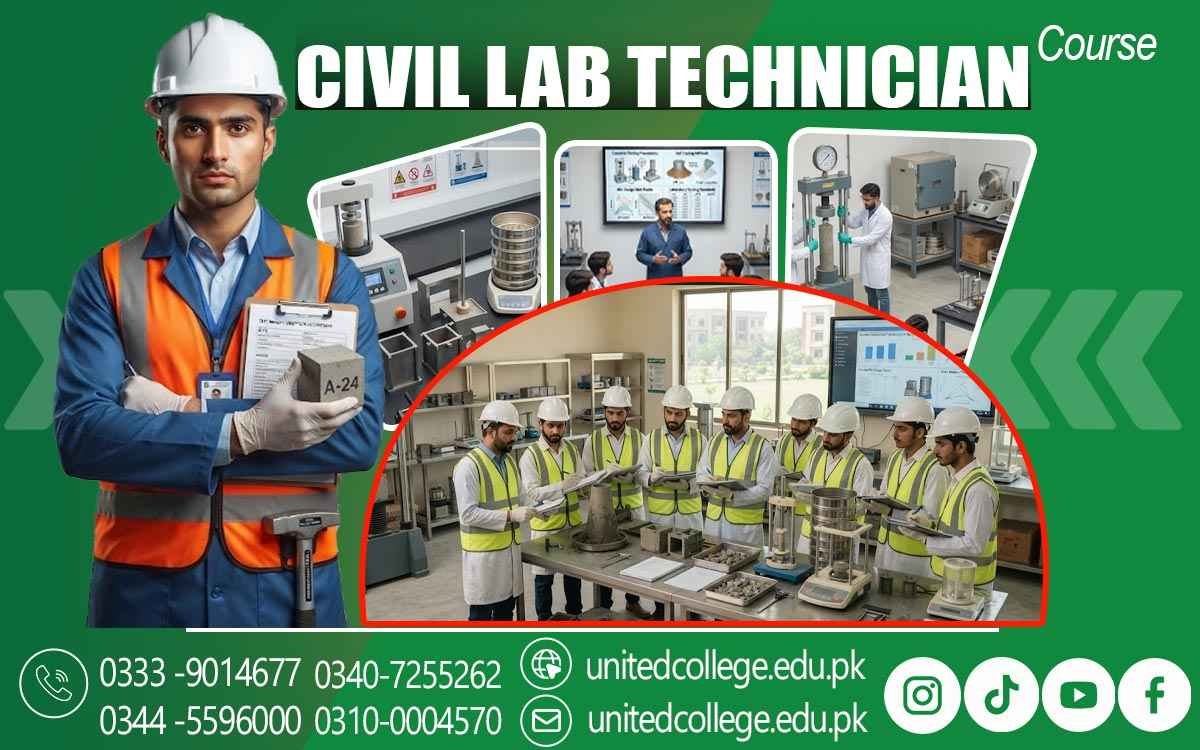

Civil Lab Technician Course in Narowal – Learn Testing Skills
When Construction Quality Depends on What You Cannot See
Walk past a construction site in Narowal, and you may notice workers mixing concrete, laying bricks, preparing foundations, or spreading soil for roads and building work. But have you ever wondered how someone knows whether those materials are actually suitable for the project? A strong-looking mixture or properly placed soil may not always tell the complete story. Behind many construction decisions are tests that examine the condition, strength, composition, and performance of materials before they are used or accepted. This is where a civil lab technician becomes important. A Civil Lab Technician Course in Narowal can introduce beginners to the practical side of construction materials testing and help them understand how laboratory work connects with real construction projects.
Through civil laboratory training, learners can become familiar with material sampling, testing procedures, measurements, equipment, record-keeping, and basic quality control practices. At United College of Technology, students can develop an understanding of these areas through structured learning and practical activities. For someone interested in civil construction but more comfortable with technical and laboratory-based work, this field can provide an interesting way to explore how construction quality is checked.
What a Civil Lab Technician Actually Does Behind the Scenes
A construction project involves many materials, and each material may need to meet certain requirements before it can be used. A civil lab technician Course helps with the practical testing process by collecting or receiving samples, preparing them for testing, operating laboratory equipment, taking measurements, recording observations, and organizing test results. The work is not simply about putting a material into a machine and reading a number. A technician needs to understand what is being tested, how the sample should be handled, which procedure is being followed, and how the results should be recorded accurately. During civil lab technician training, beginners can learn about different types of construction materials and the laboratory testing methods commonly associated with them.
They may also learn how field and laboratory testing work together, because samples collected from a construction site need to be handled carefully so that the laboratory results are meaningful. In Narowal, where residential buildings, roads, commercial structures, and other development projects require proper material handling, these skills can help learners understand the technical side of construction quality control. Careful observation and accurate documentation are important because even a small mistake in sampling or measurement can affect the usefulness of a test result.
Soil Testing Starts With Understanding What Lies Beneath
Before a building, road, or other structure takes shape, the ground beneath it needs attention. Soil may look similar from the surface, but its properties can vary from one location to another, and these differences can influence construction decisions. Soil testing helps professionals examine characteristics such as moisture content, density, compaction, and other properties relevant to construction work. In a Civil Lab Technician Course in Narowal, learners can be introduced to the process of collecting representative soil samples and preparing them for laboratory examination. Soil compaction testing is another important area because properly compacted soil can provide a more suitable base for certain construction activities.
Beginners can learn that testing is not simply about obtaining a result; it also involves following the correct procedure, using appropriate equipment, taking measurements carefully, and recording information in an organized way. A learner working with soil samples may gradually become familiar with how field conditions are connected with laboratory observations. This practical understanding can make civil laboratory training more meaningful because students can see why soil testing matters before construction progresses to later stages. For learners in Narowal who are interested in civil engineering laboratory work, soil testing can provide an excellent starting point for understanding the relationship between ground conditions and construction quality.
Cement and Concrete Testing Turns Mixtures Into Measurable Results
What happens after the materials for concrete arrive at a construction project? Simply looking at cement or freshly prepared concrete cannot provide all the information needed to judge its performance. Cement testing and concrete testing involve specific procedures that help examine important characteristics of these materials. During training, learners can become familiar with the purpose of different tests, the preparation of samples, the use of testing equipment, and the importance of following a consistent method. Concrete strength testing is particularly important because the strength of hardened concrete can provide useful information about whether a concrete sample has developed the expected performance under a particular testing procedure. Students may also learn about concrete sampling, specimen preparation, curing, measurements, and recording results.
Cement testing can introduce learners to the controlled examination of cement properties, while concrete testing helps them understand how a mixture behaves after preparation and curing. Instead of seeing concrete as simply cement, sand, aggregate, and water mixed, a learner begins to understand that every part of the process can affect the final result. This is one of the areas where a Civil Lab Technician Course in Narowal can connect classroom concepts with practical construction quality control, helping beginners understand why testing procedures need accuracy and consistency.
Aggregates, Bitumen, and Other Materials Need Their Own Checks
Concrete is only one part of construction material testing. Aggregates, bitumen, and other materials used in roads and building projects may also require examination according to the requirements of a particular project. Aggregate testing can involve checking characteristics that help professionals understand whether a particular material is suitable for its intended use. Learners can become familiar with the idea that size, grading, cleanliness, and other measurable properties can influence how materials behave in construction. Bitumen testing introduces another area of civil laboratory work, particularly for learners interested in road construction and related applications.
The testing of different construction materials requires appropriate equipment, careful sample preparation, accurate measurement, and proper recording. A beginner may initially think that laboratory work is mainly about operating machines, but practical training can show that good testing depends equally on preparation and attention to detail. In Narowal, where construction activities can include buildings, roads, drainage works, and other infrastructure, exposure to different types of material testing can give learners a broader understanding of civil construction skills. Learning about aggregates, bitumen, cement, concrete, and soil together can also help students see how different materials contribute to a complete construction project.
The Right Equipment Makes Accurate Testing Possible
Imagine trying to check concrete strength, soil density, or another material property without knowing how the testing equipment works. Even a technically capable person could struggle to obtain reliable results without understanding the instrument, testing procedure, and measurement process. Material testing equipment is therefore an important part of civil laboratory training. A Civil Lab Technician Course in Narowal can introduce students to the purpose and proper handling of different laboratory instruments used for construction material testing. Learners can become familiar with the idea that equipment must be selected according to the test being performed and that measurements need to be taken carefully.
They can also learn why equipment handling, sample preparation, calibration awareness, and correct procedures matter when recording test results. Practical exposure can make technical concepts easier to understand because students are not only reading about a test but also seeing how the testing process is organized. Whether the task involves soil samples, concrete specimens, cement, aggregates, or other construction materials, the technician needs to work carefully and systematically. This attention to equipment and procedure can help beginners develop confidence with laboratory work while also teaching them that accuracy is more important than simply completing a test quickly.
A Test Result Is Only Useful When the Sample and Record Are Reliable
Have you ever noticed how a small mistake at the beginning of a process can create a much bigger problem later? The same principle applies to civil laboratory testing. If a sample is collected incorrectly, mixed with unwanted material, poorly identified, or handled without proper care, the final result may not accurately represent the material being examined. That is why material sampling, measurement, labeling, recording, and reporting are important parts of a technician's work. During a Civil Lab Technician Course in Narowal, learners can understand how samples move from collection or receipt through preparation, testing, observation, and documentation.
They can learn to record readings carefully rather than depending on memory and can understand why clear laboratory reports make test information easier for engineers and other construction professionals to review. Field and laboratory testing can also be connected through proper identification of samples and organized records. For beginners, this part of training can develop useful habits such as checking measurements twice, keeping records clear, following instructions, and avoiding assumptions when something appears unusual. These habits may seem simple, but they are valuable in any environment where construction quality depends on accurate technical information.
Laboratory Safety Matters as Much as Testing Accuracy
A civil laboratory is a place where students and technicians may handle cement, concrete materials, soil samples, aggregates, chemicals, testing machines, and heavy specimens. This means laboratory safety cannot be treated as a minor detail. A careful technician needs to understand safe working practices, appropriate protective equipment, correct handling procedures, clean work areas, and responsible use of laboratory instruments. In practical civil lab technician training, learners can develop awareness of how to approach testing tasks without unnecessary risks. Safety also includes understanding instructions before operating equipment, keeping samples and tools organized, reporting damaged equipment, and maintaining a suitable working environment.
For someone completely new to laboratory work, these practices can help create a disciplined approach from the beginning. A Civil Lab Technician Course in Narowal can therefore provide more than knowledge about soil testing or concrete strength testing; it can help learners understand the importance of working carefully around materials and equipment. When accuracy and safety are treated as connected responsibilities, students can develop better habits for future laboratory and construction-site environments. The goal is not simply to finish a test but to complete the task in a controlled, careful, and responsible manner.
Connecting Civil Laboratory Skills With Real Construction Quality Control
A laboratory test becomes much more meaningful when a learner understands where its results may be used. Construction quality control depends on information gathered from inspections, measurements, material testing, site observations, and documented procedures. A civil lab technician can contribute to this process by providing accurate test information about materials used in construction. Through a Civil Lab Technician Course in Narowal, learners can gradually understand how laboratory testing supports decisions related to construction materials and project requirements. They can develop skills in soil testing, concrete testing, cement testing, aggregate testing, sample preparation, equipment handling, measurement, documentation, and laboratory safety.
For example, a learner may begin with a soil sample and follow the process of identification, preparation, testing, measurement, and recording before discussing what the result means in a construction context. This type of step-by-step learning can make technical subjects less intimidating for beginners. At United College of Technology, students can explore these civil laboratory concepts through structured training designed to build practical understanding. For learners in Narowal who want to develop civil construction skills without limiting themselves to classroom theory, laboratory-focused training can provide a useful foundation for continued technical learning and practical exposure.
Frequently Asked Questions (FAQs)
A Civil Lab Technician Course in Narowal introduces learners to construction material testing, laboratory procedures, sample preparation, measurements, equipment handling, and quality control practices.
Students, beginners, fresh learners, school or college graduates, job seekers, and people interested in civil construction and laboratory work can consider this type of training.
Students can learn about soil testing, concrete testing, cement testing, aggregate testing, material sampling, testing equipment, measurements, documentation, laboratory safety, and construction quality control.
Soil testing helps examine properties such as moisture, density, and compaction, providing useful information about ground conditions for construction-related work.
Concrete strength testing is a laboratory procedure used to measure the strength of concrete specimens under a specified testing method and condition.
Admission Open: Start Your Professional Journey Today!
Join United College of Technology and build a career with practical training, recognized certifications, and Gulf job support. Seats are limited.
Apply Now via WhatsAppContact Information
- Address: Rawalpindi: F-272 Main New Katarian Stop, Old IJP Road | Lahore Campus: Lahore, Pakistan
- Phone/WhatsApp: 0340-7255262 / 0333-9014677 / 0301-5044340 / 0310-0004570 / 051-8770756
- Website: unitedcollege.edu.pk
















Leave a Comment