


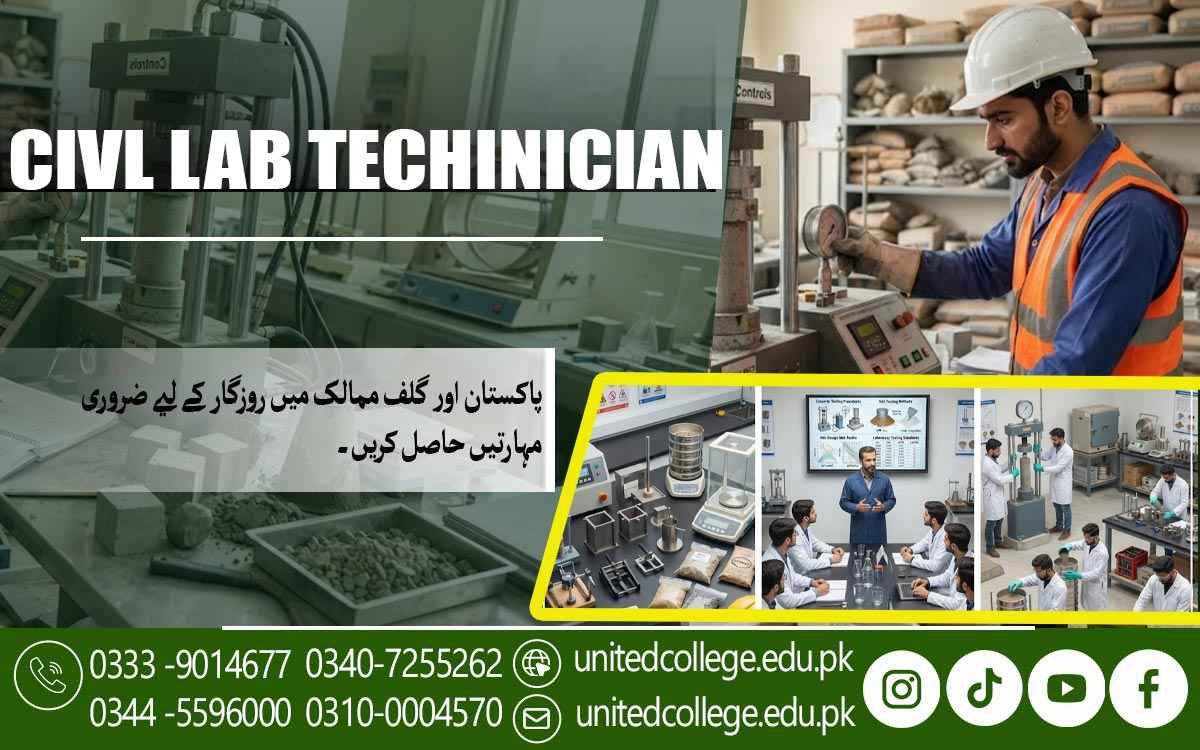

Civil Lab Technician Course in Talagang for Lab Skills
Understanding Essential Civil Laboratory Operations
Civil laboratories are an important part of construction and engineering projects because they provide a controlled environment for examining different construction materials. Buildings, roads, bridges, foundations, and other structures require materials with suitable properties. Laboratory testing helps technical professionals understand the condition and characteristics of these materials before they are used for specific construction purposes.
The Civil Lab Technician Course in Talagang introduces students to the essential operations performed in a civil engineering laboratory. Learners can understand how laboratory activities are planned and carried out, how samples are managed, and how technicians support engineers and quality control teams during testing procedures. This basic knowledge helps students become familiar with the working environment of a civil laboratory.
Students also learn the importance of accuracy, safety, cleanliness, and proper organization. A technician needs to follow instructions carefully and handle materials and equipment responsibly. Developing these habits during training can help learners approach technical laboratory assignments with greater confidence and professionalism.
Exploring Techniques for Construction Material Analysis
Construction materials need to be examined to understand their physical properties, quality, and suitability for different applications. Soil, concrete, cement, aggregates, and other materials can have different characteristics depending on their composition and condition. Laboratory analysis provides useful information that can support technical decisions during construction.
Students learn about general techniques used for analyzing construction materials and become familiar with the different stages of laboratory testing. They can understand how samples are collected, prepared, examined, and documented. This gives learners a basic understanding of how material testing is connected with construction quality.
Careful material analysis requires attention to detail and consistent procedures. Learners are introduced to the importance of accurate measurements and proper observations during testing. This knowledge can provide a useful foundation for students who want to develop technical abilities in civil laboratory and construction testing work.
Learning Practical Methods of Soil Investigation
Soil investigation is an important part of construction because the condition of the ground can influence foundations, roads, buildings, and other civil structures. Different soils may have different levels of strength, moisture, density, and composition. Understanding these characteristics can help technical teams evaluate ground conditions.
During the Civil Lab Technician Course in Talagang, students learn basic methods used to examine soil samples in a laboratory environment. They can develop knowledge about sample collection, preparation, testing procedures, measurements, and recording observations. These activities help learners understand how laboratory work provides information about soil characteristics.
Students also become aware of the relationship between soil testing and construction planning. Laboratory findings can provide useful information to engineers and other technical professionals when assessing a construction site. Learning these fundamentals can help students build a stronger understanding of practical civil engineering work.
Studying Concrete Testing for Construction Quality
Concrete is widely used in residential, commercial, industrial, and infrastructure projects. Its quality and performance are important because it can form a major part of structural and non-structural construction. Different factors, including material quality, mixing, curing, and handling, can influence concrete performance.
Students study the fundamentals of concrete testing and learn why proper sample preparation is important before a test is performed. They become familiar with the general purpose of concrete examination and understand how observations and measurements are recorded during laboratory activities.
Learning about concrete testing also helps students understand the role of quality procedures in construction. Accurate laboratory information can support engineers and quality control staff when evaluating materials. Through this knowledge, learners can develop greater awareness of how laboratory testing contributes to construction quality.
Handling Laboratory Equipment and Testing Tools
Civil laboratories contain different types of equipment and testing tools used for examining construction materials. Each instrument has a specific purpose, and technicians need to understand its basic operation before using it. Careful handling is important for maintaining equipment and supporting accurate laboratory procedures.
The Civil Lab Technician course introduces students to common laboratory equipment and helps them understand basic operating practices. Learners can develop awareness of correct handling, cleaning, storage, and routine care. They also learn why laboratory instructions should be followed when using technical instruments.
Safety is another important part of equipment handling. Students can develop responsible working habits by keeping their workspace organized and using equipment carefully. These practices can help learners become more comfortable with practical laboratory activities and technical assignments.
Developing Skills in Material Sample Preparation
Proper sample preparation is one of the most important stages of material testing. A sample must be collected, identified, measured, and prepared according to the requirements of a particular test. Incorrect handling can affect the quality of observations and may make the testing process less reliable.
Students learn the importance of preparing different construction material samples carefully. They develop basic knowledge of labeling, measuring, handling, storing, and organizing samples before laboratory examination. These procedures help maintain consistency during testing activities.
Attention to detail is especially important during sample preparation. Learners can improve their ability to follow instructions and complete technical tasks systematically. These skills can be useful when working with soil, concrete, aggregates, cement, and other construction materials in a laboratory environment.
Maintaining Proper Records of Laboratory Results
Laboratory testing involves collecting measurements, observations, sample information, and other technical details. All this information needs to be recorded clearly so that it can be reviewed later. Proper documentation helps maintain an organized record of laboratory activities and makes it easier to track individual samples.
Students learn how to maintain basic laboratory records and understand why accuracy is important when documenting test results. They can develop knowledge of recording sample details, testing dates, measurements, observations, and findings in a systematic manner.
Good record-keeping is also useful for engineers, supervisors, and quality control teams. Clear reports allow technical staff to review laboratory information and compare results when necessary. By developing accurate documentation habits, learners can improve their professional approach to civil laboratory work.
Improving Technical Readiness for Civil Laboratory Careers
Civil laboratory work requires technical knowledge as well as careful and responsible working habits. A technician may be involved in material testing, sample preparation, equipment handling, observation, documentation, and other laboratory activities. Developing an understanding of these areas can help learners become familiar with the responsibilities of the field.
The Civil Lab Technician Course in Talagang provides foundational knowledge of important laboratory practices. Students can explore construction material analysis, soil investigation, concrete testing, aggregate examination, equipment handling, sample preparation, and result documentation. This broad introduction helps learners understand how different laboratory activities are connected.
With continued practice, practical experience, and further technical learning, students can strengthen their abilities over time. The course can provide a useful starting point for learners interested in civil construction testing and laboratory-related work. Building strong basic skills can help them approach future technical assignments with better understanding and confidence.
Frequently Asked Questions (FAQs)
The Civil Lab Technician Course in Talagang is a technical program that introduces students to construction material testing, laboratory operations, sample preparation, equipment handling, and result documentation.
Students learn about the basic testing and examination of materials such as soil, concrete, cement, aggregates, and other materials commonly used in construction projects.
Students learn basic soil sample preparation, laboratory testing methods, measurements, observations, and the importance of soil properties in construction planning.
Yes, the course covers basic concrete testing concepts, sample handling, quality procedures, observations, and proper recording of laboratory findings.
Yes, students are introduced to common civil laboratory tools and equipment and learn about proper handling, safe operation, cleaning, and basic care.
Admission Open: Start Your Professional Journey Today!
Join United College of Technology and build a career with practical training, recognized certifications, and Gulf job support. Seats are limited.
Apply Now via WhatsAppContact Information
- Address: Rawalpindi: F-272 Main New Katarian Stop, Old IJP Road | Lahore Campus: Lahore, Pakistan
- Phone/WhatsApp: 0340-7255262 / 0333-9014677 / 0301-5044340 / 0310-0004570 / 051-8770756
- Website: unitedcollege.edu.pk
















Leave a Comment