


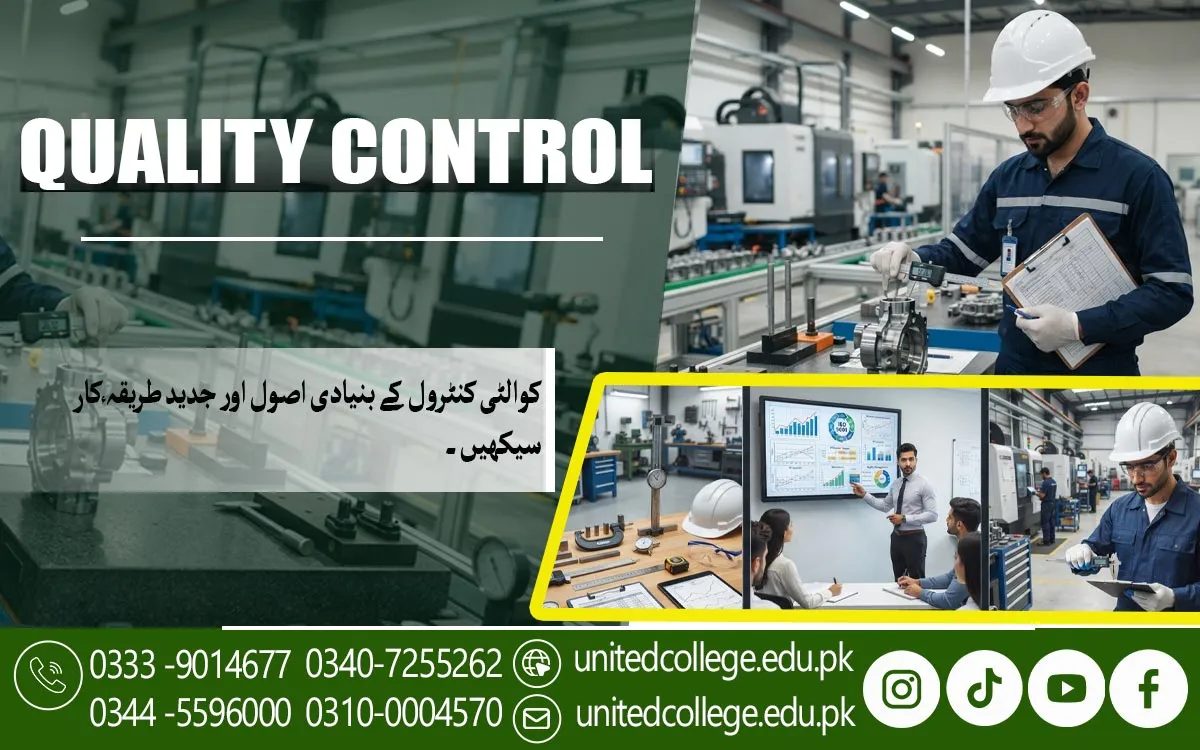

Quality Control Course in Bhakkar for Practical Quality Inspection
Learning the Core Concepts of Quality Inspection
Quality inspection involves checking products, materials, or work activities against defined requirements. The purpose is to determine whether the result is acceptable and whether any quality concerns need further attention.
Students can explore basic inspection concepts such as visual examination, measurement, comparison with specifications, and recording observations. These fundamentals can help learners understand how inspection fits into the broader quality control process.
A strong foundation is useful because inspection decisions need to be based on clear requirements rather than personal assumptions. Learners can therefore develop an appreciation for accuracy, consistency, and objective evaluation.
Understanding How Quality Problems Are Identified
Quality control problems can occur at different stages of production and may not always be immediately obvious. Some issues can be identified through visual inspection, while others may require measurements, testing, or closer examination of the production process.
Learners can study examples of problems such as incorrect dimensions, damaged surfaces, unsuitable materials, poor finishing, and inconsistent performance. Understanding these issues can improve their ability to recognize potential quality concerns.
Identification also requires proper reporting. When an issue is discovered, it should be communicated clearly so the relevant team can investigate its cause and determine what corrective action may be necessary.
Exploring Practical Techniques for Defect Prevention
Defect prevention focuses on reducing the chances of quality problems occurring during production. While inspection helps identify defects, preventive practices can address weaknesses before they result in repeated faulty products.
Students can learn how equipment maintenance, employee training, clear work instructions, proper material handling, and regular process monitoring may contribute to defect prevention.
The Quality Control Course in Bhakkar can help learners understand why prevention is often more effective than simply correcting problems after production. A proactive approach can reduce waste, save resources, and support more consistent results.
Studying Product Testing and Evaluation Procedures
Product testing provides information about whether an item performs according to the required specifications. Different products may require different types of testing depending on their purpose, materials, and technical requirements.
Quality Control Course can understand how testing procedures are selected and why they should be followed carefully. Proper testing can help identify weaknesses that may not be visible during a basic visual inspection.
Evaluation involves reviewing test results and comparing them with established requirements. Accurate records and objective assessment can help quality personnel determine whether a product should be accepted, corrected, or examined further.
Developing Skills for Maintaining Consistent Quality
Consistency is important because customers and organizations expect products to maintain a similar level of quality. Significant variations between products can create dissatisfaction, additional costs, and production difficulties.
Students can explore how standardized procedures and regular monitoring help maintain consistency. When workers follow defined methods and quality requirements, there is a greater opportunity to achieve similar results across production activities.
Maintaining consistency also requires ongoing review. If inspection results show repeated variations, quality teams can examine the process and identify possible causes. Improvements can then be considered to bring results closer to the required standard.
Understanding Quality Monitoring in Production Environments
Quality monitoring involves regularly observing production processes and reviewing results to make sure they remain within acceptable limits. Monitoring can help identify changes before they lead to larger quality problems.
Learners can study how inspection records, measurements, testing results, and process observations can be used to monitor quality. This information provides useful evidence when evaluating production performance.
Effective monitoring also depends on communication. If a quality issue is noticed, it should be shared with the appropriate personnel so that action can be considered. Timely communication can prevent small problems from becoming repeated production concerns.
Applying Inspection Knowledge Through Practical Examples
Practical examples can help learners connect quality control theory with real workplace situations. For instance, an inspector may discover that a batch of components has inconsistent dimensions or that some materials do not meet the required condition.
In such a situation, the inspector needs to observe the problem carefully, record the findings, and communicate the issue to the responsible team. Further investigation may then be required to understand what caused the variation.
These examples show why quality control requires patience and careful decision-making. The goal is not simply to identify mistakes but to provide useful information that can support correction and improvement.
Preparing for Growth in the Quality Control Field
Quality control knowledge can be useful in a wide range of professional areas, including manufacturing, engineering, construction, production, laboratories, and technical workshops. The specific inspection requirements may change, but the need for accurate quality evaluation remains important.
The Quality Control Course in Bhakkar can give learners a foundation in inspection, testing, defect prevention, monitoring, and evaluation. This knowledge can help students become more familiar with quality-related responsibilities and workplace expectations.
Further professional growth can come through practical experience, additional training, and continuous learning. By developing strong inspection habits and improving technical understanding, learners can prepare themselves for greater responsibilities in quality-focused work.
Frequently Asked Questions (FAQs)
Defect identification helps workers recognize problems in products or processes and allows organizations to take corrective action before the issue becomes larger.
Attention to detail, accurate observation, measurement, record keeping, problem identification, and understanding of quality requirements are important skills.
Products may be evaluated through visual inspection, measurements, functional checks, material assessment, and comparison with established specifications.
Regular monitoring helps detect changes in quality, identify recurring issues, and maintain stable production results over time.
Yes, quality control principles can also be applied in construction, laboratories, warehouses, engineering projects, workshops, and service-related environments.
Admission Open: Start Your Professional Journey Today!
Join United College of Technology and build a career with practical training, recognized certifications, and Gulf job support. Seats are limited.
Apply Now via WhatsAppContact Information
- Address: Rawalpindi: F-272 Main New Katarian Stop, Old IJP Road | Lahore Campus: Lahore, Pakistan
- Phone/WhatsApp: 0340-7255262 / 0333-9014677 / 0301-5044340 / 0310-0004570 / 051-8770756
- Website: unitedcollege.edu.pk
















Leave a Comment