


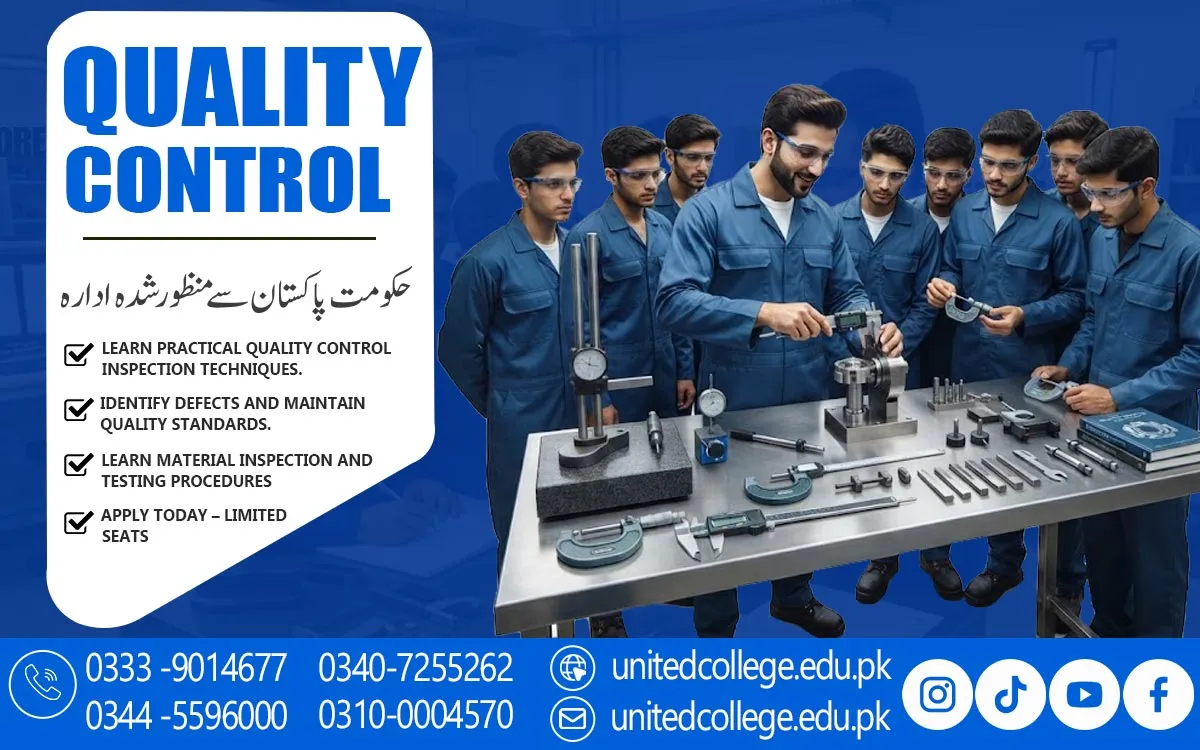

Quality Control Course in Muzaffargarh for Industrial Inspection Skills
Understanding the Fundamentals of Quality Control
Quality control refers to the processes used to check whether products, materials, or work processes meet defined requirements. It involves examining different aspects of production and identifying issues that could affect the final result. Understanding these fundamentals gives learners a clear starting point for further quality-related learning.
Students can explore concepts such as quality standards, inspection, testing, measurement, and defect identification. These concepts are useful in many industries because every production environment requires some form of checking to maintain acceptable results.
A strong understanding of quality control also helps learners recognize the difference between acceptable and unacceptable outcomes. This knowledge can support better decision-making and encourage workers to pay closer attention to details during professional activities.
Learning Product Inspection and Testing Procedures
Product inspection is an important part of quality control because it helps determine whether an item meets the required specifications. Learners can study different approaches used to examine products, materials, and components before they are accepted for further processing or delivery.
Testing procedures may vary according to the type of product and industry. Students can develop an understanding of why measurements, visual checks, functional tests, and other evaluation methods are used to identify possible quality problems.
Through the Quality Control Course in Muzaffargarh, learners can also understand the importance of following proper inspection steps. Accurate testing requires attention, consistency, and proper documentation so that quality-related decisions can be made on reliable information.
Identifying Defects Through Effective Quality Checks
Defect identification is another important area of quality control. A defect can affect the appearance, performance, safety, or reliability of a product. Learning how to recognize such issues allows quality personnel to report problems before they become larger production concerns.
Students can learn to observe products carefully and compare their condition with established requirements. Small differences in dimensions, finishing, material condition, or performance may indicate a quality issue that needs further examination.
Effective quality checks also encourage organizations to investigate why defects occur. Instead of simply identifying a faulty product, quality teams can examine production processes and help reduce the possibility of similar problems occurring again.
Exploring Methods for Maintaining Production Standards
Production standards provide a clear reference for determining whether work is being completed correctly. These standards may relate to product dimensions, materials, performance, appearance, or other requirements. Following them helps businesses maintain consistency across their production activities.
Learners can understand how quality checks are connected with production standards. When workers know the required specifications, they can compare actual results with expected results and identify areas that may require correction.
Maintaining standards also requires regular monitoring rather than checking products only at the end. Continuous quality observation can help organizations detect problems earlier, reduce unnecessary waste, and maintain more consistent production outcomes.
Developing Knowledge of Quality Assurance Practices
Quality assurance focuses on improving processes so that quality problems can be prevented rather than simply detected afterward. It involves planning, procedures, monitoring, and continuous improvement. Learning these concepts gives students a broader understanding of how organizations maintain quality.
The Quality Control course can introduce learners to practices such as process monitoring, documentation, standard operating procedures, and corrective actions. These practices help create a structured approach toward maintaining expected quality levels.
Quality assurance also depends on teamwork. Production workers, supervisors, inspectors, and managers may all contribute to maintaining standards. Understanding these responsibilities can help learners appreciate the importance of communication and cooperation in professional environments.
Understanding Workplace Quality Monitoring Techniques
Quality monitoring involves regularly observing and evaluating work processes to ensure that they continue to meet required standards. It can help identify changes or problems that may develop during production. Regular monitoring is therefore an important part of maintaining consistent performance.
Learners can explore how inspections and records are used to monitor quality. Proper documentation can provide useful information about recurring problems, production variations, and areas where improvements may be needed.
Workplace monitoring also requires attention to detail. A quality professional should be able to notice unusual results, ask appropriate questions, and communicate findings clearly. These abilities can be useful when working with different production teams and technical processes.
Applying Inspection Skills in Practical Situations
Practical application helps students understand how quality control concepts work in real workplace situations. Instead of focusing only on theoretical information, learners can consider examples involving product defects, incorrect measurements, damaged materials, or production inconsistencies.
For example, an inspector may notice that a product does not match the required dimensions. The issue can be recorded, reviewed, and communicated to the relevant team so that the cause can be investigated and appropriate corrective action can be considered.
Such situations help learners develop a more professional approach toward inspection. They learn that quality control requires accuracy, patience, proper reporting, and responsible decision-making rather than simply finding mistakes.
Preparing for Professional Opportunities in Quality Control
Quality control knowledge can be useful in manufacturing, construction, engineering, production, laboratories, warehouses, and other technical environments. Organizations in these areas often require workers who understand basic inspection and quality procedures.
The Quality Control Course in Muzaffargarh can help learners build foundational knowledge that supports their professional development. By learning inspection methods, quality standards, defect identification, and monitoring practices, students can become more familiar with the responsibilities associated with quality-related work.
Continuous learning is also important for anyone interested in this field. As industries introduce new technologies, processes, and quality requirements, professionals need to keep improving their knowledge. A strong foundation in quality control can therefore support long-term learning and career development.
Frequently Asked Questions (FAQs)
The course covers basic quality control concepts, product inspection, testing procedures, defect identification, quality standards, and workplace monitoring practices.
Students, technical learners, production workers, and individuals interested in manufacturing or inspection-related careers can benefit from quality control training.
Product inspection helps identify defects, incorrect measurements, damaged materials, and other quality issues before products reach the next stage or customer.
Learners can develop inspection, observation, testing, defect identification, documentation, and quality monitoring skills that are useful in professional environments.
Yes. Quality control principles can be applied in manufacturing, construction, engineering, production, laboratories, warehouses, and several other technical fields.
Admission Open: Start Your Professional Journey Today!
Join United College of Technology and build a career with practical training, recognized certifications, and Gulf job support. Seats are limited.
Apply Now via WhatsAppContact Information
- Address: Rawalpindi: F-272 Main New Katarian Stop, Old IJP Road | Lahore Campus: Lahore, Pakistan
- Phone/WhatsApp: 0340-7255262 / 0333-9014677 / 0301-5044340 / 0310-0004570 / 051-8770756
- Website: unitedcollege.edu.pk
















Leave a Comment