


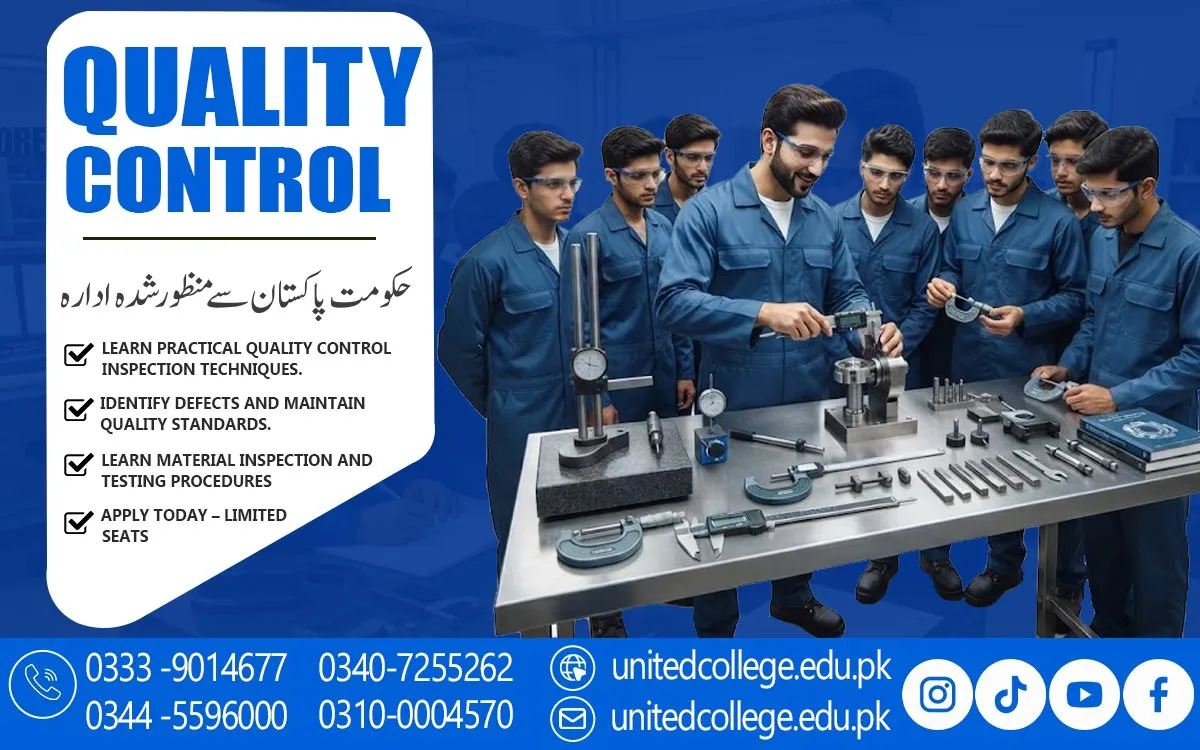

Quality Control Course in Sukkur – Build Practical Skills
When Small Quality Problems Become Bigger Workplace Issues
A small mistake in a product, material, construction activity, or production process may not look serious at first, but if it is ignored, it can affect the final result and create additional problems later. This is why quality control has an important place in modern workplaces. Quality control involves checking work at different stages to make sure that products, materials, and processes meet the required specifications. A Quality Control Course in Sukkur can help beginners understand how these checks are planned and performed in real workplace situations.
Learners can explore why inspections are carried out before, during, and after different processes and how early identification of a problem can make correction easier. Instead of thinking about quality control as simply rejecting defective products, students can understand it as a systematic process involving inspection, measurements, testing, standards, documentation, and communication. This knowledge can be useful in manufacturing, construction, workshops, warehouses, production units, and industrial environments where consistent quality is necessary for reliable results.
Learning to Inspect Products and Materials With Greater Accuracy
Quality inspection requires more than simply looking at a finished product and deciding whether it appears acceptable. A quality inspector needs to know what should be checked, which specifications apply, what inspection methods are suitable, and how the findings should be recorded. During quality control training, learners can become familiar with product inspection and material inspection and understand how these activities differ according to the workplace. For example, a product may need to be checked for dimensions, appearance, functionality, performance, or finishing, while incoming materials may need to be examined for quantity, condition, size, specifications, or other requirements.
Learners can also understand why inspection procedures should be followed consistently so that different workers can reach reliable results. Through a Quality Control Course in Sukkur, beginners can develop a more systematic approach to inspection by learning how to identify what needs to be checked, compare the actual result with the required standard, recognize irregularities, and communicate findings properly. These skills can help students understand what quality-focused work looks like beyond simple classroom definitions.
Understanding Quality Standards Before Making a Quality Decision
How can a worker decide whether something is acceptable without knowing what it is supposed to meet? Quality standards and specifications provide the reference needed to make consistent decisions. These standards may describe acceptable measurements, materials, performance levels, appearance, procedures, tolerances, or other technical requirements depending on the industry. A Quality Control Course in Sukkur can introduce learners to the importance of following workplace quality standards rather than depending only on personal judgment. For example, a product may look perfectly fine but still fail because its dimensions are outside the specified tolerance.
Similarly, construction work may appear complete while certain materials or measurements do not meet the project requirements. Learners can understand how quality inspectors compare actual results with defined specifications and document differences when requirements are not achieved. This knowledge is particularly useful in manufacturing quality control, construction quality control, production, and industrial workplaces where consistency is important. Understanding standards also helps beginners recognize that quality is not simply about appearance; it is about meeting clearly defined requirements in a reliable and repeatable way.
Identifying Defects Before They Reach the Final Stage
One of the most important responsibilities in quality control is finding problems before they become more difficult or expensive to correct. Defect identification helps workers recognize issues that may affect a product, material, process, or completed piece of work. During quality control training, learners can study how defects may appear in different forms, including incorrect measurements, damaged materials, poor finishing, missing components, improper installation, weak connections, or results that do not match specifications. They can also learn about non-conformities, which means that something does not meet an established requirement. A beginner may initially think that identifying a defect simply means noticing something that looks wrong, but professional inspection requires a more careful process.
The inspector needs to understand the applicable standard, examine the actual result, determine the difference, and record the finding accurately. Through a Quality Control Course in Sukkur, students can develop this methodical approach and understand why defect identification is important in manufacturing, construction, workshops, production areas, and other workplaces. Learning to recognize quality problems early can also help learners understand how inspection contributes to smoother processes and more reliable final results.
Using Measurement and Testing Instead of Guesswork
Visual inspection can reveal many problems, but some quality requirements cannot be judged accurately by appearance alone. Measurement and testing provide additional information that allows quality personnel to make decisions based on actual results. Depending on the workplace, measurements may involve dimensions, thickness, weight, temperature, quantity, strength, or other technical requirements. A quality control course can help learners understand the purpose of measurement and testing and how different quality control tools may be used during inspection activities. Students can learn why selecting the correct tool and following the proper measurement method matters, because an incorrect reading can lead to an incorrect quality decision.
They can also understand that recording a measurement is only one part of the process; the result needs to be compared with the relevant specification or acceptable range. Practical quality control training can make this easier to understand by connecting measurement activities with real workplace situations. Whether the environment involves production, manufacturing, construction, workshops, or industrial processes, learning how to interpret measurement and testing results can help beginners build stronger practical quality control skills.
Turning Inspection Records Into Useful Quality Information
A quality inspection does not end when the inspector finds a problem or confirms that a product meets the required standard. The findings often need to be recorded so that other people can understand what was checked and what happened during the inspection. Documentation and reporting are therefore important parts of quality management. In a Quality Control Course in Sukkur, learners can understand how inspection records, test results, measurement reports, defect reports, and corrective action records support workplace quality processes. Clear documentation can help supervisors review previous inspections, identify repeated problems, monitor changes, and communicate information between departments.
For example, if a particular defect appears several times, properly maintained records can help a quality team identify a pattern instead of treating every occurrence as an unrelated incident. Learners can also understand that quality documentation should be accurate, organized, and based on actual observations or measurements. Developing these habits can help beginners appreciate why record-keeping is not simply administrative work. It provides useful evidence that supports decision-making, accountability, process monitoring, and continuous quality improvement.
Finding the Real Cause Instead of Repeating the Same Fix
Fixing a defective item may solve the immediate problem, but it does not always prevent the same issue from appearing again. When a defect repeatedly occurs, quality teams may need to investigate its underlying cause. This is where root cause analysis and problem-solving become important. During quality control training, learners can understand how a workplace may examine materials, equipment, processes, instructions, measurements, working conditions, and other factors to determine why a problem occurred. The purpose is not simply to identify who made a mistake but to understand what allowed the problem to happen.
Once the cause is better understood, corrective actions can be taken to address the existing issue, while preventive actions can help reduce the chance of a similar problem occurring in the future. A Quality Control Course in Sukkur can introduce beginners to this way of thinking and show them why quality improvement requires more than repeatedly fixing visible defects. This approach can also help learners understand process improvement and how quality control teams can use inspection findings to make workplace procedures more effective and consistent over time.
Connecting Quality Control With Quality Assurance and Management
Quality control and quality assurance are closely connected, but they focus on different parts of the overall quality process. Quality control mainly involves checking products, materials, and processes to determine whether they meet established requirements, while quality assurance focuses more on the systems and procedures designed to support consistent quality. Learners can study how both areas contribute to a quality management system and why successful quality practices require cooperation between different people and departments. For example, quality inspection may reveal that a particular defect is occurring repeatedly, while quality assurance procedures may help the organization review the process responsible for the issue and introduce better controls.
Through a Quality Control Course in Sukkur, beginners can develop a clearer understanding of quality management and learn why standards, procedures, inspections, documentation, monitoring, and corrective actions are connected. This broader perspective is useful for students and fresh learners because it shows that quality is not the responsibility of an inspector alone. Workers, supervisors, technicians, production teams, and management may all contribute to maintaining workplace standards and supporting reliable results.
Building Practical Skills for Manufacturing and Industrial Workplaces
Quality control knowledge becomes more valuable when learners understand how it can be applied in real working environments. A Quality Control Course in Sukkur can help students and beginners explore practical areas such as workplace inspection, product checking, material inspection, measurement and testing, quality documentation, defect identification, reporting, and process monitoring. At United College of Technology, learners can study quality-related concepts and develop an understanding of the procedures and practices used to maintain workplace standards. The field can be relevant to people interested in manufacturing, construction, production, engineering-related workplaces, workshops, warehouses, and industrial environments where consistent quality is important.
Students, school or college graduates, fresh learners, and workers who want to improve their technical knowledge can explore this field according to their interests and career goals. The purpose of quality control training is not to promise a specific job or outcome, but to help learners develop useful skills such as careful observation, accurate measurement, following specifications, identifying problems, maintaining records, and communicating findings. With a practical understanding of these areas, learners can better appreciate how quality-focused teams contribute to reliable products, better processes, and consistent workplace performance.
Frequently Asked Questions (FAQs)
A Quality Control Course in Sukkur teaches learners how to inspect products, identify defects, follow quality standards, perform basic testing, and maintain quality records.
Students, fresh learners, school or college graduates, job seekers, and beginners interested in inspection and quality-related work can consider this course.
Training may cover quality inspection, defect identification, measurements, testing methods, quality standards, documentation, reporting, workplace inspections, and corrective actions.
Quality Control mainly focuses on checking products, materials, and processes to identify problems, while Quality Assurance focuses more on systems and procedures used to prevent quality problems.
Quality control skills can be useful in manufacturing, construction, production, engineering-related workplaces, workshops, warehouses, and other industrial environments.
Admission Open: Start Your Professional Journey Today!
Join United College of Technology and build a career with practical training, recognized certifications, and Gulf job support. Seats are limited.
Apply Now via WhatsAppContact Information
- Address: Rawalpindi: F-272 Main New Katarian Stop, Old IJP Road | Lahore Campus: Lahore, Pakistan
- Phone/WhatsApp: 0340-7255262 / 0333-9014677 / 0301-5044340 / 0310-0004570 / 051-8770756
- Website: unitedcollege.edu.pk
















Leave a Comment