


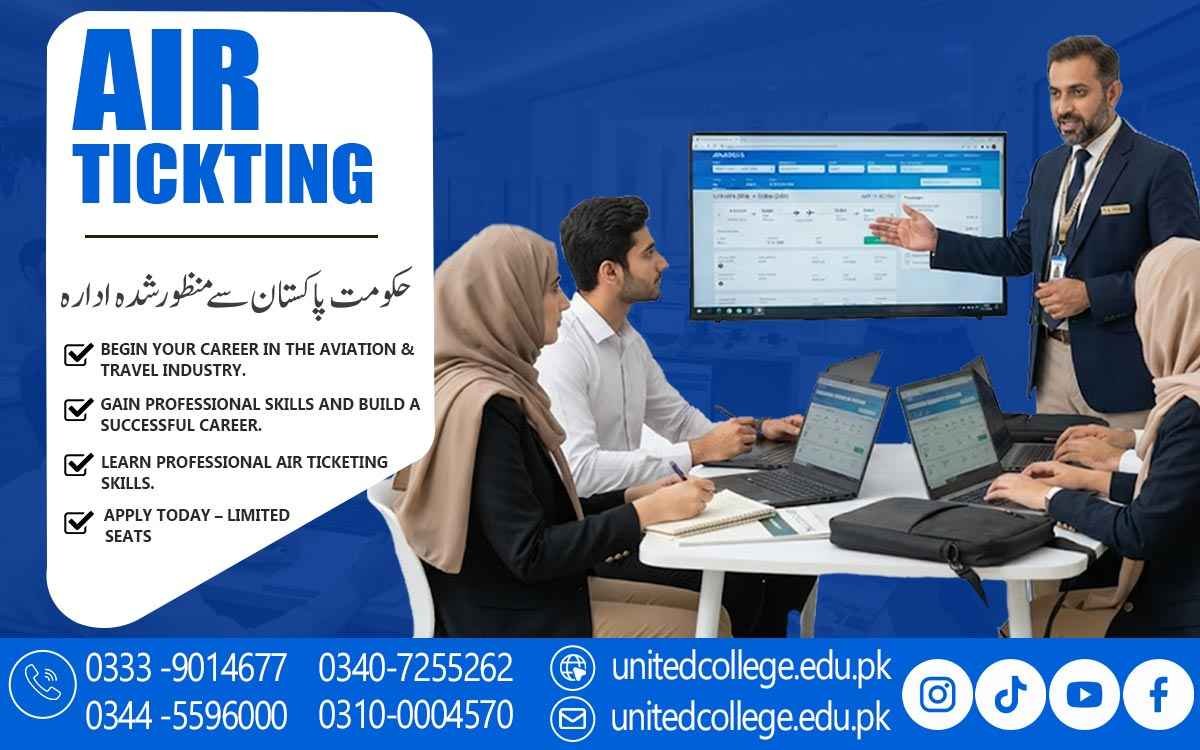

Air Ticketing in Jhang: Explore Practical Training for Travel Desk Work
Build the Skills Behind Every Smooth Flight Booking
A travel plan can change quickly when a passenger needs a different date, a better route, or a suitable flight time. Behind these simple requests is a detailed process of checking schedules, reviewing fares, entering passenger information, and keeping reservation records accurate. This makes air ticketing a practical field for learners who enjoy travel, organized office work, and customer interaction.
The Air Ticketing Course in Jhang offered by United College of Technology introduces beginners to the main tasks involved in flight booking and reservation handling. It gives learners a chance to understand how travel information is managed and how different ticketing steps connect with one another.
From a Travel Request to a Booking on Record
The first stage of ticketing usually begins with understanding what a passenger needs. A traveler may provide a destination, preferred date, number of travelers, and other journey requirements. Ticketing staff then search for suitable options and review the available information before moving toward a reservation.
Through an Air Ticketing Course in Jhang, learners can understand this process in a practical sequence. They can explore how customer requirements are converted into a booking and why every detail needs to be checked. This basic understanding gives fresh learners a useful starting point before they work with more detailed reservation tasks.
Flight Details Become Easier With the Right Knowledge
A flight search contains much more than a departure and arrival time. Learners need to become familiar with flight numbers, routes, airport codes, airline codes, connection points, and schedule information. These details help ticketing staff identify the correct journey and explain it clearly to passengers.
During air ticketing classes, beginners can learn how to read and organize such information. For example, a connecting flight may require attention to more than one departure time and airport. Understanding these details helps learners make sense of flight options and reduces confusion when preparing a travel booking.
Fare Information Shapes the Booking Choice
The cheapest flight is not always the only factor a traveler considers. Different fares can have different rules related to changes, cancellations, baggage, or other booking conditions. A person working with reservations therefore needs basic awareness of what is included with a particular fare.
Learners can study airfare basics and understand why fare conditions should be checked before confirming a ticket. They can also become familiar with concepts such as fare calculation and ticket restrictions. This knowledge helps students look at a booking as a complete package of travel information rather than focusing only on the displayed price.
Reservation Records Keep the Journey in Order
Once a passenger chooses a flight, the booking needs to be recorded correctly. Passenger names, travel dates, destinations, flight details, and booking references are important parts of this process. A well-managed reservation gives the ticketing desk a clear record of the passenger's travel plan.
Students can learn the basic role of an airline reservation system and understand how booking information is maintained. They may also become familiar with PNR-related concepts and reservation management. This area of training encourages accuracy because one incorrect detail can affect several parts of the booking.
Practical Ticketing Connects Search, Booking, and Itinerary Preparation
Learning becomes more useful when students can see how separate tasks work together. A typical practice activity may involve checking flight availability, selecting an appropriate option, recording passenger details, completing a reservation, and preparing an itinerary.
Through an Air Ticketing Course in Jhang, students can practice these essential tasks in a structured way. These exercises help beginners build real travel-booking skills while showing why ticketing work requires organized thinking. Instead of memorizing isolated terms, learners can follow a complete process and understand what information is needed at each stage.
Travel Plans Can Change Long After the Original Booking
A confirmed reservation does not always remain unchanged. Passengers may need to modify their travel date, choose another flight, cancel a booking, or ask about rebooking. The correct procedure depends on the airline and fare conditions, so each request needs to be reviewed carefully.
Ticket modification and cancellation concepts can be introduced during training to help learners understand how existing bookings are handled. Students can learn why the original reservation should be checked before discussing any possible change. This creates a more responsible approach to ticket cancellation, rebooking, and passenger requests.
Good Customer Handling Starts With Listening
A ticketing desk deals directly with people, so technical knowledge needs to be supported by clear communication. Passengers may not understand airline terminology or may be unsure about which travel option suits their requirements. A patient and organized response can make the booking process easier for everyone.
Learners can develop customer service skills in travel by practising how to listen to passenger requirements and explain booking information clearly. They can also learn the importance of professional behavior at a travel desk, including polite communication, careful information handling, and avoiding assumptions when a customer's request is unclear.
Avoiding Small Errors Builds Better Ticketing Habits
Accuracy is one of the most important habits a beginner can develop. An incorrect passenger name, wrong travel date, missed connection detail, or misunderstood airport code can create problems in a reservation. These mistakes may happen when information is entered too quickly or not reviewed before confirmation.
Practical learning can encourage students to double-check important booking details before completing a task. Reviewing passenger information, flight schedules, routes, fare conditions, and reservation records can become part of a regular working routine. These habits support stronger airline ticketing skills and help learners approach travel information with greater care.
Give Your Travel Interest a Practical Direction
Air ticketing brings together computer-based work, travel information, reservation procedures, passenger communication, and careful record management. For learners in Jhang, studying these areas can provide a clearer understanding of what happens behind everyday flight bookings and travel desk services.
The Air Ticketing Course in Jhang offered by United College of Technology gives beginners a structured way to explore these fundamentals. By learning one booking task at a time, students can strengthen their understanding of airline reservations, ticketing procedures, travel documentation, and customer handling. Those interested in the travel field can use this foundation as a starting point for further learning and skill development.
Frequently Asked Questions (FAQs)
Familiarity with typing, searching information, using online forms, and managing digital records can make it easier for beginners to learn ticketing-related systems.
Organized records make it easier to locate journey details, review reservations, respond to customer requests, and keep important travel information in the right place.
They can learn how multiple flight segments form one journey and why departure times, arrival times, airports, and connection details need to be reviewed carefully.
A properly prepared itinerary brings key journey information together in an easy-to-follow format, helping passengers understand the different parts of their planned trip.
Careful reading, accurate typing, regular checking, patience, and keeping information organized are useful habits that can support learning and everyday ticketing tasks.
Yes. Air ticketing can be studied as a focused skill while also giving learners useful knowledge about reservations, airline services, and travel arrangements.
Admission Open: Start Your Professional Journey Today!
Join United College of Technology and build a career with practical training, recognized certifications, and Gulf job support. Seats are limited.
Apply Now via WhatsAppContact Information
- Address: Rawalpindi: F-272 Main New Katarian Stop, Old IJP Road | Lahore Campus: Lahore, Pakistan
- Phone/WhatsApp: 0333-9014677 / 0344-5596000 / 0310-0004570 / 0301-5044340 / 0340-7255262
- Website: unitedcollege.edu.pk
















Leave a Comment