


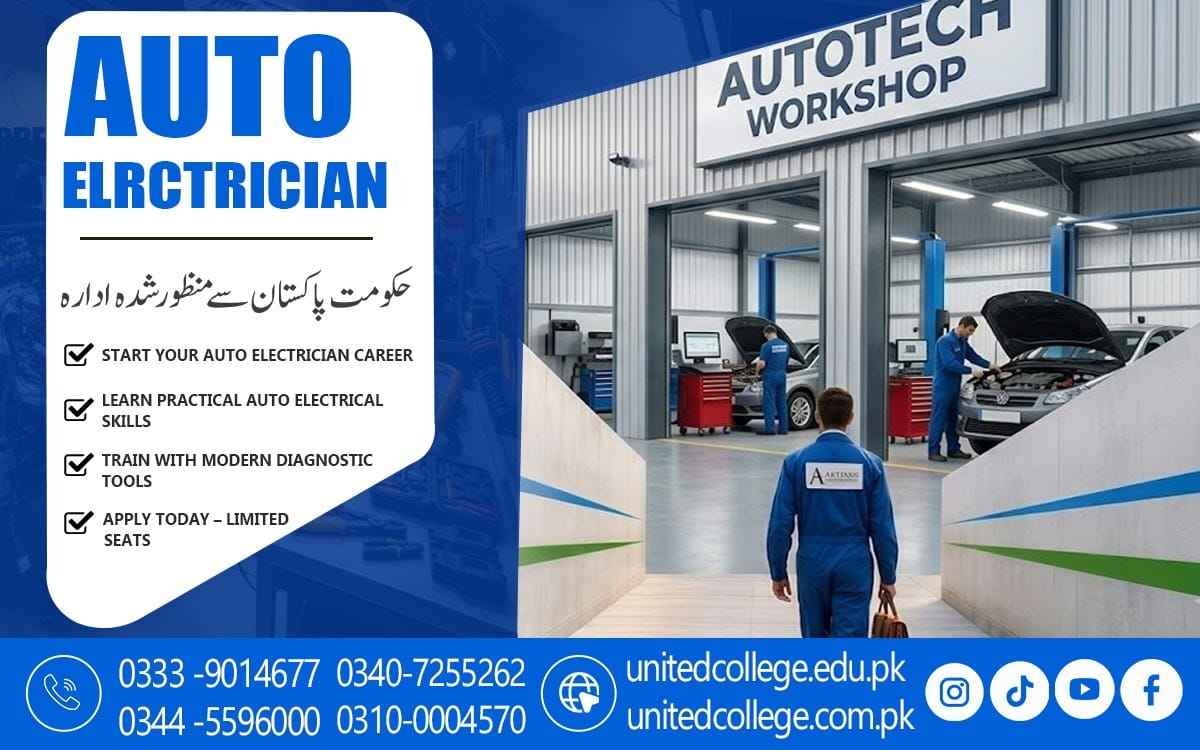

Auto Electrician Course in Sukkhar – Master Vehicle Electrical Skills
When a Car Refuses to Start, Electrical Skills Matter
A car can look perfectly fine from the outside and still refuse to start because of a small electrical fault. A weak battery, damaged wire, faulty starter, charging problem, or poor connection can keep a vehicle off the road. As vehicles continue to depend on electrical and electronic systems, people who understand these systems have an important role in automotive repair.
For students, beginners, job seekers, and car enthusiasts in Sukkur, the Auto Electrician Course in Sukkur offered by United College of Technology provides an opportunity to learn practical skills related to vehicle electrical repair. Instead of simply being interested in cars, learners can develop useful knowledge about how electrical components work, how faults can be checked, and how common problems can be approached in a workshop environment.
Turn Vehicle Electrical Problems Into a Practical Skill
Automobiles require more than engine and mechanical knowledge to remain in good working condition. Electrical power is involved in starting the engine, charging the battery, operating lights, powering accessories, and supporting different vehicle functions. When one electrical component develops a problem, the vehicle may show symptoms that can be confusing to an inexperienced person. This is why an Auto Electrician Course in Sukkur and practical auto electrician training can be a useful choice for someone who wants to develop practical technical skills and build a career in the automotive field.
Students can learn how to understand automobile electrical systems and develop an organized approach to vehicle troubleshooting. Rather than guessing which part needs replacement, training can teach learners to inspect the problem, understand possible causes, perform basic checks, and identify the area that needs attention. These skills can become a foundation for further experience in automotive repair.
What Students Actually Learn During Auto Electrician Training
The Auto Electrician Course in Sukkur can introduce students to the major electrical systems and components found in automobiles. Learners can study automotive wiring, batteries, charging systems, starter motors, alternators, fuses, relays, ignition systems, lighting systems, and basic electrical testing. The purpose is to help students understand what each component does and how different parts work together.
For example, a starting problem may not always mean that the engine itself has a fault. The battery, wiring, starter motor, or electrical connections may need to be checked first. Through an automotive electrical course, students can learn these concepts in a simple and structured way. This makes the training suitable for beginners who want to enter the automotive field without depending on extensive previous professional experience.
From Automotive Wiring to Understanding Electrical Circuits
Wiring is an essential part of almost every vehicle electrical system. Electricity needs a proper path to reach different components, and damaged wires, loose connections, or incorrect wiring can create serious problems. During training, students can become familiar with automotive wiring and learn why proper connections are important for vehicle operation. They can also develop an understanding of simple circuits and how electrical current moves from one point to another.
Learning car wiring does not mean memorizing complicated diagrams. Instead, beginners can gradually learn how to identify wires, connections, fuses, relays, and related components. This knowledge can be useful when dealing with lights that stop working, accessories that lose power, starting issues, or other common electrical faults. Good wiring knowledge also helps an auto electrical technician approach repairs more carefully.
Batteries, Charging Systems, and Starter Motors Explained
A vehicle's battery and charging system play an important role in starting and operating the electrical system. The battery supplies electrical power, while the alternator helps recharge the battery when the engine is running. The starter motor uses electrical power to help turn the engine during the starting process. If any part of this system develops a problem, the driver may experience starting difficulties or repeated battery issues.
Students in practical auto electrician training can learn how these components work and how basic checks can help identify possible faults. They can also become familiar with areas related to alternator repair and starter motor repair. Understanding these systems gives learners practical knowledge that can be useful in garages, workshops, and automotive service environments where starting and charging problems are common repair concerns.
Lights, Ignition, and Electrical Accessories Need Skilled Hands
Vehicle lighting is another important area of automotive electrical work. Headlights, brake lights, indicators, parking lights, and other lighting components depend on proper electrical connections and working circuits. A simple lighting problem may be caused by a bulb, fuse, wire, switch, or connection, so a technician needs to inspect the system rather than immediately assume one cause. Through the Auto Electrician Course in Sukkur, students can learn how to understand these lighting systems, identify common electrical faults, and develop practical skills for proper inspection and repair.
Students can also learn about the ignition system, which is involved in the process of starting and running a vehicle, along with other basic electrical and electronic components. Understanding these areas can help learners deal with different types of car electrical faults and develop better vehicle electrical maintenance habits. As they gain practical experience, students can become more comfortable identifying components and understanding how electrical systems support everyday vehicle functions.
Learn to Find the Real Cause Instead of Guessing
Imagine a customer brings in a car because it will not start. The battery may be weak, but the problem could also involve the starter, wiring, connections, or charging system. This is where car electrical troubleshooting becomes important. During training, students can learn to approach faults step by step instead of changing parts without checking the actual cause. Basic testing tools can help a technician check electrical conditions and make better decisions.
Students can develop an understanding of simple diagnostic methods and learn how observations and test results can guide the repair process. This type of vehicle diagnostics training can improve problem-solving skills and help learners become more confident when dealing with real workshop situations. The objective is not simply to repair one particular fault but to develop a logical way of thinking that can be applied to different automotive electrical problems.
Hands-On Workshop Learning Builds Real Confidence
Automotive electrical work is a practical field, so students need more than theoretical information to understand it properly. Reading about a battery, alternator, or wiring system can provide knowledge, but working with components can make that knowledge easier to remember and apply. United College of Technology offers the Auto Electrician Course in Sukkur with a focus on practical skill development and hands-on learning.
Through practical activities, learners can become more familiar with electrical components, testing methods, wiring, troubleshooting, and repair-related tasks. This type of workshop training can be especially helpful for beginners because it allows them to learn gradually and become comfortable with the tools and systems used in automotive work. Practical experience can also help students understand that different faults may require different approaches, encouraging them to inspect carefully and solve problems rather than rely on guesswork.
Build a Career Around Automotive Electrical Skills
After developing practical knowledge and gaining real-world experience, learners may explore different career paths in the automotive industry. Possible roles include Auto Electrician, Automotive Electrical Technician, Vehicle Diagnostic Technician, Car Electrical Repair Technician, Workshop Technician, Automotive Service Technician, Electrical Maintenance Technician, and Self-employed Auto Electrician. Opportunities may exist in automobile workshops, garages, service centers, dealerships, and other businesses involved in vehicle maintenance and repair.
A newly trained learner may begin by assisting an experienced technician and gradually take on more technical responsibilities as their skills improve. The course itself does not guarantee a particular job or income, but it can provide a useful technical foundation for someone who wants to enter this field. Continued practice, experience, responsible work habits, and learning about newer vehicle technology can all contribute to long-term professional development.
Practical Skills Can Also Open the Door to Self-Employment
For some students, the goal is eventually to work independently rather than remain in a traditional job. After gaining sufficient experience, an auto electrician may consider providing independent repair services or starting an auto electrical workshop. Services can involve areas such as wiring checks, electrical fault diagnosis, lighting repairs, battery-related problems, starting issues, and other vehicle electrical work. However, running an independent service requires more than completing a course.
A technician needs strong practical skills, suitable tools, careful working habits, customer communication, and the ability to diagnose problems accurately. This is why developing a solid foundation through an automotive repair course and then gaining real workshop experience can be valuable. With time and practice, technical knowledge can become a service that customers rely on.
Why Practical Auto Electrical Skills Have a Future
The automotive industry continues to change, and electrical systems are becoming an increasingly important part of vehicle servicing. Modern vehicles use many electrical and electronic components, which means automotive technicians need to understand more than traditional mechanical systems. This makes automobile repair skills related to electrical systems useful for people who want to keep learning as vehicle technology develops.
A strong understanding of wiring, charging systems, starting systems, lighting, ignition, testing, and diagnostics can give learners a useful foundation for future training. For people looking for automotive work in Pakistan or considering opportunities abroad, practical skills and experience can be valuable, although employment requirements differ between workplaces and countries. Learning should therefore continue beyond the classroom as technicians gain exposure to different vehicles and newer technologies.
Start With One Skill and Build Your Automotive Future
A person does not need to begin with years of experience to take the first step toward an automotive career. Sometimes the starting point is simply a strong interest in vehicles and the willingness to learn a practical skill. The Auto Electrician Course in Sukkur offered by United College of Technology can help learners build knowledge of automotive wiring, batteries, charging systems, starter motors, alternators, lighting, ignition, electrical testing, and fault diagnosis.
More importantly, practical training can help students understand how these skills are used when real vehicle problems appear in a workshop. If you enjoy working with cars and want a career where your hands, knowledge, and problem-solving ability all matter, learning auto electrical skills can be a meaningful first step. The road to becoming a skilled automotive technician starts with learning—and then turning that knowledge into practice.
Frequently Asked Questions (FAQs)
An Auto Electrician Course in Sukkur teaches students how vehicle electrical systems work and how to identify and handle common electrical problems. The training can cover wiring, batteries, alternators, starter motors, lighting systems, ignition systems, and basic diagnostics.
The course can be suitable for beginners, students, job seekers, car enthusiasts, and anyone interested in developing practical automotive electrical skills. You do not necessarily need professional experience to start learning.
Students can learn automotive wiring, battery and charging systems, starter motors, alternators, fuses, relays, lighting systems, ignition systems, electrical testing, fault finding, and basic vehicle troubleshooting.
Practical learning is an important part of developing automotive electrical skills. Students can practice identifying components, checking connections, understanding wiring, using basic testing tools, and troubleshooting common vehicle electrical problems.
After gaining practical experience, learners may explore roles such as Auto Electrician, Automotive Electrical Technician, Car Electrician, Vehicle Diagnostic Assistant, Workshop Technician, or Automotive Service Technician.
Admission Open: Start Your Professional Journey Today!
Join United College of Technology and build a career with practical training, recognized certifications, and Gulf job support. Seats are limited.
Apply Now via WhatsAppContact Information
- Address: Rawalpindi: F-272 Main New Katarian Stop, Old IJP Road | Lahore Campus: Lahore, Pakistan
- Phone/WhatsApp: 0333-9014677 / 0344-5596000 / 0310-0004570 / 0301-5044340 / 0340-7255262
- Website: unitedcollege.edu.pk
















Leave a Comment