


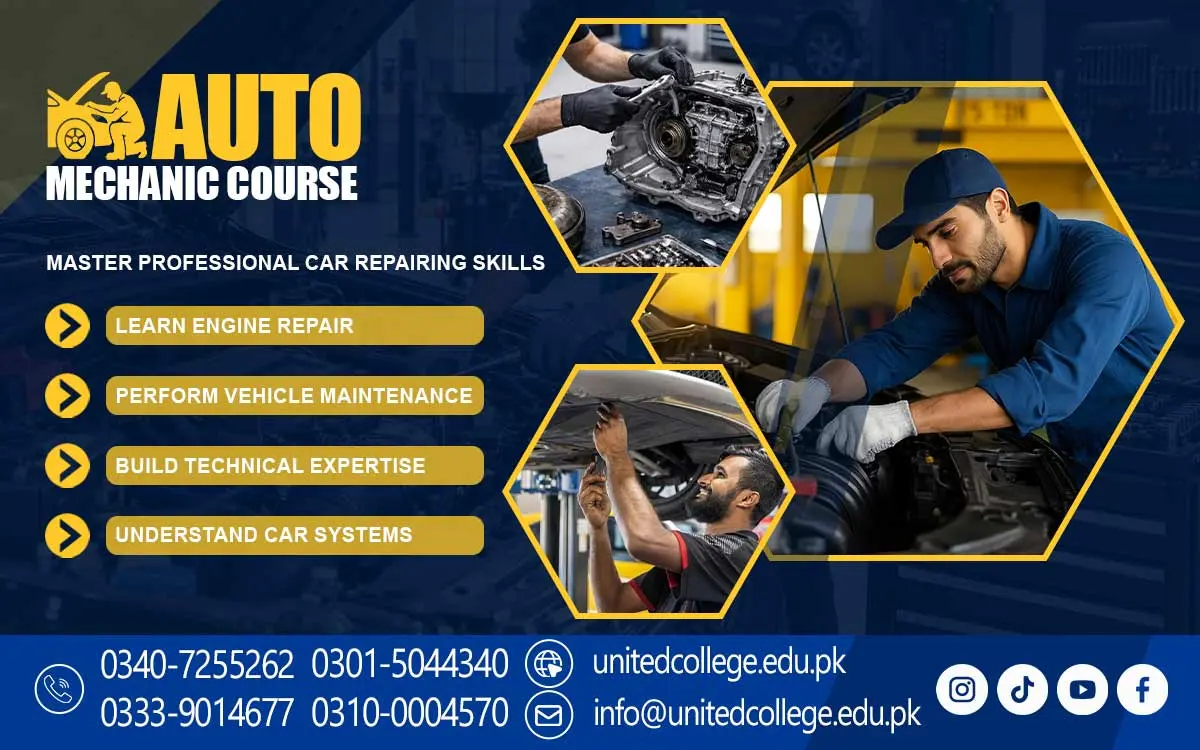

Auto Mechanic Course in Charsadda for Modern Garage Knowledge
Turn Your Curiosity About Cars into Useful Mechanical Knowledge
Every vehicle needs proper care to remain reliable on the road. From a weak battery to an unusual engine noise, small problems can affect a vehicle's performance and may require careful inspection. The Auto Mechanic Course in Charsadda provides a learning opportunity for beginners, students, fresh learners, and job seekers who want to understand how vehicles work and how common mechanical issues are handled. Through automotive training, learners can explore vehicle components, basic maintenance procedures, and practical repair methods.
They can also discover why a mechanic must understand the cause of a problem before attempting to fix it. For people interested in technical skills, this learning path offers a way to explore automotive maintenance and decide whether vehicle repair matches their interests. No advanced mechanical knowledge is needed to begin learning the basics, although patience, regular practice, and a willingness to follow safety instructions are essential.
Explore the Mechanical Systems Behind Everyday Driving
A car depends on several connected systems, and each one has a specific job. The engine produces power, the transmission transfers that power to the wheels, and the braking system helps the driver slow down or stop. Steering allows the driver to control direction, while suspension components support the vehicle and help absorb road bumps. The clutch in a manual vehicle connects and disconnects engine power during gear changes.
Understanding these systems helps beginners recognise how different components affect overall performance. For example, difficulty changing gears may point to a clutch or transmission issue, while unusual movement over bumps may require an inspection of suspension components. During the Auto Mechanic Course in Charsadda, learners can develop a basic understanding of these systems and their functions. This knowledge provides a useful foundation for identifying symptoms, following inspection procedures, and understanding when a problem requires a qualified mechanic.
Develop Practical Skills Through Common Vehicle Maintenance Tasks
Automotive repair begins with learning how to inspect a vehicle and recognise signs that something may not be working correctly. A Car Repairing Course can introduce learners to routine servicing and basic repair concepts through explanations and supervised practice. Important learning areas may include:
| Feature | Details |
|---|---|
| Engine care | Understand common engine components, visible leaks, unusual noises, and changes in performance. |
| Oil and filter servicing | Learn why engine oil reduces friction and why the correct oil and filter replacement schedule matters. |
| Brake inspection | Explore the function of brake pads, discs, and other components, along with signs of wear that need professional attention. |
| Basic electrical checks | Learn about batteries, fuses, lights, and electrical connections that may affect vehicle operation. |
| Steering and suspension | Understand how these systems influence vehicle control, stability, and driving comfort. |
These tasks help beginners connect technical information with real maintenance needs. For instance, dim headlights may indicate a lighting fault, a battery issue, or another electrical problem. The correct response is to inspect the relevant system rather than replace parts without evidence. Learners should follow manufacturer guidance and perform unfamiliar tasks under suitable supervision.
Understand Why Practical Demonstrations Make Learning More Effective
Mechanical concepts become easier to understand when learners can see how components work. Practical demonstrations allow students to connect textbook information with real vehicle parts, tools, and maintenance procedures. During an Auto Mechanic Course in Charsadda, an instructor may explain how to inspect a component, identify signs of wear, or prepare for a routine service. This helps learners understand not only what to do but also why each step matters.
Step-by-step troubleshooting is especially useful. Consider a car that does not start. The cause might involve the battery, starter motor, electrical connections, or fuel system. A careful mechanic gathers information, checks possible causes, and uses appropriate testing methods before deciding on a repair. Beginners can gradually learn this approach through observation and guided practice.
Make Workshop Safety and Responsible Tool Use Everyday Habits
Automotive work requires care because vehicles contain hot surfaces, moving parts, electrical systems, chemicals, and heavy components. Beginners should learn to prepare a clean working area, wear suitable protective equipment, and follow workshop instructions before starting a task. Vehicles must be secured properly, and approved lifting equipment and support stands must be used whenever work underneath a vehicle is necessary.
Correct tool selection is equally important. Spanners, sockets, pliers, torque wrenches, and diagnostic devices have different purposes. Using the wrong tool can damage a component, produce an inaccurate result, or cause injury. Learners should also understand why some components require specific tightening procedures and why vehicle manufacturers provide maintenance instructions.
Connect Automotive Learning with Local Technical Work
Learning mechanical skills can help people understand the type of work carried out in garages, vehicle workshops, and maintenance services. These workplaces may handle routine servicing, engine inspections, brake repairs, electrical faults, and other vehicle-related tasks. Introductory training can help learners discover which areas interest them and what additional knowledge they may need.
The Auto Mechanic Course in Charsadda can provide a starting point for people who want to explore this technical field. Automotive knowledge can also be useful in everyday life because it helps vehicle owners understand maintenance recommendations and recognise warning signs that need professional attention. However, completing a course does not guarantee a job or a particular income.
Choose Automotive Training That Fits Your Learning Goals
Before enrolling in a course, beginners should review the available information carefully. The Auto Mechanic Course offered by United College of Technology is relevant to learners interested in building their understanding of automotive systems and repair techniques. Prospective students should confirm the current syllabus, practical learning arrangements, instructor guidance, fees, schedule, and any certification details directly with the institution.
Think about what you want to learn first. If you have never worked with vehicles, basic engine knowledge, component identification, tool handling, and routine servicing may be useful starting points. If you already have some experience, you may want to explore more detailed inspection methods or diagnostic techniques. It is sensible to ask how practical activities are organised and how workshop safety is taught.
Build Confidence Through Consistent Practice and Continued Learning
Beginners can develop stronger mechanical understanding by paying attention to small details and learning one task at a time. Start by studying the names and functions of common vehicle parts. Observe experienced mechanics when possible, and ask for explanations when a procedure is unclear. Keeping notes about components, maintenance schedules, and inspection methods can help you remember important information.
Consistent practice also helps learners understand the importance of accurate observations. Learners should also become familiar with reliable service manuals and manufacturer recommendations rather than depending on guesses. As their knowledge develops, they can explore modern diagnostic systems and the differences between older mechanical designs and newer vehicles with electronic controls.
Start Building a Strong Foundation in Vehicle Repair
Automotive repair combines practical ability, technical understanding, careful observation, and a commitment to safety. The Auto Mechanic Course in Charsadda offers an opportunity for interested learners to explore engine systems, routine maintenance, electrical basics, braking components, and common mechanical faults. It can help beginners identify the skills they want to develop and consider whether further automotive training suits their goals.
Progress depends on regular practice, reliable instruction, and the ability to follow correct procedures rather than trying to learn every repair at once. If you enjoy understanding machines and solving practical problems, exploring automotive training can be a worthwhile step towards gaining useful technical knowledge. Start with the fundamentals, learn responsibly, and build your understanding gradually as you prepare for more advanced automotive learning.
Frequently Asked Questions (FAQs)
A mechanic can inspect belt tension, visible wear, unusual noise, and signs of slipping to help identify whether a belt needs adjustment or replacement.
Brake fluid helps transfer force through the braking system. Checking its level and condition can help identify maintenance needs and possible leaks.
The exhaust system carries engine gases away from the vehicle and helps control noise and emissions. Understanding its parts helps mechanics inspect exhaust-related faults.
A torque wrench helps tighten nuts and bolts to a specified level. Correct tightening reduces the risk of loose connections or damage to vehicle components.
Both transmission types transfer engine power to the wheels, but they work differently. Learning their basic operation helps beginners understand common transmission concerns.
An apprentice should follow the supervisor's checklist, verify completed work, inspect relevant components, and ensure any required safety checks have been carried out.
Admission Open: Start Your Professional Journey Today!
Join United College of Technology and build a career with practical training, recognized certifications, and Gulf job support. Seats are limited.
Apply Now via WhatsAppContact Information
- Address: Rawalpindi: F-272 Main New Katarian Stop, Old IJP Road | Lahore Campus: Lahore, Pakistan
- Phone/WhatsApp: 0340-7255262 / 0333-9014677 / 0301-5044340 / 0310-0004570 / 051-8770756
- Website: unitedcollege.edu.pk
















Leave a Comment