


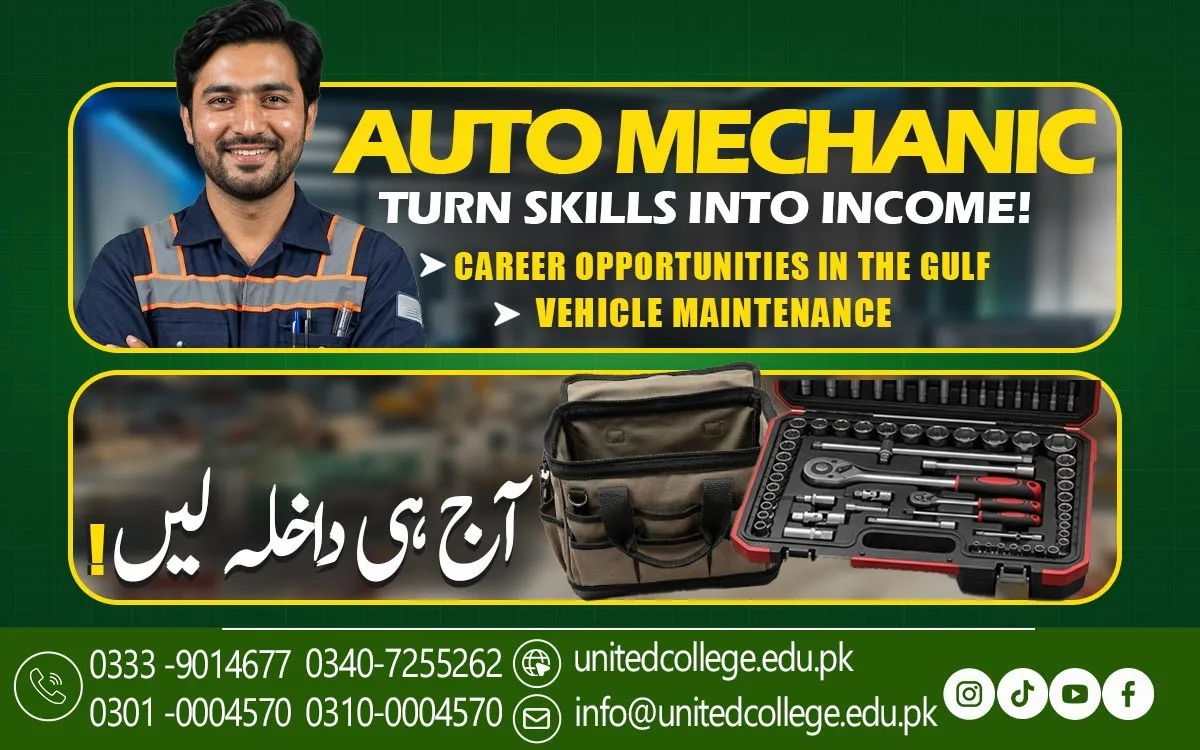

Auto Mechanic Course in Gawadar for Practical Vehicle Skills
Turn Your Interest in Cars into Useful Automotive Knowledge
Vehicles need regular care to remain safe and reliable. From engine problems and worn brake pads to oil changes and battery issues, many common vehicle problems require proper inspection and repair skills. The Auto Mechanic Course in Gawadar offers a learning path for beginners who want to understand how vehicles work and develop practical automotive knowledge. It can be a useful starting point for students, fresh learners, and anyone interested in vehicle maintenance.
Through auto mechanic training in Gawadar, learners can explore the basic systems of cars, understand common faults, and learn why proper servicing matters. Instead of relying only on theory, beginners can focus on how different vehicle parts work together. This knowledge can help them make informed decisions about automotive training and prepare for further learning in the vehicle repair field.
Discover the Main Vehicle Systems Every Beginner Should Understand
A vehicle contains several connected systems, and each one performs an important function. The engine produces power, the braking system helps control movement, and the cooling system prevents excessive engine heat. The lubrication system reduces friction between moving parts, while the electrical system supports starting, lighting, and other functions. An auto mechanic needs to understand how these systems operate before attempting repairs. For example, a car that struggles to start may have a weak battery, a faulty starter, or another electrical problem.
Similarly, an engine that overheats may require checks of the coolant level, radiator, or cooling fan. Learning these basics helps students approach faults logically instead of guessing. A structured Auto Mechanic Course in Gwadar can introduce beginners to automotive maintenance concepts and show them why accurate inspection is an important part of every repair task.
Build Essential Car Repair Skills Through Practical Learning
Auto mechanic training covers several everyday maintenance tasks that help learners understand the work performed in vehicle workshops. These skills provide a foundation for more advanced automotive learning.
| Feature | Details |
|---|---|
| Engine inspection | Learn to recognise common signs of engine trouble, such as unusual noises, leaks, and changes in performance. |
| Oil and filter changes | Understand the purpose of engine oil, the importance of correct oil levels, and the role of filters in vehicle maintenance. |
| Brake maintenance | Explore the basic function of brake pads, discs, and other braking components, including the signs that may indicate a problem. |
| Basic troubleshooting | Develop a step-by-step approach to identifying possible causes of starting difficulties, overheating, and unusual engine behaviour. |
| Vehicle servicing | Understand routine checks involving fluids, tyres, lights, belts, and other important components. |
| Mechanic tool handling | Become familiar with common hand tools, spanners, sockets, screwdrivers, and suitable inspection equipment. |
These skills help learners understand the relationship between regular servicing and vehicle reliability. They also introduce the careful working habits needed in automotive repair. Actual repair procedures should always match the vehicle manufacturer's instructions and the learner's level of training.
Practical Mechanic Training Makes Complex Repairs Easier to Understand
Reading about engines and vehicle components is helpful, but practical learning makes the information easier to apply. In an Auto Mechanic Course in Gwadar, learners can observe a mechanic inspecting an engine, checking fluid levels, or examining a worn component to connect technical terms with real vehicle parts. Guided practice also helps beginners understand the correct order of a maintenance task. For instance, identifying a possible battery problem involves more than looking at the battery.
A proper inspection may require checking connections and using suitable testing equipment under supervision. Practical mechanic training encourages learners to follow instructions, use tools correctly, and recognise when a problem needs an experienced technician. It also builds patience because not every fault has an obvious cause. With regular practice and constructive guidance, learners can improve their understanding of automotive systems and develop greater confidence in performing basic tasks safely.
Explore How Automotive Skills Connect with Workshop Work
People who enjoy working with machines may find automotive repair an interesting field to explore. Garages, vehicle workshops, service centres, and automotive maintenance businesses carry out tasks such as routine servicing, component inspection, and fault diagnosis. Understanding these activities can help learners decide which area of vehicle maintenance interests them most. Some may prefer engine-related work, while others may become interested in brakes, electrical components, or general vehicle servicing.
The Course can provide a starting point for exploring these different areas and understanding the knowledge required for workshop tasks. However, completing training does not automatically guarantee employment or business success. Further supervised experience, continued learning, responsible work habits, and knowledge of newer vehicle technologies can all be important. Learners should consider their interests and practical abilities when deciding how to develop their automotive skills after completing introductory training.
Make Workshop Safety and Accurate Inspection Your Top Priorities
Automotive repair involves tools, moving parts, hot surfaces, electrical components, and heavy equipment. For this reason, safety must remain central to every learning activity. Beginners enrolled in an Auto Mechanic Training in Gwadar should learn to keep their work area organised, wear suitable protective equipment, and follow workshop instructions.
A vehicle must be secured properly before anyone works underneath it, and a suitable lifting system must be used according to established safety procedures. Careful inspection is equally important in automotive maintenance. A mechanic should examine the available evidence before deciding what might be wrong with a vehicle. For example, unusual tyre wear may suggest a problem that requires further inspection rather than simply replacing the tyres. A warning light may also indicate a fault that needs proper diagnosis.
Learn with a Training Path That Supports Your Automotive Goals
Choosing suitable training is an important step for anyone who wants to develop useful vehicle repair knowledge. The Course offered by United College of Technology is relevant to learners interested in understanding automotive systems and building practical mechanic skills. Beginners can use this training opportunity as a way to explore vehicle maintenance, learn technical concepts, and develop a stronger foundation for future practice.
These details should be checked rather than assumed. It is also helpful to consider whether the training matches your existing knowledge and the type of automotive work you hope to understand. A suitable learning path should encourage clear explanations, careful tool use, attention to workshop safety, and a gradual move from basic concepts towards more challenging tasks.
Move Towards a Future Built on Automotive Knowledge
Learning vehicle repair can be a practical choice for people who enjoy understanding machines and solving technical problems. The Auto Mechanic Course in Gawadar can help interested learners explore engine inspection, routine servicing, brake maintenance, troubleshooting, and other essential automotive topics. It can also help beginners decide whether they want to continue towards more specialised training or gain further supervised experience in a workshop environment. Success in this field requires more than knowing the names of vehicle parts.
It depends on careful inspection, safe tool handling, regular practice, and a commitment to learning as vehicle technology changes. Before choosing a course, consider your interests, learning goals, and willingness to develop practical skills over time. With a clear plan and responsible training, you can take a meaningful step towards understanding automotive maintenance and preparing for further learning in the vehicle repair field.
Frequently Asked Questions (FAQs)
It can turn personal interest into structured learning by explaining vehicle components, maintenance methods, and basic fault-finding techniques.
Unusual sounds can provide clues about possible mechanical issues. Learning to recognise them helps beginners understand when a vehicle needs further inspection.
Service manuals provide model-specific instructions, maintenance schedules, technical details, and safety guidance that help mechanics follow suitable procedures.
Automotive learning may introduce electronic components, sensors, and diagnostic systems. The exact topics depend on the course curriculum.
They can study common symptoms, practise systematic inspections under supervision, record observations, and learn to verify possible causes instead of guessing.
Consider the course syllabus, practical learning opportunities, instructor guidance, safety practices, and whether the topics match your learning goals.
Admission Open: Start Your Professional Journey Today!
Join United College of Technology and build a career with practical training, recognized certifications, and Gulf job support. Seats are limited.
Apply Now via WhatsAppContact Information
- Address: Rawalpindi: F-272 Main New Katarian Stop, Old IJP Road | Lahore Campus: Lahore, Pakistan
- Phone/WhatsApp: 0340-7255262 / 0333-9014677 / 0301-5044340 / 0310-0004570 / 051-8770756
- Website: unitedcollege.edu.pk
















Leave a Comment