


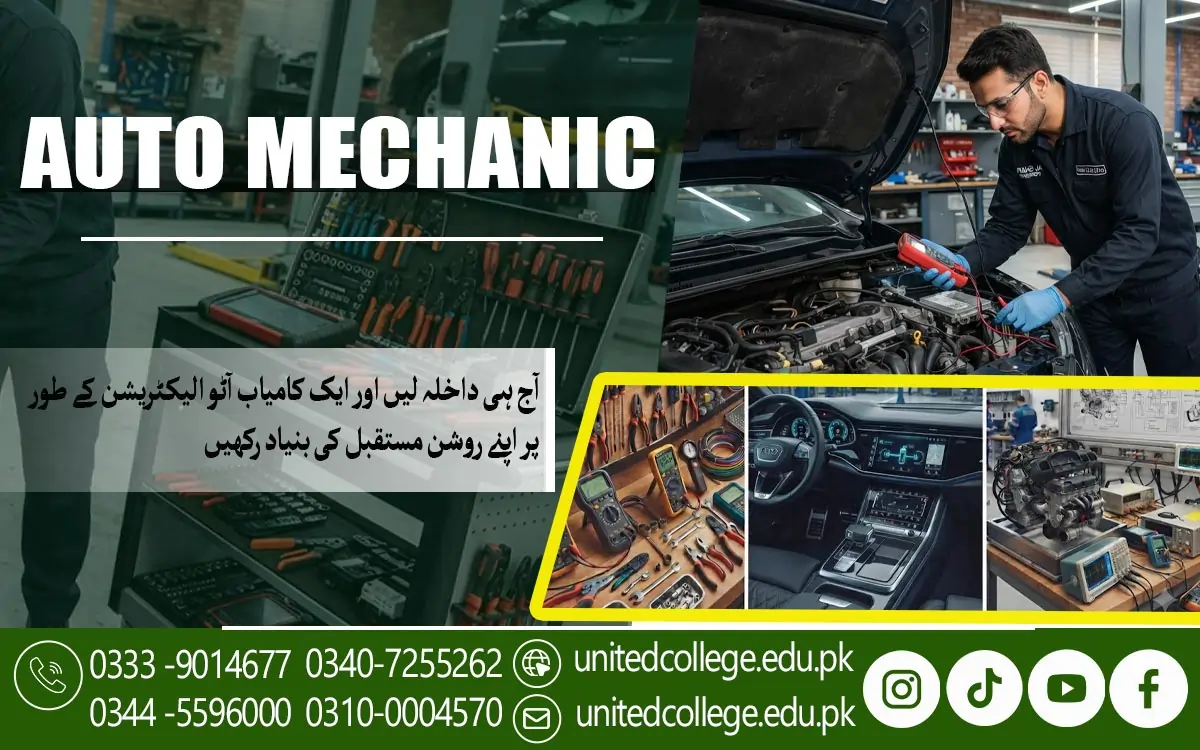

Auto Mechanic Course in Sheikhupura – Start Your Mechanic Journey
Turn Your Passion for Vehicles Into Practical Expertise
A vehicle can reveal a lot when you know what to look for. A strange engine sound, slow starting, unusual vibration, or weak braking may seem confusing to an untrained person, but these signs can become useful clues for someone with proper mechanical knowledge. For people in Sheikhupura who enjoy automobiles and prefer learning through practical work, the Auto Mechanic Course in Sheikhupura offered by United College of Technology can provide a useful path into technical education.
The course introduces learners to important vehicle systems, repair methods, servicing routines, and workshop practices. Instead of only reading about automobile parts, students can develop an understanding of how vehicles work and how mechanics approach common problems.
Where an Interest in Cars Starts Becoming a Real Skill
Many people are naturally curious about what happens under a vehicle's hood, but curiosity alone is not enough to perform reliable repair work. A learner needs to understand the purpose of different components and how they work together. Auto Mechanic Course in Sheikhupura can help beginners build this foundation step by step. Students can explore basic automobile systems before moving toward servicing and repair activities.
This may include understanding the engine, fuel system, cooling system, transmission, brakes, steering, suspension, and electrical components. Such knowledge gives learners a clearer picture of how one vehicle system can affect another. It also creates a strong starting point for developing practical auto repair skills.
Discover What Your Engine Is Trying to Tell You
The engine is one of the most important areas of automobile training because it is responsible for producing the power that moves the vehicle. Beginners can learn about major engine components and understand their functions in simple terms. Engine Repair Training can cover basic inspection, lubrication, cooling, filters, belts, and routine servicing.
Students can learn why oil levels matter, how filters support engine operation, and why regular inspection can help identify developing issues. Instead of treating engine repair as a collection of difficult procedures, practical learning can make each task easier to understand. This foundation can help learners become more familiar with car maintenance skills and develop a more careful approach to engine-related work.
Learn the Systems That Decide How a Vehicle Responds
A car needs much more than a working engine to perform properly. Brakes help control speed, the clutch connects engine power with the transmission, suspension supports the vehicle over uneven surfaces, and steering allows the driver to control direction. Students can study these systems and understand their basic functions during practical automotive training.
Brake servicing introduces learners to the importance of inspection and proper maintenance. Clutch and transmission lessons help explain how power reaches the wheels. Steering and suspension topics show how different components influence handling and stability. Understanding these areas gives students broader mechanical workshop skills and prepares them to look at vehicle problems from more than one angle.
Turn Unusual Vehicle Behavior Into Useful Diagnostic Clues
A skilled mechanic does not immediately replace a part whenever a vehicle behaves differently. First, the symptoms need to be understood. Students in an Auto Mechanic Course in Sheikhupura can learn how to examine common signs such as starting difficulties, overheating, unusual noises, reduced performance, or warning indicators. Vehicle diagnostics introduces a structured way of investigating these problems.
Learners can develop basic fault-finding habits by considering possible causes and checking relevant areas before deciding what should happen next. This type of automotive repair training develops observation and problem-solving skills. It also teaches an important lesson for beginners: accurate diagnosis is often more useful than making quick guesses.
Add Electrical Awareness to Your Mechanical Knowledge
Automobiles increasingly depend on electrical and electronic components, so modern mechanics need some understanding of these systems. Students can learn the basic role of batteries, starters, alternators, fuses, wiring, ignition components, and other electrical parts. These concepts can be introduced through simple examples. For instance, a vehicle that refuses to start may have an issue with its battery or starting circuit rather than a serious engine fault.
Understanding this difference can improve a learner's troubleshooting approach. Automobile technology continues to develop, and newer vehicles may contain more sensors and electronic controls than older models. Building basic electrical knowledge can therefore help students create a stronger technical foundation and remain prepared to learn more advanced systems later.
Put Workshop Tools to Work Instead of Leaving Them on the Shelf
Knowing the name of a tool is very different from knowing how to use it correctly. Practical training gives learners the chance to become familiar with common automotive tools and workshop equipment while learning the purpose of each item. Students can practice safe handling, organized working methods, inspection procedures, and basic servicing tasks. Practical Auto Mechanic Training can also teach learners to prepare their workspace before beginning a job and check their work afterward.
United College of Technology emphasizes practical skill development as part of its technical learning environment, helping students connect classroom explanations with workshop activities. This hands-on approach can be especially valuable for beginners because repeated practice allows unfamiliar tasks to become easier and more understandable over time.
Safety Becomes Part of the Skill
Automotive work involves tools, heavy components, electrical systems, fluids, and moving parts. For this reason, workshop safety should be treated as an essential part of learning rather than an extra topic. Students can develop habits such as using equipment correctly, keeping the workspace organized, following instructions, and avoiding careless shortcuts. Safe working methods protect both the mechanic and the vehicle.
They also create professional habits that can be useful when learners eventually enter a workshop or service environment. Learning to work carefully from the beginning can make a major difference as students move from simple activities toward more demanding automotive tasks.
Build a Career Direction From Skills You Can Keep Improving
The Auto Mechanic Course in Sheikhupura can be useful for beginners, students, job seekers, and individuals who want to explore practical technical work. After gaining training and additional field experience, learners may consider opportunities in automobile workshops, garages, service centers, dealerships, and vehicle maintenance facilities. Possible roles can include automotive technician, workshop assistant, auto repair technician, or skilled auto mechanic.
Some people may eventually explore independent repair work after developing sufficient technical experience and learning the business side of operating a workshop. Training does not guarantee a particular job, but it can provide a foundation from which further experience can grow. The automotive field also changes with new vehicle designs and diagnostic technologies, so continued learning remains important.
Frequently Asked Questions (FAQs)
Yes. It can help students experience a practical technical field before deciding on a long-term direction. Learning about automobile work may also help them understand whether mechanical work matches their interests and abilities.
Curiosity, responsibility, patience, consistency, and attention to small details can be helpful. A mechanic often needs to stay focused while working through a task, especially when the solution is not immediately obvious.
The easiest approach is to connect technical words with actual vehicle parts and everyday examples. As learners repeatedly hear and use these terms during training, they can gradually become more familiar with automotive language.
Yes. Automotive work often involves communication between technicians, assistants, supervisors, and customers. Training can help learners understand the importance of clear communication, cooperation, and completing assigned tasks responsibly.
Recording completed work can make it easier to remember what was checked, serviced, or replaced. Good records can also support better organization when a vehicle returns for future maintenance.
A good first goal is to develop a dependable foundation rather than trying to master everything immediately. Learning carefully, practicing regularly, and gaining experience can create a stronger path for future progress.
Admission Open: Start Your Professional Journey Today!
Join United College of Technology and build a career with practical training, recognized certifications, and Gulf job support. Seats are limited.
Apply Now via WhatsAppContact Information
- Address: Rawalpindi: F-272 Main New Katarian Stop, Old IJP Road | Lahore Campus: Lahore, Pakistan
- Phone/WhatsApp: 0333-9014677 / 0344-5596000 / 0310-0004570 / 0301-5044340 / 0340-7255262
- Website: unitedcollege.edu.pk
















Leave a Comment