


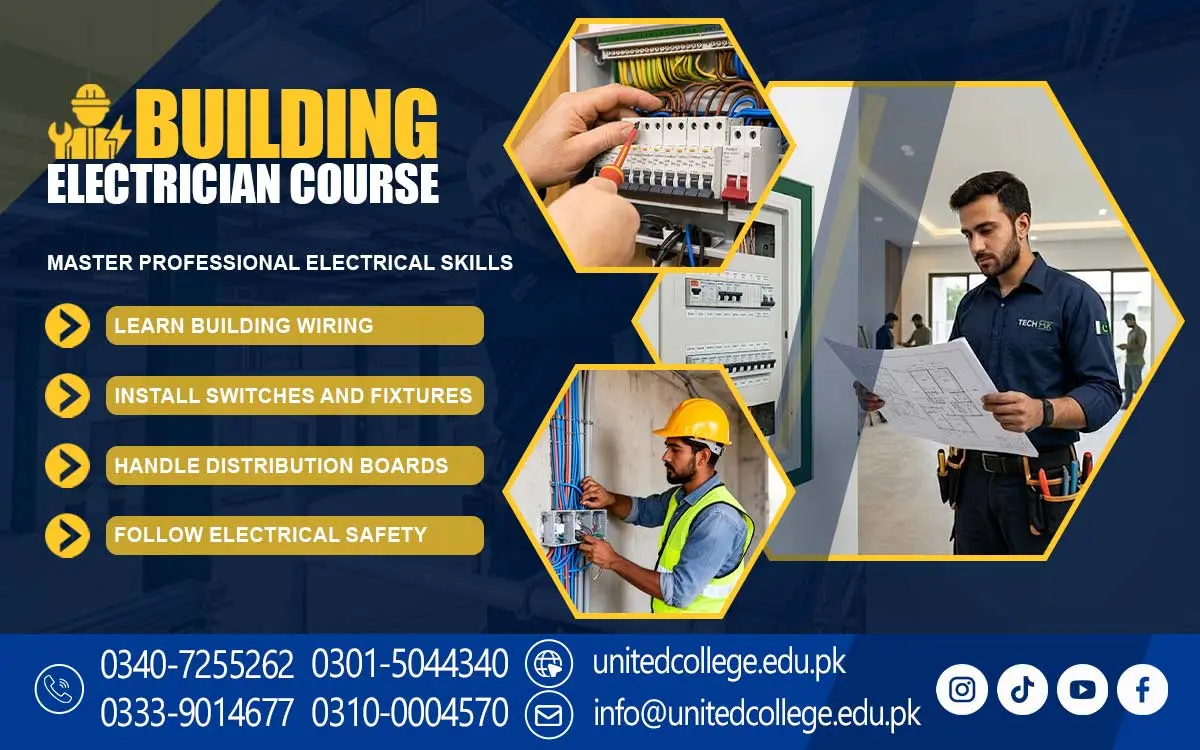

Building Electrician Course in Charsadda for Modern Building Work
Building Electrician Course in Charsadda for Practical Electrical Skills
Electrical systems are an important part of everyday life. Homes need safe lighting, shops depend on reliable power, and offices require properly installed sockets, switches, and electrical equipment. Behind these systems is the work of a building electrician who understands how electrical components connect and operate. For beginners in Charsadda, learning these skills can be a useful step toward developing practical technical knowledge.
The Building Electrician Course in Charsadda introduces learners to important electrical concepts and the methods used in building installations. It can help students, job seekers, and people interested in technical work understand how electrical systems function. Instead of relying only on theory, learners can build a foundation in wiring, tools, fault identification, and safe working practices that are essential for responsible electrical work.
Develop a Strong Foundation in Building Electrical Systems
A building electrician needs to understand how electricity moves through a building and reaches different electrical points. This includes learning about incoming power supplies, distribution boards, circuit connections, and the components that control electrical flow. Each part has a specific purpose, and an incorrect connection can create serious risks. During the Building Electrician Course in Charsadda, beginners can explore these basic concepts and learn why every installation needs careful planning.
For example, a lighting circuit must be arranged so that switches control the correct lights, while socket circuits must meet the needs of the connected equipment. Learners also need to understand the difference between conductors, insulation, and protective devices. A clear understanding of these principles makes advanced topics easier to learn. It also helps beginners recognize that electrical work requires more than connecting wires; it requires technical knowledge, accuracy, and respect for safety procedures.
Master Wiring Skills That Support Reliable Installations
Electrical wiring is one of the central subjects in building electrician training. Learners need to understand how wires connect switches, sockets, lighting points, and distribution equipment according to an appropriate electrical design. A good Electrical Wiring Course also introduces the purpose of different cable types and the importance of selecting suitable materials for each application. For instance, the wiring arrangement in a small room may differ from the requirements of a shop with several electrical appliances.
Beginners should learn how to follow wiring diagrams instead of guessing where a conductor belongs. They can also develop an understanding of cable routing, proper terminations, and the need to protect wiring from physical damage. These skills provide a useful foundation for building electrical installations in residential and commercial settings. Practical work should always take place under qualified supervision, with circuits isolated and verified safe before any hands-on task begins.
Understand Switches, Sockets, Lighting, and Circuit Protection
Different electrical components perform different functions, and a building electrician must understand how they work together. In the Building Electrician Course in Charsadda, students learn about switches, sockets, lighting systems, and their proper placement in residential and commercial buildings. They study common electrical arrangements, including room lighting, corridor lights, and socket locations for everyday appliances.
The course also explains how to select electrical components according to circuit design and equipment requirements, along with the importance of protective earthing and other essential safety measures. Through guided examples and practical training, beginners learn how unsuitable components and poorly planned circuits can create electrical hazards. Understanding these concepts helps students develop technical knowledge and practical skills while ensuring that electrical installations follow approved designs and relevant safety standards.
Turn Basic Electrical Tools into Useful Technical Skills
Electrical tools help technicians prepare, inspect, install, and maintain electrical components. However, owning tools does not automatically make someone capable of using them safely. Beginners need to learn the purpose and correct handling of common tools, such as insulated screwdrivers, wire strippers, suitable pliers, measuring instruments, and cable-cutting tools. They should understand the limits of each tool and inspect it for damage before use.
Electrician Skills Training should therefore connect tool knowledge with safe work methods and clear instructions. Learners can gradually practise identifying components, measuring materials, preparing cable ends, and checking work quality in controlled training conditions. They should never attempt live electrical measurements or repairs without the required competence, protective arrangements, and supervision. Developing careful habits early can reduce mistakes and support better workmanship as technical knowledge grows.
Build Confidence Through Fault Identification and Basic Maintenance
Electrical faults can affect lighting, sockets, appliances, and other parts of a building. A light that fails to operate, a breaker that repeatedly trips, or a socket that shows signs of overheating may indicate a problem requiring proper investigation. Basic Electrical Maintenance begins with recognizing warning signs and understanding that symptoms do not always reveal the exact cause. Learners can study common fault categories, including loose connections, damaged insulation, overloaded circuits, and defective components.
They can also practise reading simple diagrams and following a logical inspection process in safe training environments. For example, a technician should not repeatedly reset a circuit breaker without understanding why it trips. Repeated tripping, burning smells, sparks, or unusually hot electrical equipment require prompt attention from a qualified professional. A structured approach helps learners distinguish between simple observations and repairs that require specialist knowledge.
Apply Electrical Knowledge Across Homes, Shops, and Workplaces
Building electrician skills can be relevant in several types of environments. Residential buildings require lighting installations, socket arrangements, distribution systems, and maintenance of electrical components. Shops and offices may need carefully planned circuits for lighting, computers, cooling equipment, and other appliances. Construction projects also require electrical work to coordinate with building layouts and the progress of other trades. In each setting, electricians must follow the approved design, communicate clearly, and respect site safety rules.
The Building Electrician Course in Charsadda can help learners understand the technical foundations behind these applications and explore how electrical knowledge connects with construction and maintenance work. Some learners may later choose to develop additional skills in areas such as industrial electrical systems, solar installations, or advanced fault diagnosis, depending on their interests and further training.
Choose Training That Values Safety, Guidance, and Practical Understanding
Selecting a suitable training course requires more than looking at its name. Beginners should consider whether the learning content covers wiring principles, electrical components, diagrams, tool handling, fault identification, and safety procedures. They should also look for clear explanations, opportunities to ask questions, and practical activities carried out under qualified supervision. Before enrolling, it is sensible to ask the training provider about the course syllabus, teaching approach, available practice opportunities, and any applicable entry requirements or costs.
The Building Electrician Course in Charsadda is a relevant topic for learners exploring technical education close to their community. This course is offered by United College of Technology, giving interested learners a starting point for exploring an electrical skills training option. Prospective students should confirm the current course details directly with the institution rather than relying on assumptions about fees, duration, facilities, or certificates.
Turn Your Interest in Electrical Work into Lasting Technical Growth
Developing electrical skills takes time, patience, and a willingness to learn from mistakes in safe, supervised conditions. Beginners do not need to understand every electrical system immediately. They can start with basic concepts, gradually learn how components connect, and build confidence through carefully guided practice. Keeping notes, studying wiring diagrams, reviewing safety procedures, and asking questions can strengthen understanding.
For students and job seekers in Charsadda, the Building Electrician Course in Charsadda offers a way to explore a practical technical field and understand the responsibilities involved in electrical work. With a solid foundation, continued learning, and a safety-first mindset, learners can prepare themselves to pursue further training and develop useful abilities for different building environments. The most valuable progress comes from combining knowledge with care, discipline, and a commitment to doing every task correctly.
Frequently Asked Questions (FAQs)
Load calculations help determine the expected electrical demand of a building and support the correct selection of cables, protective devices, and circuit arrangements.
Single-phase power is commonly used in many homes and small premises, while three-phase power supports many larger loads and commercial or industrial applications. The suitable supply depends on the building's requirements.
Electrical symbols represent items such as lights, switches, sockets, and distribution equipment. Learning to read them helps electricians understand installation layouts before work begins.
Damaged insulation can expose conductors and increase the risk of electric shock, short circuits, and fires. Any suspected damage needs safe assessment and repair by a qualified person.
Outdoor lighting requires suitable equipment for the environment, correct protection against moisture and dust, safe cable routing, and compliance with relevant electrical standards.
They can review electrical diagrams, practise calculations, study updated safety guidance, and pursue supervised experience or further training in areas such as advanced maintenance and electrical installation.
Admission Open: Start Your Professional Journey Today!
Join United College of Technology and build a career with practical training, recognized certifications, and Gulf job support. Seats are limited.
Apply Now via WhatsAppContact Information
- Address: Rawalpindi: F-272 Main New Katarian Stop, Old IJP Road | Lahore Campus: Lahore, Pakistan
- Phone/WhatsApp: 0340-7255262 / 0333-9014677 / 0301-5044340 / 0310-0004570 / 051-8770756
- Website: unitedcollege.edu.pk
















Leave a Comment