


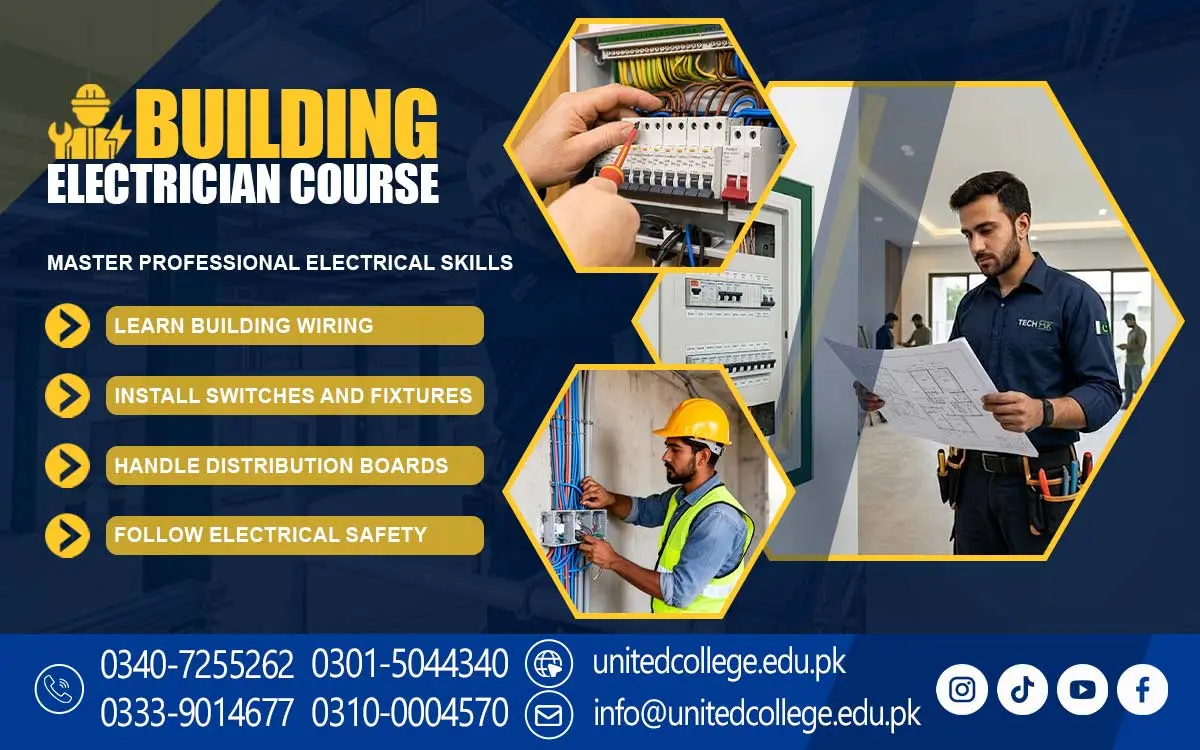

Building Electrician Course in Swabi for Power Systems
Exploring Electricity Distribution Inside Buildings
The Building Electrician Course in Swabi offered by United College of Technology helps students understand how electricity is distributed throughout residential and commercial buildings. Electrical distribution systems deliver power from the main supply to different areas, including rooms, kitchens, offices, and commercial spaces. Students learn about the basic arrangement of electrical circuits, distribution boards, wiring routes, and connected equipment. This knowledge helps beginners understand how different parts of a building receive electricity for daily activities.
During the course, learners explore the functions of main supply connections, distribution panels, circuit breakers, and branch circuits. They study how electrical power is divided among different sections of a building and why circuits must be organized according to their intended use. Students can also learn how wiring layouts help electricians identify the routes and connections required for an installation. These concepts provide a foundation for understanding electrical distribution in modern buildings.
Knowledge of electricity distribution is useful for students who want to enter the construction and electrical services industry. Learners develop an understanding of how a properly planned electrical system supports reliable operation and easier maintenance. They also discover why correct circuit arrangements and suitable protective devices are important. Through theoretical lessons and supervised practical activities, students can gradually prepare for work involving building electrical installations.
Understanding Electrical Loads and Power Requirements
Electrical loads refer to the devices and equipment that consume electrical energy, including lights, fans, refrigerators, computers, and air conditioners. The Building Electrician Course in Swabi introduces students to different types of electrical loads and their power requirements. Learners explore how electrical appliances use electricity and why every installation must be designed to support the expected demand. Understanding these principles helps students recognize the importance of selecting appropriate wiring and protective equipment.
Students learn basic concepts related to voltage, current, power, and energy consumption. They can study appliance ratings and understand how the combined demand of connected equipment affects a building's electrical system. Lessons also explain why circuit capacity must be considered when planning electrical installations. This knowledge helps learners understand the relationship between the equipment being used and the electrical infrastructure required to supply it safely.
Understanding electrical loads can help students prepare for tasks involving installation planning and maintenance. They learn why overloaded circuits can cause overheating, nuisance tripping, and other electrical problems. They also develop awareness of the importance of following approved designs and applicable electrical standards. These concepts provide useful technical knowledge for anyone interested in building electricity and electrical system management.
Studying Main Supply and Distribution Connections
The main electrical supply provides the connection between an external electricity source and a building's electrical installation. Through the Building Electrician Course in Swabi, students learn about the basic components involved in supplying and distributing electricity within a property. These may include the incoming supply, main switch, distribution board, circuit breakers, and outgoing circuits. Understanding their functions helps learners recognize how electrical power reaches different parts of a building.
Students explore how electrical distribution connections are organized and why each component must be selected and installed according to the system's requirements. They learn about the purpose of main switches and protective devices and how these components support the safe management of electrical circuits. Basic wiring diagrams help students understand the relationship between the incoming supply and individual circuits. Practical demonstrations can strengthen their understanding of electrical distribution arrangements.
Learning about main supply systems is important for anyone preparing for building electrical work. Students become familiar with the terminology and components commonly found in residential and commercial installations. They also learn that work on incoming supplies and distribution equipment requires suitable qualifications, safe isolation, and qualified supervision. This knowledge can support their future development in electrical installation and maintenance.
Learning the Purpose of Earthing Systems
Earthing is an essential safety feature in many electrical installations because it helps provide a controlled path for fault current under appropriate fault conditions. The Building Electrician Course in Swabi introduces students to the purpose of earthing systems and their role in protecting people and electrical equipment. Learners study the difference between earthing conductors and normal current-carrying conductors. They also explore why proper earthing is an important part of electrical safety in residential and commercial buildings.
Students learn about basic earthing components, protective conductors, and the relationship between earthing and circuit protection. They discover how an appropriate earthing arrangement can help protective devices operate when an electrical fault occurs. Lessons also explain why earthing connections must be continuous, correctly installed, and inspected according to relevant standards. These concepts help learners understand the importance of safe electrical design rather than relying on incorrect or improvised connections.
Understanding earthing systems can prepare students to recognize safety requirements during building electrical installation. They learn why damaged protective conductors and improper earthing arrangements can create serious hazards. Students also develop awareness of the need for suitable inspection and testing by competent professionals. This knowledge supports a responsible approach to electrical work and provides a foundation for further technical training.
Examining Cable Ratings and Current Capacity
Electrical cables must be selected according to the amount of current they are expected to carry and the conditions in which they will be installed. The Building Electrician Course in Swabi helps students understand cable ratings, conductor sizes, insulation types, and current-carrying capacity. Learners explore why cables used for lighting circuits may differ from those required for equipment with higher power demands. They also study how unsuitable cable selection can increase the risk of overheating and insulation damage.
During training, students become familiar with factors that influence cable selection, including installation methods, ambient temperature, cable grouping, and voltage drop. They learn that a cable's suitability cannot be determined by conductor size alone because several conditions affect its performance. Students can also examine cable markings and technical specifications to understand the information provided by manufacturers. These lessons help build a foundation for making informed decisions during electrical installation planning.
Knowledge of cable ratings is valuable for students interested in residential wiring, commercial buildings, and electrical maintenance. Learners understand why cable selection must follow approved designs and applicable electrical standards. They also discover the importance of coordinating cable capacity with circuit protection and expected electrical loads. This technical understanding can help students develop the knowledge required for supervised installation tasks.
Understanding Energy Consumption in Buildings
Energy consumption refers to the amount of electrical energy used by appliances, lighting systems, and other equipment over time. In the Building Electrician Course in Swabi, students learn how electricity is consumed in homes, offices, shops, and other buildings. They explore the relationship between appliance power ratings, operating hours, and energy usage. This knowledge helps learners understand how electrical systems influence everyday electricity consumption and operating costs.
Students can study electricity meters, energy units, and basic methods of estimating appliance consumption. They learn how efficient lighting, suitable equipment, and responsible electricity use can help reduce unnecessary energy waste. Training also introduces the importance of identifying equipment that consumes excessive power because of poor performance or unsuitable operation. These concepts help students connect electrical knowledge with practical energy management.
Understanding energy consumption can be useful in building maintenance and electrical service work. Students develop awareness of how electrical equipment can be operated more efficiently without compromising safety or performance. They may also learn about the role of energy-efficient appliances and lighting solutions in modern buildings. This knowledge gives learners an additional area of technical understanding that can support future employment opportunities.
Practicing Electrical System Inspection Techniques
Electrical inspection helps identify visible defects and other conditions that may affect the safety and reliability of a building's electrical installation. The Building Electrician Course in Swabi introduces students to the importance of checking wiring systems, electrical accessories, distribution boards, and protective devices. Learners study common warning signs, such as damaged insulation, loose components, burn marks, and unusual heating. Recognizing these signs helps them understand why electrical systems require appropriate inspection and maintenance.
Students learn about the basic principles of systematic inspection and the role of suitable testing equipment. Depending on the training provided, they may be introduced to continuity checks, insulation resistance testing, and the verification of protective devices. They also learn why inspection findings should be reported clearly and why faults must be addressed before an installation is considered safe. Practical testing should be performed by competent individuals using appropriate equipment and safe isolation procedures.
Developing inspection knowledge helps students understand the responsibilities involved in electrical maintenance. They learn that regular checks can identify potential problems before they lead to equipment failure or serious hazards. Students also discover why electrical systems should not be modified without proper technical knowledge. These lessons support a safety-focused approach to building electricity and help prepare learners for further practical training.
Preparing for Work in Building Power Installations
Building power installations involve the planning, installation, and maintenance of electrical systems that supply homes, offices, shops, and other properties. The Building Electrician Course in Swabi helps students develop an understanding of the components and procedures used in these installations. Learners explore wiring arrangements, electrical loads, cable selection, distribution systems, and safety requirements. This knowledge can help beginners understand the responsibilities associated with electrical work in the construction industry.
Students can strengthen their technical foundation by learning how to interpret wiring diagrams, recognize electrical components, and understand installation requirements. They also develop awareness of workplace safety, correct tool handling, and the importance of following instructions from qualified professionals. Practical experience under appropriate supervision can help learners connect classroom concepts with real installation tasks. Continued learning is important because electrical standards and technologies can change over time.
After developing relevant knowledge and experience, students may explore entry-level opportunities with electrical contractors, construction companies, and building maintenance providers. Potential roles can include electrician assistants, installation helpers, and maintenance support workers, depending on individual qualifications and employer requirements. United College of Technology provides a learning pathway for people interested in technical education. For students in Swabi, the Building Electrician Course can be a useful starting point for developing electrical knowledge and preparing for future career opportunities.
Frequently Asked Questions (FAQs)
A building electrician helps install, inspect, and maintain electrical wiring, lighting, sockets, distribution boards, and related equipment according to applicable safety requirements.
Load calculations help determine the expected power demand of connected equipment and support the selection of suitable cables, circuits, and protective devices.
An earthing system provides a protective arrangement that helps manage electrical fault conditions and supports the operation of appropriate safety devices.
Students can learn to examine cable markings, specifications, insulation condition, and current-carrying ratings to understand whether a cable is appropriate for its intended application.
Electrical power describes the rate at which electricity is used, measured in watts or kilowatts. Electrical energy measures consumption over time and is commonly recorded in kilowatt-hours.
Admission Open: Start Your Professional Journey Today!
Join United College of Technology and build a career with practical training, recognized certifications, and Gulf job support. Seats are limited.
Apply Now via WhatsAppContact Information
- Address: Rawalpindi: F-272 Main New Katarian Stop, Old IJP Road | Lahore Campus: Lahore, Pakistan
- Phone/WhatsApp: 0340-7255262 / 0333-9014677 / 0301-5044340 / 0310-0004570 / 051-8770756
- Website: unitedcollege.edu.pk
















Leave a Comment