


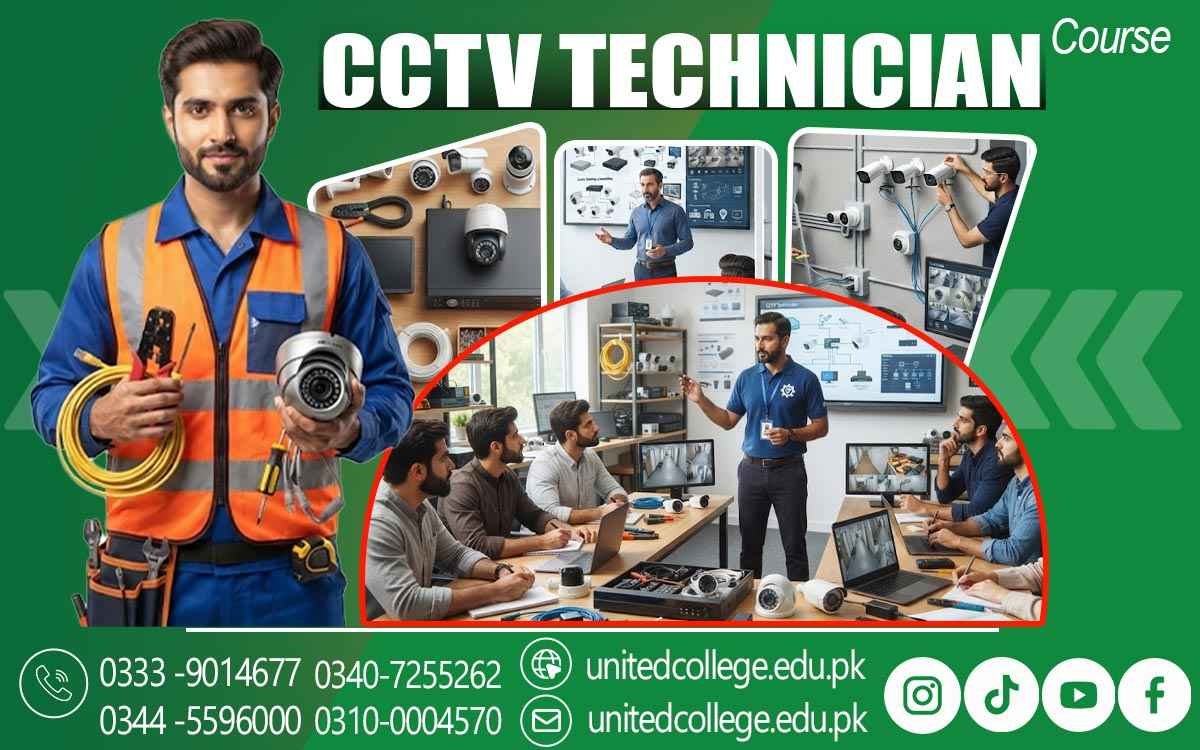

CCTV Technician Course in Toba Tek Singh – Gain CCTV Skills
When a CCTV Camera Becomes a Real Technical Skill
A CCTV camera may be easy to notice, but making an entire surveillance system work properly requires practical technical knowledge. A camera has to be installed at the right height, connected with suitable wiring, supplied with stable power, configured correctly, and tested before it can provide useful video. In Toba Tek Singh, CCTV systems can be useful in homes, shops, offices, schools, warehouses, workshops, factories, and other places where people need to monitor important areas. This growing use of surveillance technology creates opportunities for learners to develop practical skills in CCTV installation and system maintenance. A CCTV Technician Course in Toba Tek Singh can introduce beginners to the equipment, procedures, and technical concepts involved in modern security systems.
Students can learn how cameras communicate with recording devices, how cables and power connections are arranged, and how basic faults are identified when something does not work as expected. United College of Technology offers this type of technical training with a practical learning approach, allowing learners to build familiarity with CCTV equipment while understanding the complete installation process. Instead of only memorizing technical terms, learners can gradually develop the ability to look at a CCTV system as a complete working setup.
Different Cameras Bring Different Installation Requirements
Walk into a modern security installation, and you may see several cameras that look completely different from one another. That difference is not only about appearance; each camera type can be designed for particular surveillance requirements. A CCTV Technician Course in Toba Tek Singh can introduce learners to common options such as dome cameras, bullet cameras, PTZ cameras, analog cameras, and IP cameras. Dome cameras are often selected for compact installations, while bullet cameras can provide a more directional view. PTZ cameras can offer pan, tilt, and zoom functions when supported by the equipment and configuration, making them different from fixed cameras.
Analog cameras generally use traditional cabling and connect with compatible recording equipment, while IP cameras transmit digital video through a network. Learners can study these differences while considering factors such as lighting, installation height, viewing direction, required coverage, and the environment where the camera will be used. This helps beginners understand why camera selection should be based on the actual surveillance requirement rather than simply choosing the newest-looking device. Learning about different camera types also gives students a stronger foundation for security camera installation in residential and commercial environments around Toba Tek Singh.
Camera Positioning and Wiring Can Make or Break the Installation
What good is a camera if it cannot properly see the area it was installed to monitor? This is why camera positioning is one of the most important parts of practical CCTV installation. Learners can study how to select suitable mounting points, consider viewing angles, reduce blind spots, and check whether important areas remain within the camera's field of view. They can also learn how to mount equipment securely and route cables in an organized manner. Depending on the system, a technician may work with coaxial cable for traditional CCTV setups or Ethernet cable for network-based cameras. Power connections, connectors, cable protection, and proper routing also need attention during installation.
Through CCTV camera training, students can practice connecting equipment, checking power, testing video signals, and making adjustments when a camera does not provide the expected coverage. Good cable management is equally important because loose or poorly protected cables can create connection problems later. A CCTV Technician Course in Toba Tek Singh can therefore help learners understand that installation is a combination of planning, positioning, wiring, testing, and safe working practices rather than simply attaching a camera to a wall.
DVR and NVR Systems Keep Recorded Video Organized
Live monitoring is only one part of a CCTV system. In many locations, recorded footage is just as important because users may need to review an event that happened earlier. DVR and NVR systems provide the recording and management functions required in many surveillance installations. A Digital Video Recorder is commonly used with traditional analog cameras, while a Network Video Recorder is generally designed for IP-based cameras. During a CCTV Technician Course in Toba Tek Singh, learners can become familiar with DVR and NVR configuration, camera connections, storage devices, recording schedules, playback, backup, and monitoring.
They can understand how cameras send video to recording equipment and how storage capacity affects the amount of footage that can be retained. Motion detection settings may also be used where supported, allowing recording behavior to be adjusted according to movement. Students can practice checking whether cameras are connected correctly, whether recording is active, and whether stored footage can be played back when required. These skills are useful because a technician may need to diagnose whether a recording problem comes from the camera, connection, recorder settings, storage device, or another part of the system.
IP Cameras Bring CCTV Into the World of Networking
Modern surveillance systems increasingly use network-based cameras, which means CCTV technicians need to understand some basic networking concepts as well. IP cameras communicate through a network, so installation may involve Ethernet cables, LAN connections, IP addresses, switches, routers, and PoE technology. Power over Ethernet, commonly called PoE, can allow compatible cameras to receive power and transmit data through an Ethernet connection, depending on the equipment being used. In the CCTV Course in Toba Tek Singh, learners can be introduced to these concepts in simple language and gradually understand how network cameras communicate with NVRs and other devices.
An IP address can be explained as an identifier that allows a device to be recognized on a network, while a switch can connect multiple network devices. Students can also learn why an incorrect IP configuration or a disconnected network cable may cause a camera to appear offline. Understanding CCTV networking gives learners a wider technical foundation because modern security systems may combine cameras, recorders, computers, mobile devices, and network equipment. This makes basic networking knowledge an important part of learning how to install and support contemporary video surveillance systems.
Remote CCTV Viewing Depends on Proper System Configuration
Imagine a shop owner who is away from the premises and wants to check the cameras from a mobile phone. Modern CCTV systems can support remote CCTV viewing when the cameras or recording equipment are properly connected and configured. However, remote access involves more than simply connecting a camera to the internet. The recorder or IP camera, local network, router, application, user access, and relevant configuration all need to work together. During a CCTV Technician Course in Toba Tek Singh, learners can explore the basic concepts behind remote CCTV viewing and understand how surveillance systems may be accessed through suitable computers or mobile devices.
They can also learn why network settings need to be checked when remote monitoring stops working. For example, a technician may need to inspect the network connection, confirm that the device is online, review configuration settings, or check whether the appropriate application can communicate with the system. Security is also important, so access should be properly controlled and limited to authorized users. Learning these concepts helps beginners understand how CCTV monitoring has developed from a simple camera-and-monitor setup into a connected security technology system.
Troubleshooting Starts With Finding the Real Cause
A CCTV system can stop working for many different reasons, and replacing equipment without checking the actual fault can waste time and money. A blank screen might be caused by a power problem, damaged cable, loose connector, incorrect configuration, camera fault, or recorder issue. Poor image quality can have different causes as well, while an IP camera going offline may point toward a network or configuration problem. Through practical CCTV training, learners can study common faults such as no video, poor image quality, connection failures, power issues, recording problems, storage errors, and network communication faults.
They can learn a step-by-step approach to fault diagnosis by checking power first, inspecting cables and connectors, confirming camera connections, reviewing recorder settings, and testing network communication where required. CCTV maintenance can also include cleaning lenses, inspecting connections, checking storage health, testing recording functions, and reviewing equipment performance. These procedures help learners develop a logical troubleshooting mindset instead of relying on guesswork. A CCTV Technician Course in Toba Tek Singh can therefore provide useful exposure to the type of technical thinking needed when maintaining and servicing surveillance systems.
The Right Tools Make Practical CCTV Work Easier to Understand
Technical skills become much more useful when learners become comfortable handling the equipment and tools involved in actual installation work. CCTV technicians may use screwdrivers, drills, cable cutters, crimping tools, connectors, testing devices, network cables, mounting accessories, and other tools depending on the installation. During hands-on CCTV training, students can learn how these tools support tasks such as mounting cameras, preparing cables, making connections, testing power, checking signals, and organizing installations. Workplace safety should also remain part of the learning process. Drilling walls, working at height, handling electrical connections, routing cables, and working around existing wiring all require care and appropriate precautions.
Practical learning can help beginners understand why a technician should inspect the installation area before beginning work and why cables should be secured instead of left loose. Students can also become more comfortable identifying equipment and following installation procedures in the correct order. This practical exposure is valuable because reading about CCTV tools is different from actually using them. A structured CCTV Technician Course in Toba Tek Singh can help learners connect technical explanations with hands-on tasks and become more familiar with the working environment of a security system technician.
Building CCTV Skills for Real Security Environments in Toba Tek Singh
Learning CCTV technology is not limited to understanding cameras; it involves bringing installation, configuration, networking, recording, maintenance, and troubleshooting skills together. A CCTV Technician Course in Toba Tek Singh can help learners develop this broader understanding through practical exposure to CCTV equipment and realistic installation procedures. United College of Technology can provide a structured learning environment where students become familiar with camera installation, wiring, DVR and NVR systems, IP camera configuration, networking, monitoring, and fault-finding.
Learners may use this foundation for further technical learning or explore entry-level work related to CCTV installation, maintenance, and security-system support. Employment opportunities can vary depending on practical ability, experience, technical knowledge, and local demand, so training should be considered a way to build useful technical skills rather than a guarantee of a particular job or income. With regular practice and continued learning, beginners can become more comfortable working with changing CCTV equipment and develop a stronger understanding of modern surveillance and electronic security systems.
Frequently Asked Questions (FAQs)
A CCTV Technician Course in Toba Tek Singh teaches practical skills related to camera installation, wiring, recording systems, networking, monitoring, and basic troubleshooting.
Students, beginners, fresh learners, and anyone interested in learning practical CCTV installation and security system skills can consider this training.
Students can learn about CCTV cameras, camera positioning, cabling, DVR and NVR systems, IP cameras, networking, remote viewing, maintenance, and troubleshooting.
DVR is commonly used with traditional analog CCTV cameras, while NVR is generally designed for IP-based network cameras and digital video recording.
Yes. Beginner-friendly CCTV training can introduce learners to the equipment, tools, installation procedures, wiring methods, and basic troubleshooting step by step.
Admission Open: Start Your Professional Journey Today!
Join United College of Technology and build a career with practical training, recognized certifications, and Gulf job support. Seats are limited.
Apply Now via WhatsAppContact Information
- Address: Rawalpindi: F-272 Main New Katarian Stop, Old IJP Road | Lahore Campus: Lahore, Pakistan
- Phone/WhatsApp: 0333-9014677 / 0344-5596000 / 0310-0004570 / 0301-5044340 / 0340-7255262
- Website: unitedcollege.edu.pk
















Leave a Comment