


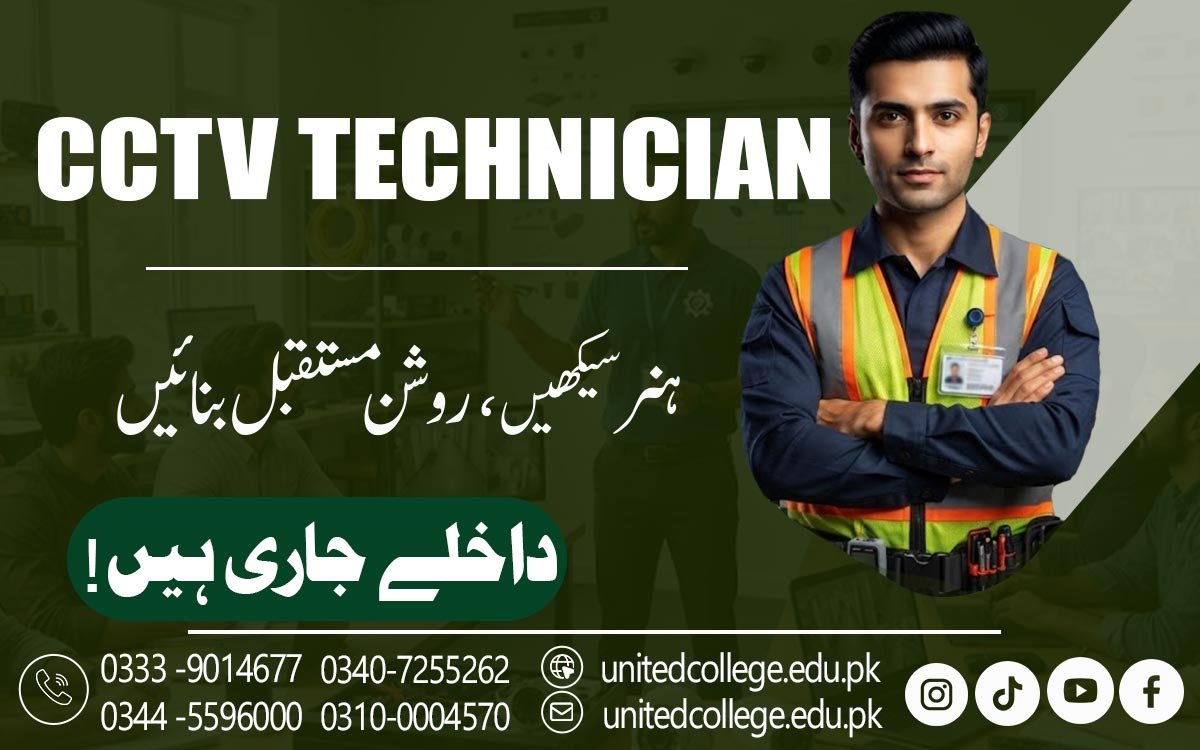

CCTV Technician Course in Vehari – Learn Advanced CCTV Techniques
When a CCTV System Has to Work When Nobody Is Watching
A security camera is easy to notice, but the technical work behind a reliable surveillance system often goes unnoticed. Think about a shopkeeper who wants to check the entrance and counter, a family that wants to monitor the outside of a house, or a warehouse manager who needs to keep an eye on storage areas. In all these situations, installing a camera is only the beginning. The camera needs the right position, suitable wiring, a stable power connection, proper recording equipment, and correct configuration. If any of these parts are handled poorly, the final video may be unclear, recording may fail, or important areas may remain outside the camera's view.
This is why learning CCTV installation requires more than knowing how to mount a camera on a wall. A CCTV Technician Course in Vehari can help beginners understand the practical side of security camera systems, from selecting and positioning cameras to connecting cables, configuring DVR or NVR equipment, testing video feeds, and identifying common faults. For students, fresh learners, job seekers, and anyone interested in security technology, this type of practical training can provide a useful foundation for understanding how modern surveillance systems operate.
Understanding What a CCTV Technician Actually Does
What happens after a customer decides to install CCTV cameras? A technician has to turn that basic requirement into a working surveillance system. This can involve understanding the area that needs monitoring, identifying suitable equipment, planning camera positions, preparing cables, connecting power, setting up recording devices, testing the cameras, and explaining basic system operation to the user. During a CCTV Technician Course in Vehari, learners can explore these responsibilities in a simple and practical way. They can become familiar with the different components that form a CCTV system and learn how each part contributes to the complete setup.
A technician may work with cameras, DVRs, NVRs, monitors, cables, connectors, power supplies, storage devices, switches, and networking equipment depending on the installation. Practical CCTV training can also introduce learners to safe working methods and organized installation procedures. This is important because technical work is not only about making connections; it is also about checking those connections, testing the system, identifying mistakes, and making sure the equipment operates as intended. Understanding this complete process helps beginners see CCTV work as a practical technical field rather than simply a task of installing cameras.
Different CCTV Cameras Bring Different Installation Requirements
One camera may be suitable for a small indoor room, while another may be better suited to an outdoor entrance or a larger area. Learning how to recognize these differences is an important part of CCTV technician skills. Beginners can become familiar with analog cameras, IP cameras, network cameras, dome cameras, bullet cameras, and other commonly used surveillance equipment. Analog cameras generally transmit video through traditional cabling to a compatible recording device, while IP cameras send digital video through a network. The choice between different camera types can depend on factors such as location, lighting, viewing distance, required coverage, mounting position, and the type of recording system being used.
A CCTV Technician Course in Vehari can help learners understand these factors without making the subject unnecessarily complicated. They can learn why a camera's viewing angle matters, how installation height can affect the image, and why lighting conditions should be considered before fixing equipment. This knowledge can be useful for installations in homes, shops, offices, schools, warehouses, workshops, and commercial buildings. Instead of choosing equipment simply because it looks advanced, learners can develop the habit of thinking about the actual surveillance requirement first and then matching the camera and installation method to that requirement.
Camera Positioning and CCTV Wiring Need Careful Planning
A camera pointed in the wrong direction can leave a critical area hidden, even if the rest of the installation is technically correct. That is why camera positioning is one of the most important practical areas in CCTV installation training. Learners can study how technicians consider entrances, doors, pathways, counters, storage areas, windows, lighting sources, and possible blind spots before mounting cameras. Once the position is planned, attention turns to wiring and connections. Depending on the system, CCTV wiring may involve coaxial cables, Ethernet cables, power cables, connectors, and other components. Beginners can learn how cables are routed, how connectors are attached, how power connections are checked, and why cable management matters.
Poorly arranged or damaged cables can create problems that may appear to be camera faults when the actual issue is the connection. During a CCTV Technician Course in Vehari, practical exercises can help learners become comfortable with mounting procedures, cable connections, power supply checks, camera testing, and basic configuration. They can also learn the importance of keeping wiring organized and carrying out suitable safety checks during installation. These small details can make a significant difference when setting up a surveillance system for a residential or commercial property.
DVR and NVR Systems Keep Surveillance Footage Organized
A CCTV system is not only about viewing live images. In many installations, users also need to record footage, store it, review previous events, and manage several cameras from one place. DVR and NVR systems are important for these tasks. A Digital Video Recorder, or DVR, is commonly used with traditional analog CCTV cameras, while a Network Video Recorder, or NVR, is generally designed for IP-based surveillance systems. Through a CCTV Technician Course in Vehari, learners can understand how these recording devices work with connected cameras and what settings technicians may need to configure.
Training can cover camera channels, recording schedules, storage requirements, playback, date and time settings, and basic system configuration. Learners can also understand why available storage matters when multiple cameras are recording continuously or according to a selected schedule. A camera may display a live picture but still fail to save footage because of incorrect settings, storage problems, connection issues, or other configuration faults. By practicing with DVR and NVR equipment, beginners can better understand the path from camera capture to recorded video and develop the ability to perform basic checks when recording does not work as expected.
IP Cameras Bring Networking Into Modern Surveillance Work
Modern CCTV installations increasingly involve network technology, particularly when IP cameras are used. This means a technician can benefit from understanding basic networking concepts without needing advanced networking knowledge. An IP-based CCTV system may include cameras, Ethernet cables, switches, routers, an NVR, computers, and mobile devices. These components need to communicate correctly for the system to function properly. In practical CCTV training, learners can be introduced to simple ideas such as IP addresses, network connections, routers, switches, and device configuration. They can learn how network cameras connect to a surveillance system and why an incorrect network setting can prevent a camera from communicating with the recorder.
Some compatible installations may also use Power over Ethernet, or PoE, which can allow data and power to travel through a suitable network cable. A CCTV Technician Course in Vehari can introduce these concepts step by step so beginners do not feel overwhelmed by networking terminology. Understanding basic networking can make it easier to install IP cameras, connect network equipment, test communication, and identify whether a fault is related to the camera, cable, network, or configuration.
Remote Viewing Makes Correct Configuration Even More Important
Imagine checking a shop's camera from a mobile phone while being away from the premises. This kind of remote CCTV monitoring has become a useful feature of many modern surveillance systems, but it depends on several components working together correctly. The camera or recorder needs suitable network connectivity, the relevant settings must be configured, and the viewing application or device must communicate properly with the system. During a CCTV Technician Course in Vehari, learners can understand the basic principles behind remote viewing and mobile monitoring. They can learn why simply connecting a recorder to the internet does not automatically guarantee remote access.
A technician may need to check the network connection, device configuration, user access, application settings, and communication between the surveillance equipment and the network. Practical training can help beginners understand these relationships and carry out basic checks when remote viewing is unavailable. This knowledge is becoming increasingly relevant as CCTV systems move beyond traditional monitors and become connected security solutions. It also gives learners a better understanding of how networking, recording, and monitoring work together in a modern video surveillance environment.
CCTV Troubleshooting Teaches You to Find Problems Step by Step
Even a properly installed CCTV system can develop faults. A camera may suddenly show no video, the picture may become unclear, a recording device may stop saving footage, or an IP camera may disappear from the network. When this happens, replacing equipment immediately is not always the right approach. A technician needs to investigate the system logically and identify where the problem is actually coming from. CCTV troubleshooting training can introduce beginners to common issues involving power supplies, cables, connectors, cameras, recording devices, storage, network connections, and configuration settings. For example, a blank screen may be related to a power problem or cable fault rather than a damaged camera.
Similarly, missing recordings may be caused by storage or recording settings. CCTV maintenance also involves regularly checking equipment, inspecting connections, keeping camera lenses reasonably clean, reviewing system performance, and noticing signs of physical damage. Through a CCTV Technician Course in Vehari, learners can practice a step-by-step approach to fault finding instead of guessing. They can learn to check the simplest possible causes first and then move toward more detailed checks. This method can help build confidence and make CCTV repair and maintenance tasks easier to understand.
Hands-On Practice Builds Skills for Real CCTV Installation Work
CCTV equipment becomes much easier to understand when learners can work with it directly. Reading about cameras, cables, DVRs, NVRs, and network equipment can provide useful information, but connecting those components and testing a working system gives beginners a clearer picture of how everything fits together. At United College of Technology, the CCTV Technician Course can provide practical learning that helps students become familiar with CCTV installation tools, surveillance equipment, camera mounting, cable connections, power checks, camera testing, recording devices, basic networking, configuration, and troubleshooting procedures. This hands-on approach allows learners to connect classroom knowledge with real CCTV equipment and better understand how different parts of a surveillance system work together.
A learner can gradually understand how to inspect a camera before installation, plan its position, make the required connections, test the video feed, configure recording equipment, and investigate problems when something does not work properly. These skills can be relevant in different environments across Vehari, including homes, retail shops, offices, educational institutions, warehouses, workshops, and other commercial properties. Continuous practice is important because CCTV technology continues to change, and technicians need to remain willing to learn new equipment and installation methods. For someone starting from the beginning, developing careful installation habits and practical troubleshooting skills can create a strong foundation for further learning in the field of security systems.
Frequently Asked Questions (FAQs)
A CCTV Technician Course in Vehari teaches students how to install, configure, maintain, and troubleshoot CCTV security systems.
Students, beginners, fresh learners, and anyone interested in learning practical CCTV installation and security system skills can join the training.
Students can learn camera installation, wiring, DVR and NVR setup, IP cameras, networking, remote monitoring, troubleshooting, and basic maintenance.
Yes. Training can introduce learners to common camera types such as dome, bullet, PTZ, analog, and IP cameras and their installation requirements.
Yes. Beginner-friendly practical training can help learners understand CCTV equipment and develop installation and troubleshooting skills step by step.
Admission Open: Start Your Professional Journey Today!
Join United College of Technology and build a career with practical training, recognized certifications, and Gulf job support. Seats are limited.
Apply Now via WhatsAppContact Information
- Address: Rawalpindi: F-272 Main New Katarian Stop, Old IJP Road | Lahore Campus: Lahore, Pakistan
- Phone/WhatsApp: 0333-9014677 / 0344-5596000 / 0310-0004570 / 0301-5044340 / 0340-7255262
- Website: unitedcollege.edu.pk
















Leave a Comment