


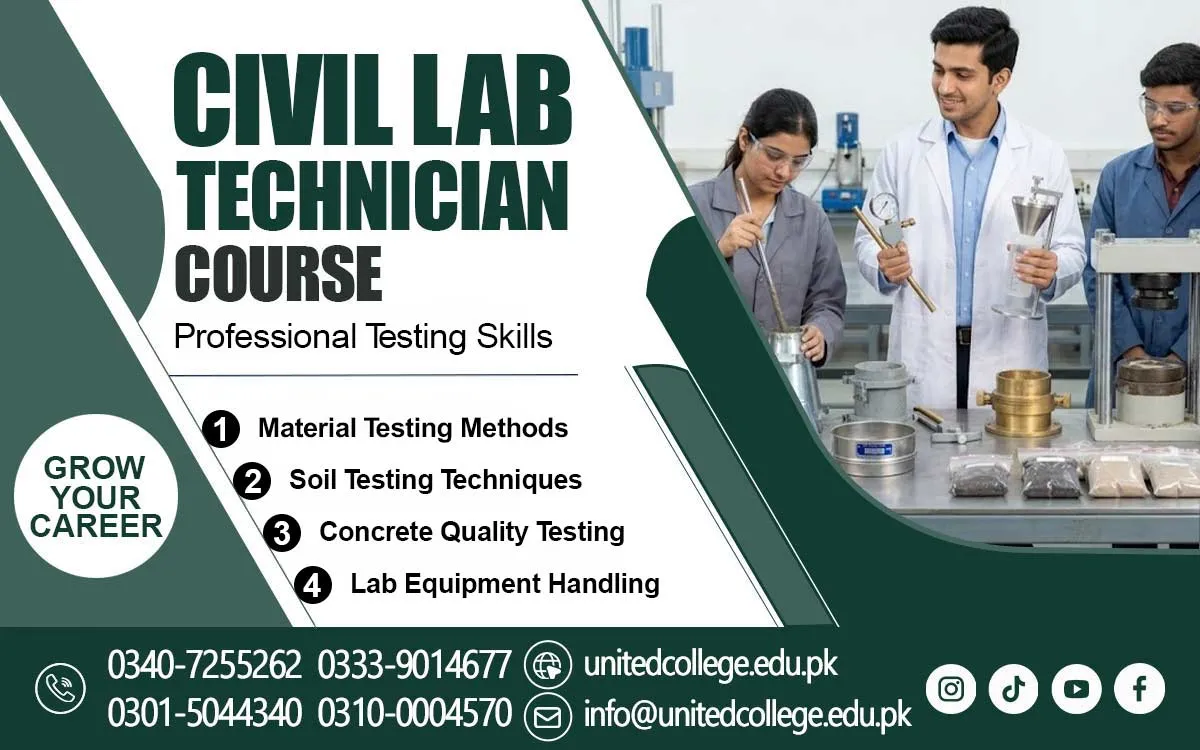

Civil Lab Technician Course in Balakot – Learn Civil Testing Skills
The Role of Civil Lab Technicians in Modern Construction
Civil lab technicians perform important tasks in construction projects by checking the quality and properties of building materials. Their work helps construction teams understand whether materials meet the required project specifications. For example, before concrete is used in a building foundation, a technician may prepare samples and perform different tests to check its properties. Similarly, soil samples can be examined to understand their condition and suitability for construction. A civil lab technician usually works under the guidance of experienced laboratory staff, engineers, or quality control professionals. Responsibilities may include collecting material samples, preparing them for testing, operating laboratory equipment, recording measurements, and maintaining test reports.
Accuracy is especially important because engineers use laboratory results when making technical decisions. The Civil Lab Technician Course in Balakot introduces students to these responsibilities and helps them understand the importance of careful laboratory work. Students also learn that a technician must follow testing procedures instead of guessing results. Even a small mistake in measuring, weighing, or preparing a sample can affect the final reading. By developing attention to detail, basic mathematical skills, and an understanding of construction materials, learners can prepare themselves for the responsibilities commonly associated with civil laboratory work.
Construction Material Testing and Quality Control Standards
Construction material testing helps identify the quality and physical properties of materials before and during construction activities. Every project requires suitable materials because soil, cement, sand, gravel, steel, and concrete perform different functions in a structure. If the materials do not meet the required specifications, the project may face technical and safety problems. Quality control involves checking these materials through suitable testing methods and comparing the results with project requirements. For instance, concrete testing helps determine whether a prepared mixture has the required workability and strength characteristics. Soil testing provides information about moisture, density, and other properties that may affect foundation work.
Through the Civil Laboratory Course, students can understand the importance of these procedures and their connection with construction quality assurance. They also become familiar with the idea that every test follows a particular method and requires accurate measurements. A technician must record the actual results clearly and report any unusual findings to the responsible engineer. These activities help construction teams identify possible material problems early and take suitable action. Learning construction material testing gives students a better understanding of the standards and procedures followed in building, road, and infrastructure projects.
Essential Laboratory Tests for Building and Construction Materials
A civil laboratory uses different tests to examine the properties of construction materials. One common procedure is the concrete slump test, which checks the workability of fresh concrete. It helps indicate whether the mixture is too stiff or too fluid for the intended work. The concrete compressive strength test measures how much compressive load a hardened concrete sample can withstand under specified testing conditions. Soil testing is another important area because the condition of the ground can influence foundation design and construction planning. A sieve analysis test checks the particle-size distribution of soil or aggregates by passing a sample through sieves with different openings.
Aggregate testing examines properties such as grading, specific gravity, water absorption, and other characteristics depending on project requirements. Cement testing may include checking fineness, consistency, setting time, and strength. Moisture content testing helps determine the amount of water present in a soil or material sample. During the Civil Lab Technician Course in Balakot, students can develop an understanding of these testing methods and their practical applications. They learn that each test has a different purpose and requires suitable equipment, sample preparation, and accurate recording. These skills are useful for understanding the quality of materials used in residential buildings, commercial structures, roads, and other civil engineering projects.
Practical Civil Engineering Skills Through Laboratory Training
Learning civil laboratory work requires more than reading technical information because technicians need to understand how testing procedures are performed. Practical training helps students become familiar with material samples, measuring tools, laboratory instruments, and testing steps. For example, a learner may study the process of preparing a concrete sample before understanding the compressive strength testing procedure. Similarly, soil samples can be examined to learn about moisture content, particle size, and density. Students also develop basic skills in weighing materials, taking measurements, following instructions, and recording observations. These activities help build confidence when working with laboratory equipment.
The Civil Lab Technician Training offered by United College of Technology introduces learners to the technical knowledge associated with construction material testing. Students can also improve their understanding of laboratory calculations, sample identification, and test documentation. Another important skill is attention to detail. A technician must check measurements carefully and avoid changing or guessing test results. Communication is also useful because laboratory findings need to be shared with engineers and other construction professionals. By learning these practical civil engineering skills, beginners can develop a clearer understanding of laboratory responsibilities. Regular practice, guidance, and a willingness to learn are important for improving performance in a civil engineering laboratory environment.
Common Laboratory Equipment Used in Material Testing
Civil laboratories use different tools and machines to perform construction material testing. Each instrument has a particular purpose, and technicians must understand its correct use before starting a test. A weighing balance is used to measure the weight of soil, cement, sand, and aggregate samples. Sieve sets help separate particles according to their sizes during sieve analysis. A concrete slump cone is used to check the workability of fresh concrete, while a compression testing machine measures the compressive strength of concrete specimens under controlled conditions. Moisture content testing may involve an oven and weighing balance to determine the water present in a sample.
Other equipment can include measuring cylinders, trays, sample containers, tamping rods, and laboratory mixing tools. Some laboratories also use equipment for testing aggregate properties, cement characteristics, and soil compaction. Through the Civil Lab Technician Course in Balakot, students can learn about the purpose of common laboratory testing equipment and the importance of following proper operating procedures. Equipment should always be inspected before use, and measurements should be taken according to the relevant testing method. Proper cleaning and storage are also important because damaged or poorly maintained instruments can affect test accuracy.
Sample Preparation and Laboratory Safety Procedures
Accurate testing begins with proper sample preparation. Even a suitable testing machine cannot provide useful results if the material sample has been collected or prepared incorrectly. Concrete specimens need to be prepared, labelled, and cured according to the relevant procedure before strength testing. Aggregate samples may require cleaning, drying, weighing, and separation through different sieve sizes. Students learning civil lab technician skills should understand that every material has its own preparation requirements. Laboratory safety is equally important because technicians may work with heavy equipment, electrical machines, hot ovens, cement dust, and other materials that require careful handling.
Wearing suitable personal protective equipment, such as gloves, safety shoes, and protective eyewear, can help reduce workplace risks. Students should also keep working areas clean, avoid touching moving machine parts, and follow instructions when operating equipment. The Civil Lab Technician Course in Balakot introduces the importance of organised laboratory practices and responsible handling of materials. Clear labelling, proper record-keeping, and correct disposal of waste materials also support a safe working environment. Developing these habits during training helps learners understand the discipline required in professional civil engineering laboratories and construction testing facilities.
Supporting Engineers Through Accurate Testing Reports
Civil lab technicians support engineers, contractors, site supervisors, and quality control teams by providing material testing information. Their work helps professionals understand the condition and characteristics of materials used in construction. For example, an engineer working on a building foundation may need soil testing information before finalising technical decisions. Similarly, a contractor may require concrete test results to check whether the supplied mixture meets the project's specifications. A technician collects and prepares samples, performs the required tests, and records the readings in an organised format. These records may include sample details, testing dates, equipment information, measurements, and final observations.
A clear laboratory report allows the responsible engineer to review the findings and decide whether further testing or corrective action is necessary. During civil lab technician training, students can learn the importance of accurate documentation and professional communication. They should understand that technicians are responsible for reporting actual results rather than making independent structural decisions. If a result appears unusual, it should be brought to the attention of the supervisor or engineer. The Civil Lab Technician Course in Balakot helps learners understand this connection between laboratory testing and site activities. Accurate testing reports contribute to better coordination, quality monitoring, and informed decision-making throughout construction projects.
Career Opportunities in Construction and Testing Laboratories
Civil laboratory skills can be useful in different areas of the construction industry. People with relevant training and practical experience may explore entry-level opportunities in construction companies, material testing laboratories, building projects, road construction, and infrastructure development. Some technicians work in laboratories where soil, concrete, cement, and aggregate samples are examined. Others may assist quality control teams with sample collection, basic testing, measurements, and documentation at construction sites. Road development projects may require material testing to check soil, sub-base, base materials, and asphalt-related properties.
The Civil Lab Technician Course in Balakot can help beginners understand the technical responsibilities connected with these work environments. However, employment depends on several factors, including practical ability, education, experience, employer requirements, and knowledge of relevant testing procedures. Some positions may require additional qualifications or experience before a person can work independently. Students should focus on improving their technical understanding, laboratory discipline, communication, and reporting skills. With continued learning and workplace experience, they may explore further opportunities in civil engineering support and construction quality control.
Building Technical Knowledge Through Civil Lab Training in Balakot
Balakot and nearby areas have construction needs connected with residential buildings, commercial spaces, roads, and infrastructure development. These projects require proper planning and attention to the quality of construction materials. People interested in technical education can benefit from learning skills related to soil examination, concrete testing, aggregate grading, and laboratory procedures. The Civil Lab Technician Course in Balakot offered by United College of Technology provides an opportunity for beginners and students to explore this specialised area of civil engineering. It can be suitable for individuals who have an interest in construction work, laboratory activities, material testing, or quality control.
Students with a basic educational background can start by developing an understanding of measurements, construction materials, and common testing methods. Before joining, interested learners should understand the course outline, practical training arrangements, and entry requirements. Building strong technical skills takes time, regular practice, and attention to correct procedures. Learning under proper guidance can help students become more familiar with the responsibilities of a civil lab technician. With a clear understanding of construction material testing and a commitment to improving their abilities, learners can take a practical step towards exploring the civil engineering and construction industry.
Frequently Asked Questions (FAQs)
A Civil Lab Technician Course teaches students how to test construction materials such as soil, cement, concrete, and aggregates using different laboratory methods.
The course covers concrete testing, soil testing, sieve analysis, cement testing, aggregate testing, laboratory equipment, and construction quality control.
Students, beginners, fresh learners, and individuals interested in civil engineering and construction material testing can consider joining this course.
A civil lab technician collects material samples, performs laboratory tests, records measurements, prepares test reports, and assists engineers with material quality checks.
Yes, practical training helps students understand laboratory equipment, testing procedures, sample preparation, measurements, and safety practices.
Admission Open: Start Your Professional Journey Today!
Join United College of Technology and build a career with practical training, recognized certifications, and Gulf job support. Seats are limited.
Apply Now via WhatsAppContact Information
- Address: Rawalpindi: F-272 Main New Katarian Stop, Old IJP Road | Lahore Campus: Lahore, Pakistan
- Phone/WhatsApp: 0340-7255262 / 0333-9014677 / 0301-5044340 / 0310-0004570 / 051-8770756
- Website: unitedcollege.edu.pk
















Leave a Comment