


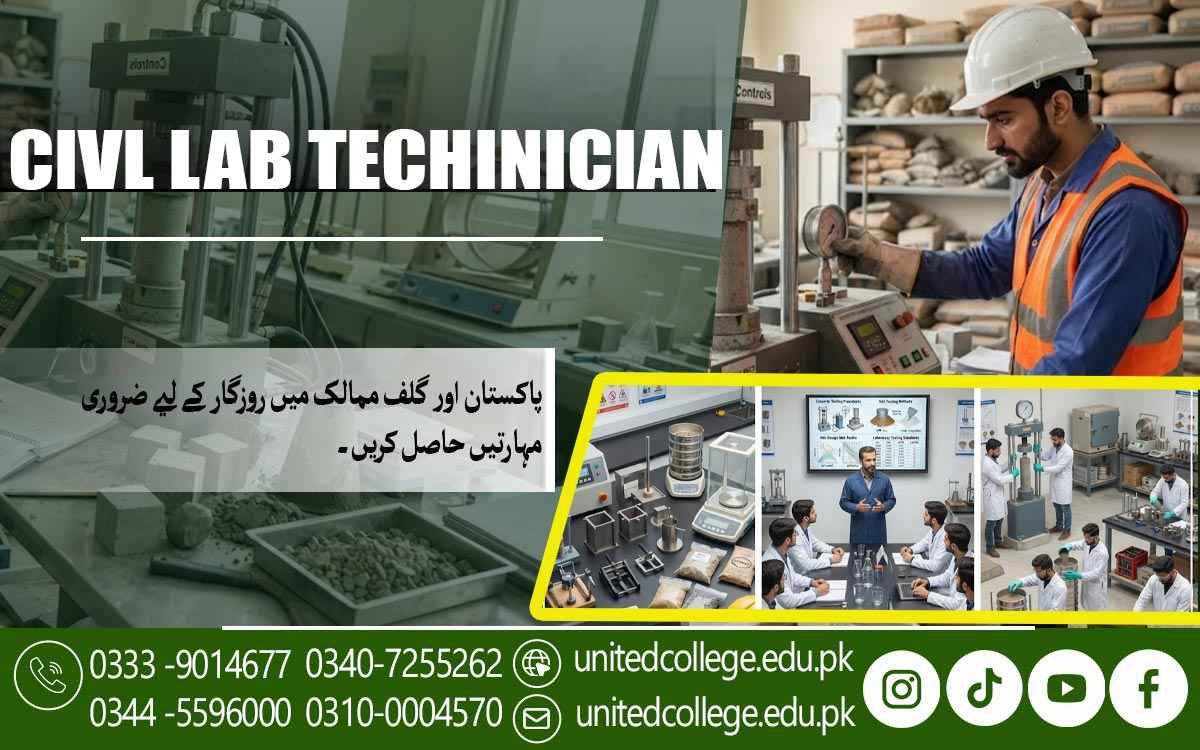

Civil Lab Technician Course in Khanewal – Learn Practical Skills
When Construction Materials Need More Than a Visual Check
Walk around a construction project in Khanewal, and you may see bricks being arranged, concrete being mixed, soil being compacted, and materials being moved from one place to another. Everything may appear normal from the outside, but how can anyone know whether those materials are actually suitable for the work? A material can look fine and still require proper testing before it is used in an important construction activity. This is where civil laboratory work becomes valuable. A Civil Lab Technician Course in Khanewal can help beginners understand how construction materials are examined through proper testing, measurement, sampling, and documentation.
Civil lab technicians support construction quality by carrying out or assisting with tests on materials such as soil, cement, concrete, aggregates, bricks, and other building materials. During practical civil training, learners can gradually understand how laboratory results are produced and why accurate testing matters for roads, buildings, foundations, and infrastructure projects. At United College of Technology, students can explore these areas through structured learning and practical activities, making the subject easier to understand for people who may have little previous laboratory experience.
Understanding the Work Behind a Civil Engineering Laboratory
What actually happens inside a civil engineering laboratory? The work involves much more than placing a sample on a testing machine and writing down a number. A civil lab technician may receive samples from a construction site, identify and prepare them, follow a particular testing procedure, operate suitable equipment, take measurements, record observations, and help prepare test reports. Each step needs attention because an error in sample preparation or measurement can affect the reliability of the final result. Through civil laboratory training, beginners can learn how laboratory work supports engineers, supervisors, contractors, and quality control teams. They can also develop an understanding of how different materials require different testing approaches.
For example, soil testing is handled differently from concrete strength testing, while cement and aggregate testing involve their own procedures and equipment. A Civil Lab Technician Course in Khanewal can introduce learners to these differences practically and understandably. Instead of treating laboratory testing as a collection of complicated technical terms, students can learn by connecting each test with an actual construction purpose. This approach can help beginners understand the role of a civil lab technician and develop greater confidence in technical laboratory environments.
Soil Testing Begins With Knowing the Ground
Before a building rises above the ground, there is an important question that needs attention: what is the condition of the soil underneath it? Soil can vary considerably in its properties, and construction work may require information about characteristics such as moisture content, density, and compaction. Soil testing helps provide measurable information that can be considered during construction planning and quality control. In a Civil Lab Technician Course in Khanewal, learners can be introduced to soil sampling, sample preparation, laboratory testing, and the recording of test results. They can learn why representative samples are important and how careless collection or handling may affect the usefulness of an analysis.
Soil compaction testing is another practical area where students can understand the relationship between fieldwork and laboratory procedures. A technician may need to work with samples connected to roads, foundations, building sites, or other construction activities. By learning both field testing and laboratory testing methods, beginners can see how information gathered from the ground becomes organized technical data. This can make soil analysis easier to understand while showing students why proper procedures, measurements, and documentation are important in civil construction work.
Concrete and Cement Testing Reveal What the Mixture Can Handle
Concrete may look like one simple construction material, but its performance depends on several factors, including its ingredients, proportions, preparation, curing, and testing. This makes concrete testing an important part of civil laboratory work. Learners can be introduced to the preparation and testing of concrete samples and can understand how measurements are taken according to established procedures. Concrete strength testing can help students see how the strength of a specimen is measured under controlled conditions rather than judged simply by appearance. Cement testing provides another useful area of learning because cement properties can influence the behavior of concrete and other construction applications.
During practical training, students can learn about sample handling, testing equipment, observations, and recording results in an organized manner. A Civil Lab Technician Course in Khanewal can help beginners connect these laboratory activities with actual construction quality control. When students understand why concrete samples are prepared, cured, tested, and documented, the laboratory process becomes more meaningful. This practical perspective can also help learners appreciate why testing should be performed carefully and why a test result should always be connected to the correct sample and testing procedure.
Aggregates, Bricks, and Building Materials Tell Their Own Story
Concrete and cement are not the only materials that require attention. Aggregates, bricks, and other construction materials also play important roles in buildings, roads, and infrastructure projects. Aggregate testing allows learners to explore how the properties of stones and other granular materials can be examined using suitable testing methods. Brick testing can introduce students to the idea that building units should also be checked according to relevant requirements rather than accepted only because they look strong or uniform. During civil lab technician training, learners can become familiar with the importance of material inspection, sample preparation, measurements, and controlled testing.
They can also understand that different materials have different characteristics and therefore cannot all be tested in the same way. This variety can make laboratory work especially interesting for beginners because each material presents a different practical question. In Khanewal, learners interested in civil construction training can use this knowledge to build a broader understanding of construction material testing. Instead of focusing on one material alone, students can gradually see how soil, cement, concrete, aggregates, bricks, and other materials fit into the larger quality control process used across construction projects.
Learning to Handle Civil Lab Equipment With Care and Accuracy
Have you ever wondered how a laboratory turns a physical material into a useful measurement? The answer involves appropriate equipment, correct procedures, careful preparation, and accurate observation. Civil lab equipment is designed for different testing purposes, so a technician needs to understand what a particular instrument is used for and how it should be handled. During a Civil Lab Technician Course in Khanewal, students can become familiar with the role of testing equipment used for soil, concrete, cement, aggregates, and other construction materials. Practical exercises can help them understand the importance of setting up a test correctly, placing samples properly, taking readings, and recording measurements without unnecessary mistakes.
Learners can also develop the habit of checking equipment and following instructions before beginning a test. This is important because technical equipment does not automatically produce a meaningful result; the sample, procedure, instrument, and measurement all need to work together correctly. Through hands-on civil lab training, beginners can gradually become more comfortable with laboratory instruments while developing useful laboratory technician skills. This practical experience can make technical concepts easier to remember because learners can see how equipment is connected with the testing process rather than studying the names of instruments without understanding their purpose.
Good Testing Starts Before the Sample Reaches the Laboratory
A reliable test does not begin when the machine is switched on. It often begins with collecting the correct sample. If a sample does not properly represent the material being examined, even a carefully performed laboratory test may not provide useful information. This is why sample collection and preparation are important parts of civil laboratory work. Learners can study how samples are identified, handled, prepared, and kept organized before testing. They can also learn the value of accurate measurements, clear labeling, observation records, and properly prepared test reports. In construction quality control, these details can help ensure that laboratory information remains connected to the correct material and project activity.
A Civil Lab Technician Course in Khanewal can help beginners develop a systematic approach to these tasks instead of treating documentation as an unimportant administrative step. Students can learn that recording a result means more than writing down a number; it may also involve noting the sample, testing conditions, procedure, observations, and other relevant information. These habits can become useful civil lab technician skills for anyone interested in laboratory testing, construction site testing, or material inspection.
Safety and Standards Keep Laboratory Work Under Control
Technical knowledge is important, but safe working habits are equally necessary in a civil material testing laboratory. Learners may work with heavy samples, testing machines, cement, aggregates, soil, concrete specimens, and other materials, so they need to understand laboratory safety before becoming comfortable with practical tasks. Training can introduce students to responsible equipment handling, suitable protective practices, organized work areas, and careful movement around testing instruments. At the same time, learners can develop an understanding of construction material standards and why testing procedures need to follow defined methods rather than personal assumptions.
Standards provide a reference for determining how a material or test should be assessed, while consistent procedures help make results more meaningful and comparable. Through practical civil training, beginners can learn to follow instructions carefully, avoid shortcuts, and report unusual observations rather than ignoring them. A Civil Lab Technician Course in Khanewal can therefore combine testing knowledge with the discipline needed for laboratory work. These habits are useful because quality control is not only about obtaining a result; it is also about producing that result through a controlled, careful, and properly documented process.
Turning Laboratory Results Into Practical Construction Quality Skills
A laboratory result becomes most useful when a learner understands how it connects with the construction project outside the laboratory. Soil tests may relate to foundations or road work, concrete tests may support quality checking of concrete used in structures, and aggregate or brick tests may provide information about construction materials. This connection between testing and construction quality control is what makes civil laboratory training a practical field of learning. Through a Civil Lab Technician Course in Khanewal, students can develop skills in material sampling, testing procedures, measurements, equipment handling, observation recording, test reports, laboratory safety, and quality control testing.
They can also gain a clearer understanding of how field and laboratory testing complement each other during construction activities. At United College of Technology, learners can build their understanding through structured training and practical exercises that introduce civil laboratory work step by step. For beginners in Khanewal, this can be a useful way to explore civil engineering skills without relying only on theoretical study. With continued practice, learners can improve their ability to handle construction materials, follow testing procedures, interpret basic observations, and work carefully in laboratory or construction-related environments.
Frequently Asked Questions (FAQs)
A Civil Lab Technician Course in Khanewal teaches learners about construction material testing, sample preparation, laboratory equipment, measurements, testing procedures, and quality control practices.
Students, beginners, fresh learners, school or college graduates, job seekers, and people interested in civil construction and laboratory work can consider this training.
Civil laboratories may test materials such as soil, cement, concrete, aggregates, bricks, bitumen, and other construction materials depending on the project and testing requirements.
Learners can develop skills in material sampling, testing procedures, equipment handling, measurements, observation recording, test reports, laboratory safety, and construction quality testing.
Material testing provides useful information about the properties and performance of construction materials and supports quality control during building, road, foundation, and infrastructure projects.
Admission Open: Start Your Professional Journey Today!
Join United College of Technology and build a career with practical training, recognized certifications, and Gulf job support. Seats are limited.
Apply Now via WhatsAppContact Information
- Address: Rawalpindi: F-272 Main New Katarian Stop, Old IJP Road | Lahore Campus: Lahore, Pakistan
- Phone/WhatsApp: 0340-7255262 / 0333-9014677 / 0301-5044340 / 0310-0004570 / 051-8770756
- Website: unitedcollege.edu.pk
















Leave a Comment