


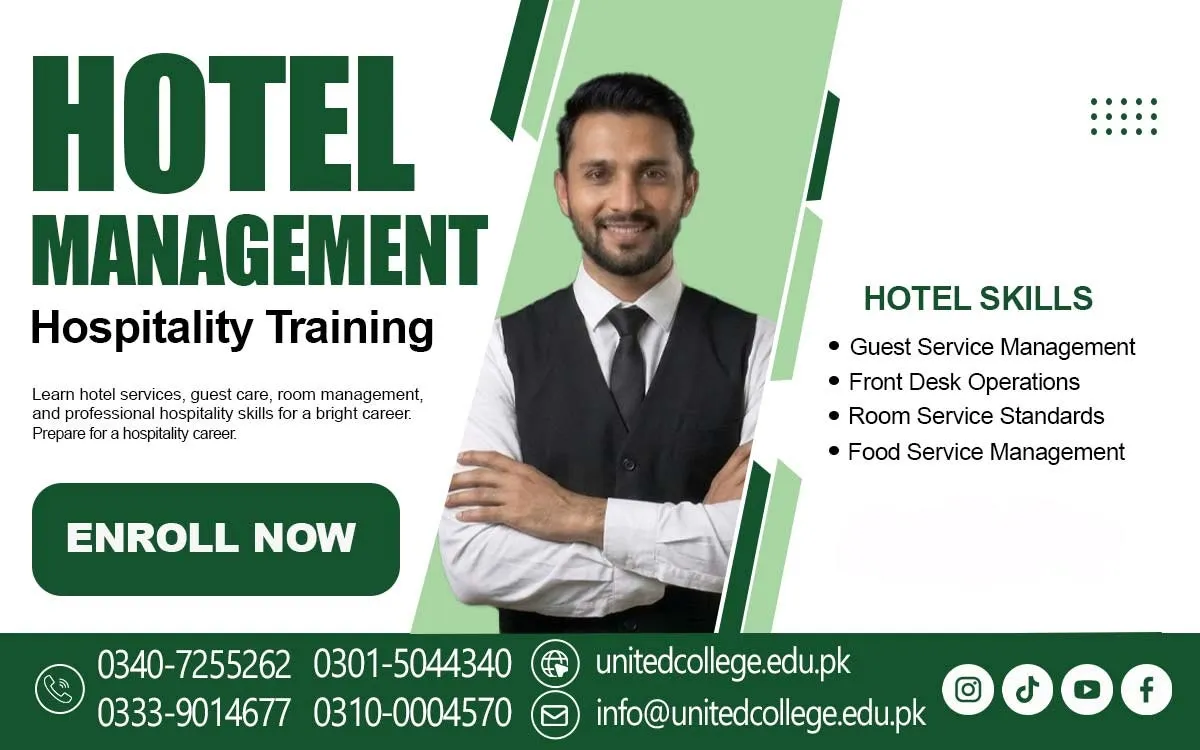

Hotel Management Course in Swat – Build Hospitality Skills
Developing Professional Skills for the Hospitality Industry
Imagine a family arriving at a hotel after travelling for several hours, only to discover that their room is not ready and the reception staff cannot find their booking. Such situations can create frustration and leave guests with a poor impression of the hotel. Good hotel management helps prevent these problems through proper planning, communication, and professional service. The hospitality industry depends on trained individuals who understand guest needs and can manage different responsibilities with care. A hotel is not only a place where people stay; it is an environment where reception, housekeeping, restaurant services, administration, and customer care must work together.
For students interested in this field, the Hotel Management Course in Sawat offered by United College of Technology (UCT) provides an opportunity to understand the responsibilities involved in hotel operations. Hotel management training introduces learners to important hospitality practices, including guest handling, room management, food service, and workplace communication. These skills are useful for people who want to understand the hotel and tourism industry before entering a professional environment. Beginners can also develop confidence by learning how hotel departments operate and how staff members cooperate to provide a comfortable experience.
Understanding Daily Hotel Operations and Departmental Responsibilities
A hotel may appear calm and organised to its guests, but several activities take place behind the scenes to keep everything running smoothly. Reception staff manage reservations, housekeeping teams prepare rooms, restaurant employees serve meals, and administrative workers maintain important records. Each department has separate responsibilities, but their work is connected. For example, when a guest checks out early, the front office needs to inform housekeeping so the room can be inspected and prepared for another visitor. Similarly, restaurant staff may need to coordinate with reception when guests request meal information or special arrangements.
In a Hotel Management Course in Sawat, learners can become familiar with each department's purpose and understand how their responsibilities support one another. Hotel administration also involves scheduling, coordinating staff, managing supplies, and maintaining service standards. Beginners should understand that successful hotel operations require teamwork rather than individual effort. A delay in one department can affect the entire guest experience, so clear communication is essential. Learning about departmental coordination helps students recognise workplace responsibilities and understand the importance of completing tasks on time.
Front Office Management and Professional Guest Reception
The reception area is usually the first place guests visit when they enter a hotel, making it an important part of the overall hospitality experience. A receptionist must welcome visitors politely, check reservation details, explain hotel facilities, and guide guests through the check-in process. Imagine a traveller arriving late at night after a long journey. They expect a quick check-in, accurate booking information, and clear instructions about their room. If the receptionist cannot communicate properly or find the reservation, the guest may become uncomfortable. Hotel Receptionist Training can introduce learners to reservation handling, guest registration, check-in and check-out procedures, telephone communication, and basic record keeping.
Students can also learn the importance of confirming guest details before making changes to a booking. In situations involving booking mistakes, reception staff should remain calm, check available information, and explain possible solutions politely instead of blaming other employees. A receptionist may also need to answer questions about room facilities, dining services, payment methods, and local information. The Hotel Management Course in Sawat helps learners understand the knowledge and communication skills associated with front desk duties. These responsibilities require patience, accuracy, professional behaviour, and the ability to manage several tasks without making guests feel ignored.
Housekeeping Management and Maintaining Guest Room Standards
A clean room can make a guest feel comfortable, while an untidy bathroom, dusty furniture, or missing towels can quickly damage their experience. Housekeeping is therefore one of the most important departments in a hotel because it directly affects cleanliness, hygiene, and guest satisfaction. Housekeeping Management includes preparing rooms, changing bed linen, cleaning bathrooms, arranging furniture, replacing supplies, and checking that essential facilities are ready before a guest arrives. Staff members must follow proper cleaning procedures and use suitable products according to the surface and type of dirt. They should also understand safe storage practices for cleaning chemicals and avoid mixing products that could produce harmful reactions.
Room inspections are another important responsibility because they help identify problems such as damaged equipment, leaking taps, broken lights, or missing items. If a guest reports that their room has not been cleaned properly, housekeeping staff should respond respectfully and arrange the necessary correction. Hotel staff must also respect guest privacy, follow room-entry procedures, and handle personal belongings carefully. Through the Hotel Management Course in Sawat, beginners can develop an understanding of housekeeping duties and the standards expected in professional accommodation services. Learning about room preparation, hygiene practices, laundry coordination, and workplace organisation gives students useful knowledge about the daily responsibilities of hotel housekeeping teams.
Food and Beverage Service and Restaurant Management Practices
A guest may enjoy a comfortable hotel room but still leave disappointed if restaurant service is slow or their food order is incorrect. Food and beverage services play an important role in the hospitality industry because dining experiences influence how customers remember a hotel or restaurant. This department includes restaurant operations, food preparation coordination, table arrangement, order taking, serving meals, and maintaining dining area cleanliness. Staff members should understand basic dining etiquette, including how to welcome customers, present menus, communicate meal options, and serve food respectfully. They must also pay attention to hygiene because food safety is essential in every professional kitchen and dining environment.
For example, if a customer receives the wrong meal, the employee should listen carefully, apologise politely, confirm the correct order, and coordinate with the kitchen to resolve the problem. Students learning about hospitality can explore how food service operates and why timing, presentation, and customer communication matter. The Hotel Management Course in Sawat offered by UCT introduces learners to important areas of hotel and restaurant services, helping them understand the relationship between food quality and customer satisfaction. Knowledge of food and beverage service can also be useful in restaurants, cafés, catering businesses, and other hospitality-related workplaces where professional service is expected.
Guest Relations and Effective Customer Service Skills
A hotel employee may follow every service procedure correctly, but poor communication can still make a guest feel unwelcome. Guests may have different needs, expectations, languages, and personal preferences, so staff members must communicate with patience and respect. Customer Service Skills include greeting visitors, listening carefully, providing accurate information, responding to complaints, and handling difficult situations professionally. Consider a guest who complains that the air conditioning in their room is not working properly during warm weather. Instead of ignoring the complaint or arguing, a trained employee should listen, acknowledge the inconvenience, inform the responsible department, and follow up to check whether the issue has been resolved.
Professional behaviour also includes maintaining a polite tone, using clear language, respecting privacy, and avoiding unnecessary arguments. Employees should understand that not every guest will be satisfied immediately, but their response can make a difficult situation easier to manage. During hotel management training, learners can develop communication, teamwork, problem-solving, and time-management abilities that support better guest experiences. The Hotel Management Course in Sawat provides an opportunity to understand the importance of these skills in hospitality environments. Good guest relations are not limited to reception desks; they are required in restaurants, housekeeping, room service, and almost every department that communicates with visitors.
Hotel Administration and Organised Workplace Management
Behind the daily activities of a hotel, administrative work helps maintain order and makes it easier for managers to monitor business operations. Hotel administration involves maintaining guest records, preparing schedules, managing supplies, checking expenses, coordinating employees, and organising important documents. These responsibilities may not always be visible to customers, but they influence how efficiently a hotel operates. For example, if a hotel does not maintain accurate booking records, two guests may be assigned the same room, or available rooms may be incorrectly reported. Similarly, poor stock management can result in shortages of towels, cleaning supplies, kitchen ingredients, or other essential items.
Basic computer knowledge can also support hotel administration through digital reservation systems, spreadsheets, billing records, and communication tools. The Hotel Management Course in Sawat offered by United College of Technology helps beginners understand the administrative side of hospitality and the importance of organised workplace practices. Students can learn why accurate documentation, proper planning, and responsible management are necessary for hotel operations. These skills are relevant to different hospitality businesses, including hotels, resorts, restaurants, and guest houses, where organised administration supports smooth daily work.
Practical Hotel Training and Development of Workplace Skills
Understanding hotel management through reading is useful, but practical learning helps students connect information with real workplace responsibilities. A learner may know the meaning of guest check-in, but performing the process requires confidence, attention, and accurate communication. Similarly, understanding housekeeping procedures is different from preparing a room according to professional cleanliness standards. Practical Hotel Training can help beginners become familiar with common hospitality tasks and workplace expectations. During structured learning, students may explore front desk procedures, reservation records, guest communication, room inspection, restaurant service, and basic administrative activities. Role-playing exercises can also be useful.
For example, one student can act as a receptionist while another plays the role of a guest who has a reservation problem. Hotel staff training also focuses on punctuality, teamwork, personal presentation, time management, and professional conduct. These qualities are important because hospitality employees often work in busy environments where several tasks need attention at the same time. At United College of Technology, the Hotel Management Course in Sawat is an option for individuals who want to develop an understanding of hospitality responsibilities and related professional skills. Students should also recognise that practical experience, regular practice, and willingness to learn remain important for improving their abilities after completing a training programme.
Hospitality Career Paths and Professional Growth Opportunities
Hotels, resorts, restaurants, guest houses, catering businesses, and tourism-related organisations all depend on employees who understand customer service and daily operations. Depending on their training, practical experience, communication abilities, and interests, beginners may explore entry-level responsibilities such as front desk assistance, receptionist duties, housekeeping support, restaurant service, or administrative assistance. With additional workplace experience and skill development, individuals may gradually work towards supervisory responsibilities in areas such as front office operations, housekeeping, food and beverage service, or hotel administration.
However, career progress depends on several factors, including an individual's performance, available opportunities, professional experience, and employer requirements. The Hospitality Industry in Pakistan also includes businesses that serve local travellers, families, tourists, and corporate visitors, creating a need for organised services and professional guest handling. The Hotel Management Course in Sawat offered by United College of Technology can help interested learners build an educational foundation for understanding this field. Learning about Hotel and Tourism Management can also help them understand the wider connection between accommodation, travel services, and customer experiences.
Frequently Asked Questions (FAQs)
A Hotel Management Course teaches students how to manage hotel operations, guest services, housekeeping, front office duties, and restaurant services.
Students, beginners, fresh learners, and individuals interested in the hospitality industry can consider joining this course.
Students can learn guest handling, communication, front office management, housekeeping, food and beverage service, and hotel administration.
Hotel management training may include practical activities, demonstrations, and workplace-related exercises to help students understand hospitality responsibilities.
Front office management involves guest reception, reservation handling, check-in, check-out, telephone communication, and maintaining guest records.
Admission Open: Start Your Professional Journey Today!
Join United College of Technology and build a career with practical training, recognized certifications, and Gulf job support. Seats are limited.
Apply Now via WhatsAppContact Information
- Address: Rawalpindi: F-272 Main New Katarian Stop, Old IJP Road | Lahore Campus: Lahore, Pakistan
- Phone/WhatsApp: 0340-7255262 / 0333-9014677 / 0301-5044340 / 0310-0004570 / 051-8770756
- Website: unitedcollege.edu.pk
















Leave a Comment