


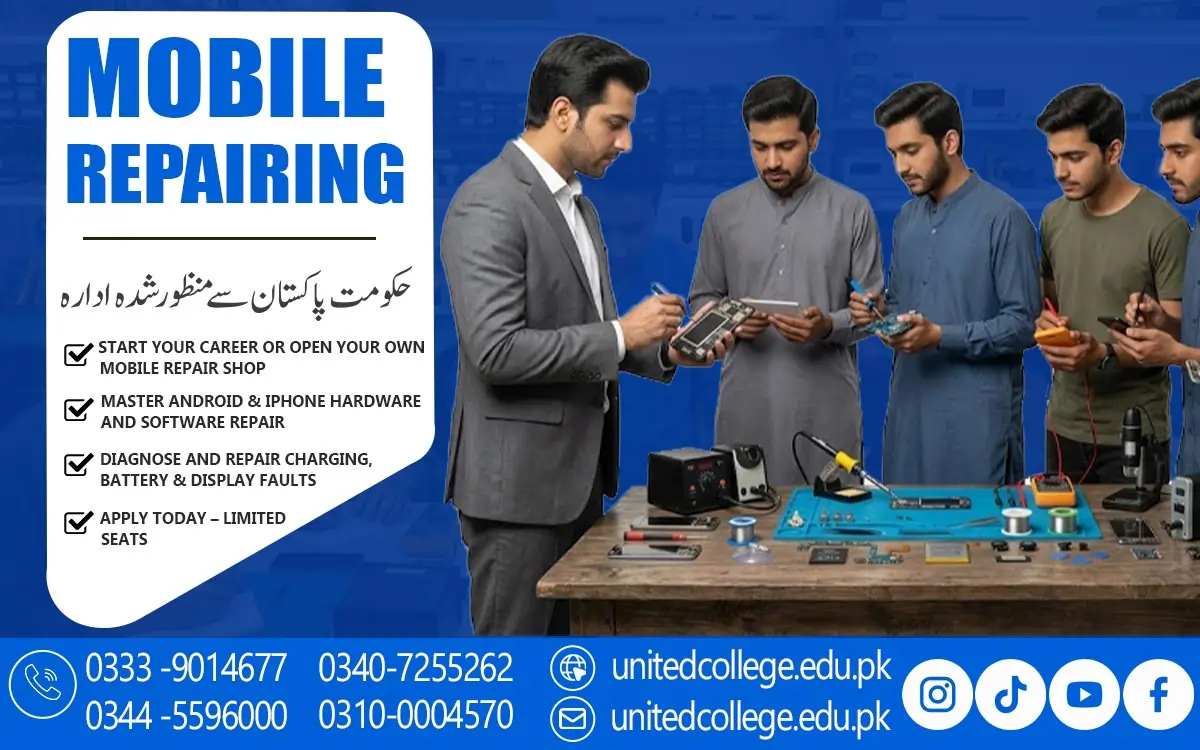

Mobile Repairing Course in Talagang for Practical Repair Work
Starting with Essential Mobile Repair Concepts
Mobile phones have become an important part of modern communication, education, business, and everyday activities. With the increasing use of smartphones, skilled technicians are needed to identify and resolve different mobile problems. A Mobile Repairing Course in Talagang introduces learners to the basic concepts of mobile phone repair and servicing.
Students begin by understanding how smartphones work and how technicians approach different repair situations. They learn about basic device inspection, safe handling, common repair terms, and the importance of identifying a problem before starting any servicing task.
This foundation can be especially useful for beginners who want to enter the mobile repair field. Learning basic concepts step by step allows students to develop technical confidence before moving toward more advanced troubleshooting and practical repair work.
Understanding the Functions of Phone Components
A smartphone consists of many electronic components, and each part has a specific function. Students learn about important components such as the motherboard, battery, display, charging section, camera, speaker, microphone, connectors, and other internal parts.
Learners explore how these components work together to support different phone functions. Understanding the purpose of each part helps students recognize how a faulty component may affect the performance of a particular section of the device.
Knowledge of phone components is an important part of mobile repair training. It allows learners to inspect devices more effectively and develop a better understanding of which areas may require testing during troubleshooting.
Learning About Smartphone Hardware Faults
Smartphones can experience different hardware problems, including charging failure, battery issues, display faults, power problems, and audio-related difficulties. Students learn about common hardware faults and the symptoms that may indicate a problem.
The training introduces basic methods for examining hardware issues. Learners understand why proper inspection and testing should be performed before replacing or repairing a component.
Practical exposure helps students improve their ability to analyze hardware problems. With regular practice, they can develop a more organized approach to finding possible causes and selecting suitable repair procedures.
Exploring Solutions for Software Problems
Mobile Repairing Course can also develop problems caused by software rather than physical components. Students learn about common software issues such as slow performance, application errors, system crashes, and certain startup problems.
Learners are introduced to basic software troubleshooting techniques and learn how to examine the symptoms of a device before applying an appropriate solution. This helps them understand the difference between hardware- and software-related faults.
Software knowledge can make a mobile technician more versatile. By learning both hardware repair and software troubleshooting, students can become better prepared to handle a wider range of smartphone servicing requirements.
Using Diagnostic Tools for Mobile Testing
Proper diagnostic tools are important for checking mobile components and identifying faults. Students learn about commonly used testing equipment and understand how different tools can assist during mobile repair procedures.
Learners become familiar with tools used for checking electrical values, examining circuits, handling components, and performing other diagnostic activities. They also learn why using the correct equipment is important when working with delicate smartphone parts.
Practical experience with diagnostic tools can improve students' technical confidence. Regular use of testing equipment helps them understand how measurements and observations can support more accurate fault identification.
Practicing Common Phone Repair Procedures
Practical repair procedures allow students to apply their theoretical knowledge to actual mobile servicing tasks. They can learn how to inspect devices, handle components, use repair tools, and follow suitable procedures for different types of faults.
Students are encouraged to follow an organized repair process that begins with inspection and diagnosis. They can then move toward component testing, servicing, and final device checking.
Regular practice helps learners improve their accuracy and technical handling. It also teaches the importance of patience and careful work when dealing with small and sensitive smartphone components.
Gaining Experience Through Hands-On Tasks
Hands-on activities give learners an opportunity to develop practical mobile repairing skills. Students can work with mobile devices, components, diagnostic tools, and troubleshooting procedures under proper guidance.
Through practical tasks, learners can connect classroom concepts with real repair situations. They learn how to examine a device, identify possible problems, test relevant components, and apply suitable servicing methods.
Continued practical experience can improve confidence, problem-solving, and attention to detail. These skills can become valuable for students who plan to work in mobile repair shops or other technical environments.
Moving Toward Professional Mobile Repair Knowledge
Mobile technology continues to develop, with new smartphone models and features regularly entering the market. For this reason, technicians need to continue learning and updating their knowledge of mobile hardware, software, and repair techniques.
A Mobile Repairing Course in Talagang can provide learners with a foundation in component knowledge, hardware troubleshooting, software issues, diagnostic tools, and practical repair procedures. This combination of knowledge and hands-on practice can help students prepare for technical work.
After gaining sufficient experience, learners can explore opportunities in mobile repair shops, service centers, and electronics-related businesses. Some may also choose to provide independent mobile repair services and continue developing their expertise as mobile technology evolves.
Frequently Asked Questions (FAQs)
Students learn mobile hardware, smartphone components, software troubleshooting, diagnostic tools, fault identification, and practical phone repair procedures.
Yes, beginners can start with essential mobile repair concepts and gradually develop their skills through practical training and hands-on activities.
Training can cover common problems involving charging, batteries, displays, power, audio, connectivity, and software performance.
Diagnostic tools help technicians test components, check electrical values, and gather information that can assist in identifying the source of a mobile fault.
After gaining practical experience, learners can work in mobile repair shops, service centers, and electronics businesses or develop their own mobile servicing setup.
Admission Open: Start Your Professional Journey Today!
Join United College of Technology and build a career with practical training, recognized certifications, and Gulf job support. Seats are limited.
Apply Now via WhatsAppContact Information
- Address: Rawalpindi: F-272 Main New Katarian Stop, Old IJP Road | Lahore Campus: Lahore, Pakistan
- Phone/WhatsApp: 0340-7255262 / 0333-9014677 / 0301-5044340 / 0310-0004570 / 051-6770756
- Website: unitedcollege.edu.pk
















Leave a Comment