


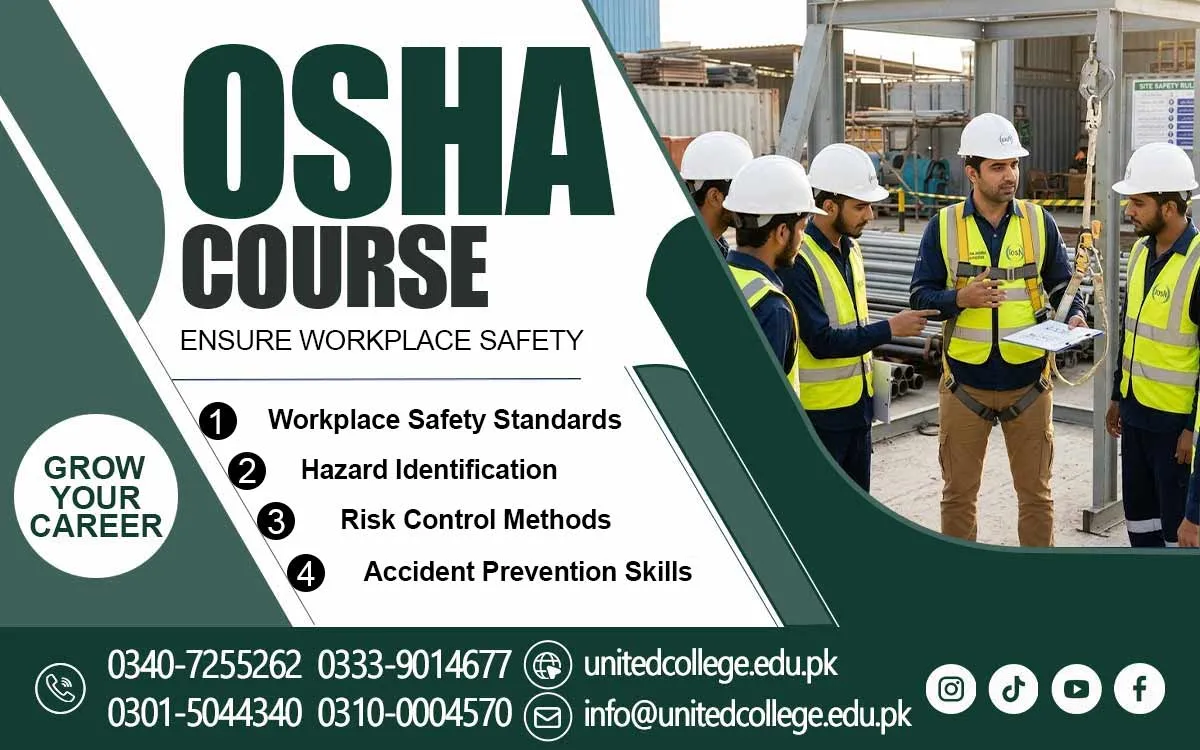

OSHA Course in Hangu Advances Knowledge of Occupational Protection
Build the Knowledge That Helps Prevent Workplace Accidents
Workplace safety is essential wherever people use tools, operate machinery, handle materials, or perform physically demanding tasks. On construction sites, a careless decision can lead to a fall, while in factories, unsafe equipment or poor handling practices can expose workers to serious injuries. These incidents can affect workers, their families, and the smooth operation of a business. Understanding how to recognize hazards and follow safety procedures is therefore an important part of professional development.
The OSHA Course in Hangu introduces beginners, students, fresh learners, and job seekers to the basic principles of occupational health and safety. OSHA stands for the Occupational Safety and Health Administration, a United States agency known for workplace safety standards and guidance. OSHA Safety Training introduces learners to workplace hazards, accident prevention, protective measures, and responsible work habits.
Understand How OSHA Training Connects Safety Rules With Daily Work
Occupational Safety and Health focuses on protecting people from dangers associated with their jobs. OSHA-related training helps learners understand why safety rules exist, how workplace hazards can affect people, and why preventive action matters. It introduces basic ideas such as identifying hazards, evaluating risks, following approved procedures, and reporting unsafe conditions. A hazard is something that can cause harm, while risk refers to the possibility and potential seriousness of that harm occurring.
A suitable response may involve following the workplace procedure to restrict access, report the problem, and arrange safe cleaning. The OSHA Course in Hangu can help learners understand this kind of safety thinking and recognize that every task requires attention to its working conditions. Training does not automatically make someone qualified to perform every safety duty, but it can introduce important principles that learners can develop through further education, appropriate supervision, and practical experience.
Recognize Workplace Hazards Before They Develop Into Serious Incidents
Hazard Identification is one of the important concepts in workplace safety. Hazards may include exposed electrical wires, moving machinery, unstable ladders, falling objects, harmful chemicals, excessive noise, and poorly arranged materials. Some dangers are easy to notice, while others require workers to understand how equipment and work processes operate. In a workshop, for example, a damaged power cable may expose workers to electric shock or create a fire risk.
On a construction site, materials placed near an edge may fall and injure people below. OSHA-related learning introduces the importance of observing these conditions, understanding possible consequences, and reporting concerns through the correct channels. Learners should also understand that not every hazard can be managed by an individual worker. Some situations require qualified personnel, specialized equipment, or formal risk assessments.
Use Safety Signs, PPE, and Work Procedures With Greater Confidence
Safety signs communicate important information about workplace dangers and required precautions. Warning signs may highlight hazards, prohibition signs identify actions that are not allowed, and mandatory signs indicate steps workers must follow. Understanding these messages helps people recognize potential risks before entering an area or starting a task. Personal protective equipment, commonly called PPE, provides another layer of protection when selected for the hazards involved.
However, PPE does not replace safe equipment design, effective hazard controls, or proper work procedures. Workers must use suitable equipment correctly, check it for damage, and follow instructions. Workplace Safety Training also emphasizes that workers should not operate unfamiliar machinery or carry out dangerous tasks without appropriate training and authorization. The OSHA Course in Hangu can introduce learners to these principles and help them understand how safety signs, protective equipment, and approved procedures work together to reduce workplace risks.
Strengthen Safety Communication Across Construction and Industrial Teams
Workplace safety depends on more than individual knowledge. Workers also need to communicate clearly, understand instructions, and share relevant safety concerns with the appropriate people. On a construction project, a worker may notice that a walkway has become obstructed by building materials. Reporting the obstruction can help the responsible team arrange its removal and reduce the chance of someone tripping.
Clear communication is especially important when tasks change, different teams share an area, or equipment requires attention. OSHA-related training can introduce learners to the importance of reporting hazards accurately, listening to safety instructions, and understanding individual responsibilities. It can also help them appreciate why guessing, hiding a mistake, or ignoring an unsafe condition may create additional risks.
Prepare for Emergencies Through Awareness and Responsible Action
Even when workplaces have preventive measures, unexpected emergencies can occur. Fires, serious injuries, chemical spills, electrical incidents, and equipment failures may require workers to respond quickly and follow established instructions. OSHA Safety Training can introduce learners to emergency preparedness, evacuation awareness, alarm procedures, and incident reporting. For example, when workers hear a fire alarm, they should follow the site's emergency plan instead of delaying evacuation to collect personal belongings.
Workers should also understand the importance of accessible emergency exits and clear routes, along with knowing how to report a dangerous situation. The correct response depends on the type of emergency and the procedures established for that workplace. Learners must not assume that one response is suitable for every incident. Studying the OSHA Training in Hangu can help beginners understand why preparation, clear instructions, and responsible communication are important parts of accident prevention.
Explore OSHA Learning With United College of Technology in Mind
People considering safety training should review their learning goals and understand what a particular course actually covers. The OSHA Course in Hangu may be relevant to students, beginners, fresh learners, and job seekers who want to explore occupational safety concepts or develop knowledge related to industrial work. The course offered by United College of Technology can be explored by contacting the institute for current information about its training options.
They should also check whether the course's content and recognition suit their intended professional direction. OSHA-related training can differ in scope, so completing a course should not automatically be treated as proof of eligibility for every safety-related position. Some roles may require additional education, experience, or specific credentials. Comparing available information carefully helps learners make realistic decisions and understand what they can expect from their training.
Turn Safety Learning Into a Foundation for Continued Professional Growth
Learning workplace safety can help people understand the responsibilities involved in protecting workers and maintaining safer working conditions. The OSHA Course in Hangu introduces concepts such as Hazard Identification, Accident Prevention, PPE, safety communication, and emergency awareness. These subjects may be useful to people exploring construction, manufacturing, maintenance, or occupational health and safety, but career development also depends on further learning, practical experience, and the requirements of individual roles.
Learners can build on their foundational knowledge by studying risk assessment, workplace inspections, incident documentation, and relevant safety procedures. They should also develop patience, observation, clear communication, and the confidence to report unsafe conditions through proper channels. Applying safety knowledge requires more than memorizing rules; it involves understanding why procedures exist and following them consistently.
Frequently Asked Questions (FAQs)
It helps learners understand how responsible behavior, clear instructions, and cooperation can influence safety standards within a working team.
Extreme heat or cold can affect concentration, physical performance, and health. Safety awareness helps workers recognize warning signs and understand the need for suitable precautions.
These procedures help prevent machinery from starting unexpectedly during maintenance or servicing by controlling hazardous energy sources through authorized processes.
It encourages workers to stay focused, follow instructions, avoid unnecessary interruptions, and give full attention to tasks involving equipment or other workplace risks.
Learners can understand that cylinders require suitable handling, secure storage, proper identification, and protection from damage or unsafe conditions.
It introduces the importance of coordinating safety responsibilities, communicating site rules, and ensuring that different teams understand the hazards connected with shared work areas.
Admission Open: Start Your Professional Journey Today!
Join United College of Technology and build a career with practical training, recognized certifications, and Gulf job support. Seats are limited.
Apply Now via WhatsAppContact Information
- Address: Rawalpindi: F-272 Main New Katarian Stop, Old IJP Road | Lahore Campus: Lahore, Pakistan
- Phone/WhatsApp: 0340-7255262 / 0333-9014677 / 0301-5044340 / 0310-0004570 / 051-8770756
- Website: unitedcollege.edu.pk
















Leave a Comment