


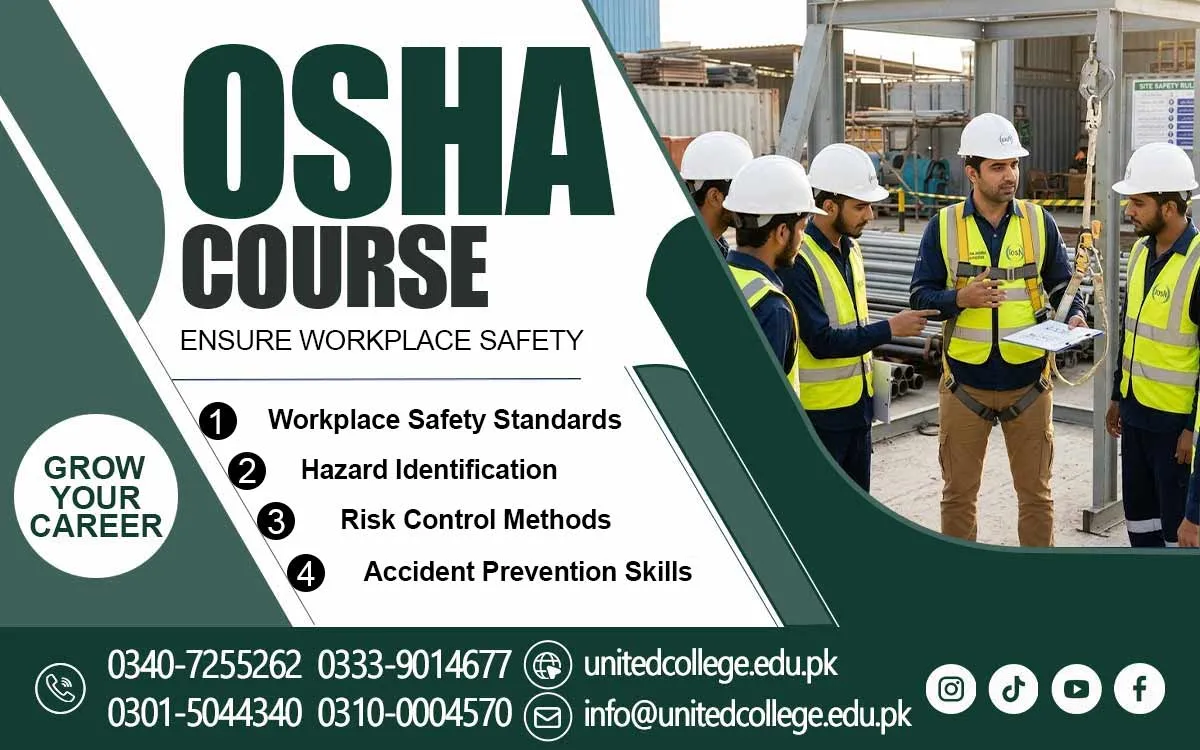

OSHA Course in Haripur – Build Your Safety Knowledge
Workplace Safety Challenges That Require Professional Knowledge
Imagine a construction worker climbing an unstable ladder while carrying heavy equipment, or an electrician noticing a damaged wire near a wet floor. These situations may appear ordinary during a busy working day, but they can quickly lead to serious injuries if nobody takes action. Workplace accidents often happen because hazards are overlooked, safety procedures are ignored, or workers do not receive proper training. This is why occupational health and safety knowledge is important in construction sites, factories, warehouses, workshops, and other working environments. The OSHA Course in Haripur introduces learners to workplace safety principles that help them recognise hazards, understand potential risks, and follow appropriate preventive measures.
OSHA-related safety training can also help workers understand the importance of reporting unsafe conditions instead of waiting for an accident to happen. For students, fresh learners, and job seekers, learning these principles can provide a useful foundation for understanding professional safety practices. United College of Technology (UCT) is an institution learners can explore when considering workplace safety training. Before enrolling, students should review the course syllabus and confirm which topics are covered. Developing safety awareness requires more than memorising rules; it involves understanding how everyday decisions affect people, equipment, and the working environment.
Occupational Safety Standards and the Purpose of OSHA Training
OSHA stands for the Occupational Safety and Health Administration, a United States government agency responsible for helping ensure safe and healthy working conditions through workplace safety regulations and enforcement. Its standards address different occupational hazards, including falls, electrical risks, machinery, chemicals, and exposure to harmful substances. OSHA-related training introduces learners to safety principles and practices that can help them understand these workplace risks. It is important to recognise that OSHA is a United States agency, not a Pakistani government department. Similarly, an OSHA-related course does not automatically represent an official OSHA certification, because the recognition of training depends on the specific programme and its requirements.
The OSHA Course in Haripur can be considered by learners who want to understand occupational health and safety concepts and their practical applications. These concepts include identifying unsafe conditions, following established procedures, using protective equipment correctly, and communicating safety concerns to the appropriate people. For example, a worker who understands basic electrical safety may recognise that damaged insulation or exposed wiring requires attention from a qualified professional. In the same way, a warehouse employee may understand why emergency routes should remain clear and heavy materials should be stored securely. Learning about OSHA safety standards helps develop a more responsible approach to daily tasks.
Hazard Identification and Risk Assessment Skills
A workplace may contain several hazards that are difficult to notice during routine activities. A wet floor, an overloaded electrical socket, an unstable stack of materials, or a machine without suitable guarding can create risks for employees and visitors. Hazard identification involves recognising anything that could cause injury, illness, or damage. Risk assessment takes this process further by considering how likely an incident is to happen and how serious its consequences could be. During occupational health and safety training, learners can develop an understanding of these two connected activities. For example, a person inspecting a construction area might notice that workers are moving beneath a location where tools are being used at height.
The exact measures depend on the working conditions and applicable safety requirements. Students exploring the OSHA Course in Haripur should look for learning material that explains these concepts through realistic workplace situations. Other useful subjects include accident prevention, workplace hazard prevention, safe work procedures, and communication between workers and supervisors. Risk assessment is not simply about filling in a form; it requires careful observation and informed decisions. When learners understand the relationship between hazards, risks, and preventive controls, they can better recognise problems before work begins. These skills are relevant to construction safety training, industrial safety training, and many other occupational environments where people work with equipment, materials, electricity, or potentially dangerous substances.
Common Workplace Hazards in Construction and Industry
Construction sites, factories, workshops, and warehouses have different working conditions, but many of their hazards are similar. Slips and trips can occur because of spilled liquids, loose cables, uneven surfaces, or materials left in walkways. Falls may happen when workers use unsuitable ladders, work near unprotected edges, or access elevated areas without appropriate fall protection. Electrical hazards include damaged cables, unsafe connections, overloaded circuits, and contact with energised equipment. Machinery can cause serious injuries if moving parts are exposed or equipment is used incorrectly. Falling objects are another concern where tools, building materials, or stored goods are handled above ground level.
Chemical hazards may arise from cleaning products, industrial substances, fumes, or other materials that require careful handling. The OSHA Course in Haripur can help learners become familiar with these industrial workplace hazards and understand why suitable controls are necessary. For example, a workshop employee should not continue using a machine simply because it appears to be functioning normally if a protective guard is missing. The equipment should be handled according to established safety procedures, and the issue should be reported to the responsible person. Similarly, workers handling chemicals need to understand relevant labels, storage instructions, ventilation requirements, and protective measures.
Personal Protective Equipment and Safe Working Practices
Personal protective equipment, commonly known as PPE, helps reduce exposure to workplace hazards when selected and used correctly. Depending on the task, PPE may include safety helmets, protective gloves, safety shoes, goggles, face shields, hearing protection, respirators, or specialised protective clothing. Each item serves a particular purpose, so workers need to understand which equipment is suitable for their activities. For instance, safety shoes can help protect feet from certain impact and puncture hazards, while suitable eye protection can reduce the risk of injury from flying particles or splashes. However, ordinary protective equipment cannot protect against every danger, and using the wrong type may create a false sense of security.
PPE should also be used alongside other safety controls rather than as the only method of preventing accidents. For example, a machine should have appropriate guarding and safe operating procedures even when an operator wears gloves or safety glasses. Learners taking an OSHA safety course should understand the relationship between personal protection and wider workplace safety management practices. Training can also explain the importance of following workplace rules, using tools correctly, maintaining good housekeeping, and reporting damaged equipment. Students considering the OSHA Course in Haripur should check whether the programme explains PPE selection and safe working practices in a practical, understandable way.
Fire Prevention, Emergency Response, and First Aid Awareness
A small workplace fire can become dangerous when combustible materials are stored carelessly, electrical equipment is damaged, or workers do not understand emergency procedures. Fire safety training helps people recognise possible ignition sources, maintain clear escape routes, and follow the workplace emergency plan. For example, storing cardboard boxes beside electrical equipment or blocking an emergency exit with building materials can increase danger during an incident. Workers should understand how to raise an alarm, leave the affected area safely, and report to the designated assembly point. They should never delay evacuation to collect personal belongings or attempt to fight a fire without the required training, equipment, and a safe escape route.
First aid awareness is another useful subject because prompt assistance can matter when someone is injured. However, first aid should be provided within the responder's training and abilities, while emergency medical services should be contacted when necessary. The OSHA Course in Haripur may be relevant to learners seeking an introduction to these occupational safety principles, although the exact subjects depend on the course syllabus. Understanding emergency responsibilities helps workers respond more calmly and avoid actions that put themselves or others at greater risk. Regular drills, clear communication, accessible emergency equipment, and properly maintained evacuation routes are important parts of workplace preparedness.
Safety Inspections, Incident Reporting, and Workplace Responsibilities
Safety inspections help identify problems such as damaged tools, leaking containers, missing machine guards, blocked walkways, or poorly stored materials. Depending on the workplace, inspections may be conducted by supervisors, safety officers, maintenance staff, or other authorised personnel. The purpose is to identify unsafe conditions and ensure that appropriate corrective action is taken. Incident reporting is equally important because accidents and near misses can reveal weaknesses in existing safety arrangements. A near miss is an event that could have caused injury or damage but did not. For example, a heavy object falling close to a worker should be reported even if nobody is hurt. Recording the incident can help the organisation investigate its cause and prevent a similar event.
The information should be accurate and recorded according to the organisation's procedures. Learners studying occupational health and safety training can benefit from understanding how these records support communication and accountability. The OSHA Course in Haripur may introduce students to safety inspection methods and incident reporting principles, depending on its content. A safety officer's responsibilities can include observing working conditions, communicating hazards, assisting with risk assessments, and supporting safety awareness activities. However, responsibilities vary by role, employer, and applicable requirements. Effective safety management also requires cooperation from workers, supervisors, and management.
Workplace Applications and Career-Related Safety Knowledge
On construction sites, safety practices may involve controlling access to hazardous areas, checking ladders, managing work at height, and keeping materials organised. In factories, employees may need to understand machinery hazards, chemical handling, noise exposure, and safe operating procedures. Warehouse workers may deal with vehicle movement, heavy loads, storage systems, and pedestrian routes. Workshops can involve electrical tools, sharp equipment, welding activities, and maintenance tasks. Each environment requires controls suited to its particular risks. The OSHA Course in Haripur can be relevant to students and job seekers who want to build an understanding of construction safety training, industrial safety training, and general workplace hazard prevention.
This knowledge may also support people who are already working and want to improve their awareness of occupational safety practices. However, completing an OSHA-related course does not guarantee employment, a particular salary, or eligibility for every safety-related position. Employers may require additional qualifications, practical experience, recognised training, industry-specific knowledge, or other competencies. Some technical activities also require specialised training and authorisation beyond basic safety awareness. Learners interested in safety officer training should research the requirements of the roles and industries they want to enter. Understanding hazard identification, risk assessment, PPE, incident reporting, and emergency procedures can provide a useful foundation, but professional development depends on continued learning and responsible workplace experience.
Practical Learning Considerations at United College of Technology
Students should understand what the syllabus includes, which training standards the programme follows, how learning is assessed, and what type of certificate may be awarded. These details are especially important for OSHA-related training because different courses may cover different topics and have different recognition arrangements. Learners in Haripur who are considering the OSHA Course in Haripur can explore United College of Technology (UCT) as a possible training provider and confirm the current programme details directly with the institution. Before enrolling, they should ask about the course content, duration, delivery method, instructor qualifications, practical learning opportunities, assessment requirements, and certificate recognition.
Beginners do not need to understand every technical term before starting, but they should be willing to ask questions, follow instructions, and practise safe decision-making. Reading introductory material about occupational health and safety can also help learners become familiar with common workplace hazards. Most importantly, they should distinguish between gaining safety knowledge and receiving a specific professional qualification. A well-informed choice helps students understand what they are enrolling in and what the training can realistically offer. By approaching workplace safety as an ongoing responsibility rather than a one-time certificate, learners can build stronger habits and contribute more effectively to safer working environments.
Frequently Asked Questions (FAQs)
The OSHA Course in Haripur introduces learners to workplace safety principles, hazard identification, risk assessment, accident prevention, and occupational health and safety practices.
OSHA stands for the Occupational Safety and Health Administration, a United States agency responsible for workplace safety and health regulations.
Students, fresh learners, job seekers, construction workers, industrial workers, and individuals interested in workplace safety can explore OSHA-related training options.
OSHA-related training may cover hazard identification, risk assessment, personal protective equipment (PPE), fire safety, emergency procedures, workplace inspections, and accident prevention. The exact syllabus depends on the programme.
You can contact United College of Technology (UCT) to confirm the current availability, syllabus, duration, and enrolment requirements for its OSHA-related training programmes.
Admission Open: Start Your Professional Journey Today!
Join United College of Technology and build a career with practical training, recognized certifications, and Gulf job support. Seats are limited.
Apply Now via WhatsAppContact Information
- Address: Rawalpindi: F-272 Main New Katarian Stop, Old IJP Road | Lahore Campus: Lahore, Pakistan
- Phone/WhatsApp: 0340-7255262 / 0333-9014677 / 0301-5044340 / 0310-0004570 / 051-8770756
- Website: unitedcollege.edu.pk
















Leave a Comment