


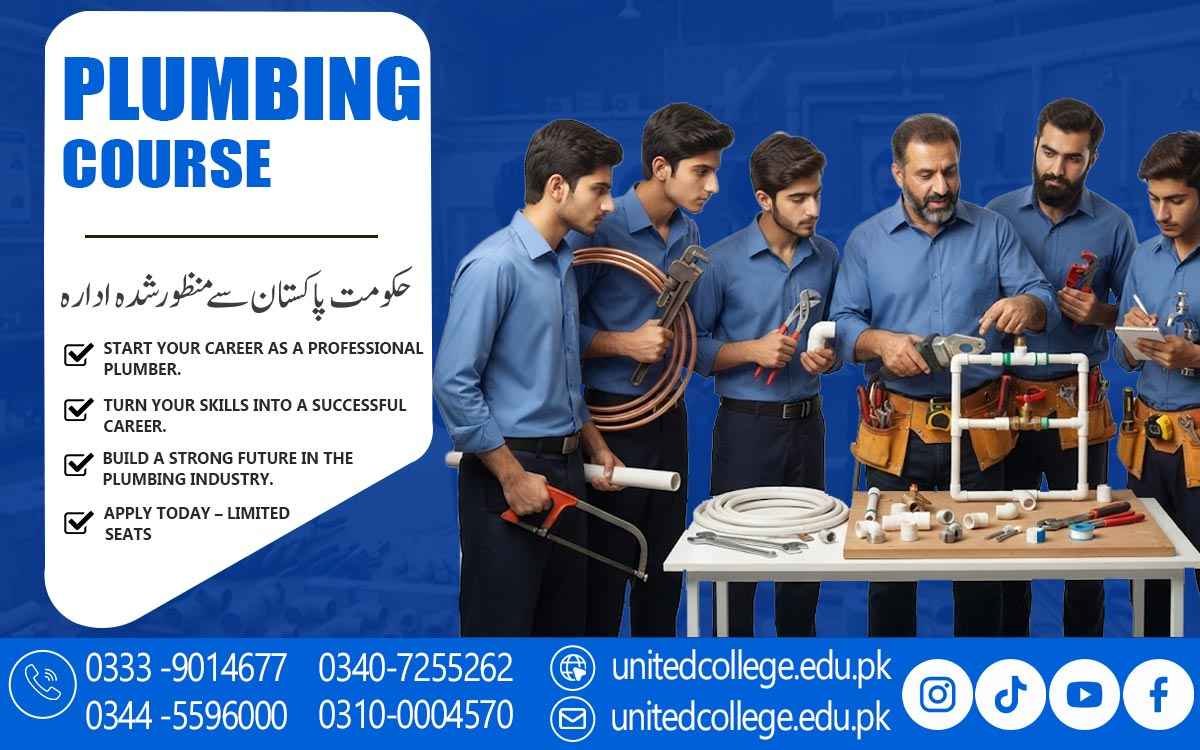

Plumbing Course in Bagh AJK: Build Skills for Real Work
Turn Practical Skills into Hands-On Expertise
Plumbing is one of those practical skills that quietly keeps homes, shops, offices, schools, and construction projects working every day. From supplying clean water to removing wastewater, plumbing systems need proper installation, regular maintenance, and careful repair. A small pipe leak or blocked drain can quickly become a bigger problem when it is not handled correctly.
For beginners and fresh learners in Bagh AJK, learning plumbing can provide a practical way to understand how these systems work. A Plumbing Course in Bagh AJK offered by United College of Technology focuses on building useful knowledge through practical learning. Students can gradually understand plumbing tools, pipe fitting, installation methods, repair work, and safe working practices.
Start With The Building Blocks Of Modern Plumbing
Before working on complicated plumbing systems, learners need to understand the basic ideas behind them. Plumbing involves moving water where it is needed and directing wastewater safely away from buildings. This requires knowledge of pipes, fittings, valves, connections, pressure, and water flow. During a Plumbing Course In Bagh, AJK, beginners can learn how different parts work together.
They can understand the purpose of supply lines, drainage pipes, water outlets, and control valves. These basic concepts make later practical tasks easier to understand. Learning the foundation also helps students avoid common mistakes. Instead of simply connecting pipes, they begin to understand why a particular pipe, fitting, or connection is used in a specific situation.
Get Familiar with the Tools Behind Every Pipe Job
Good plumbing work depends heavily on using the right tools correctly. A learner may encounter pipe cutters, wrenches, measuring tools, pliers, threaders, joining equipment, and other plumbing tools during practical training. Students can learn how to select and handle these tools according to the task.
For example, accurate measurement is important before cutting a pipe, while the correct wrench can help tighten a fitting without damaging it. This practical knowledge turns basic plumbing tools into useful working equipment. Learners also become more comfortable with measuring, cutting, tightening, joining, and checking plumbing components.
Build Confidence with Pipes, Fittings, and Connections
Pipe installation is a major part of plumbing work. Different plumbing systems can use different pipe materials and sizes, so learners need to recognize common pipe types and understand where fittings are used. A plumbing course can introduce students to elbows, tees, couplings, adapters, valves, and other fittings.
They can practice creating connections that follow the required layout of a plumbing system. Pipe fitting also requires attention to alignment and measurement. A poorly positioned pipe can affect water flow or make future maintenance difficult. Practical exercises help learners understand these details instead of learning them only from theory.
Follow Water from the Supply Line to the Final Outlet
Water supply systems need careful planning so that water can reach different parts of a building. Residential buildings may have pipelines leading to bathrooms, kitchens, washing areas, tanks, and other points of use. Through practical plumbing training, learners can explore how supply pipelines are arranged and connected.
They can study the role of water tanks, valves, outlets, and distribution lines within a plumbing system. For someone learning plumbing in Bagh AJK, this knowledge can be useful when working around residential buildings, shops, offices, and construction settings. Understanding the complete route of water makes individual installation tasks easier to perform correctly.
Turn Bathrooms And Kitchens Into Practical Workspaces
Bathrooms and kitchens contain several plumbing points in a relatively small space. A learner may need to work with water supply lines, waste pipes, taps, sinks, wash basins, toilets, and other sanitary fittings. Practical training allows students to understand how these fixtures are installed and connected. During a Plumbing Course In Bagh, AJK, students can practice measuring positions, preparing connections, fitting components, and checking for leaks after installation.
Kitchen plumbing can involve sink connections, water outlets, and drainage arrangements, while bathroom plumbing may require several supply and waste connections. Working through these examples helps learners connect classroom concepts with real plumbing tasks and develop a better understanding of how different fixtures work within a complete plumbing system.
Learn to Trace Leaks Before Replacing Parts
Pipe repair is not always about replacing a component immediately. A good plumbing technician first needs to identify where the problem is coming from. Water may appear at one location while the actual leak is somewhere else. Learners can develop basic leak detection and troubleshooting skills by examining connections, joints, valves, and visible pipe sections.
They can also learn how loose fittings, damaged pipes, blocked lines, or worn components can contribute to plumbing problems. Maintenance work becomes easier when a person follows a logical process. Checking the system step by step can help identify the source of a problem before carrying out a repair.
Safety Belongs in Every Plumbing Task
Plumbing work involves tools, water, confined spaces, slippery surfaces, and sometimes electrical equipment located near water connections. Safe working practices therefore need to be part of practical plumbing skills from the beginning. Students can learn to use tools carefully, keep work areas organized, protect themselves with suitable safety equipment, and follow sensible procedures before starting repair or installation work.
Safety also includes checking the water supply before opening or repairing a pipeline. Simple precautions can reduce unnecessary risks and help learners develop responsible working habits for residential and construction environments.
Put Plumbing Techniques into Practice with United College of Technology
Reading about plumbing is useful, but practical ability develops through doing the work. A learner needs opportunities to measure pipes, prepare fittings, make connections, inspect installations, and troubleshoot common problems. The Plumbing Course in Bagh AJK offered by United College of Technology gives learners a structured setting to develop plumbing knowledge and practical skills.
The focus can help beginners become familiar with plumbing systems, pipe installation, sanitary fittings, drainage work, repair methods, and everyday maintenance tasks. For learners in Bagh AJK, this type of training can provide a practical learning path connected with real building environments. Whether the goal is to understand household plumbing better or develop skills for practical work, consistent practice remains an important part of learning.
Take the Next Step with Skills You Can Practice
Plumbing is learned through accuracy, repetition, observation, and hands-on practice. A learner who understands how pipes, fittings, water supply, drainage, sanitary fixtures, and repair techniques work together can approach practical tasks with greater understanding.
For someone starting from zero, the sensible next step is to learn the basics, practice each technique carefully, follow safe procedures, and gradually take on more complex plumbing tasks. A Plumbing Course in Bagh AJK can be a useful starting point for learners who want to develop practical plumbing abilities through structured training and regular practice.
Frequently Asked Questions (FAQs)
Beginners mainly need a willingness to learn, practice, and follow instructions. Training introduces the tools and equipment needed for plumbing tasks.
Yes. Plumbing knowledge is relevant to building projects where water lines, drainage connections, fixtures, and pipeline layouts are installed.
Pipe fitting involves selecting suitable pipes and connectors, measuring sections, preparing joints, and assembling them according to the required layout.
Practical plumbing tasks encourage learners to inspect a problem, identify its possible source, and choose an appropriate repair or maintenance method.
Hands-on training lets learners physically work with pipes, fittings, and tools, making it easier to understand how plumbing techniques are applied.
It can be applied in areas such as water lines, washrooms, kitchens, drainage points, storage tanks, and other places where plumbing systems are installed.
Admission Open: Start Your Professional Journey Today!
Join United College of Technology and build a career with practical training, recognized certifications, and Gulf job support. Seats are limited.
Apply Now via WhatsAppContact Information
- Address: Rawalpindi: F-272 Main New Katarian Stop, Old IJP Road | Lahore Campus: Lahore, Pakistan
- Phone/WhatsApp: 0333-9014677 / 0344-5596000 / 0310-0004570 / 0301-5044340 / 0340-7255262
- Website: unitedcollege.edu.pk
















Leave a Comment