


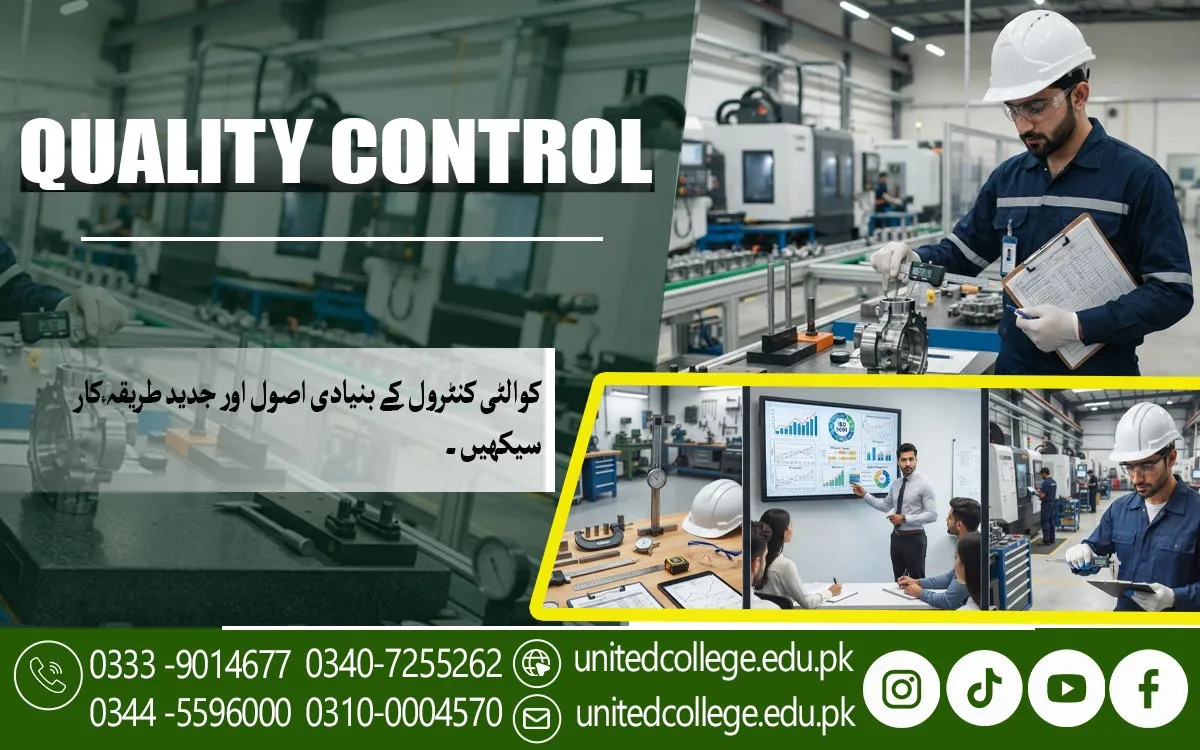

Quality Control Course in Chakwal for Quality Assurance Skills
The Importance of Quality Control in Modern Industries
Quality has become a key factor in determining the success of every industrial organization. Whether a company manufactures machinery, constructs buildings, produces food items, or develops engineering products, maintaining high-quality standards is essential for customer satisfaction and business growth. The Quality Control Course in Chakwal is designed to provide students with the practical knowledge and technical expertise required to inspect products, monitor production activities, and maintain quality standards in different industries.
This course combines theoretical concepts with practical industrial training, allowing learners to understand how quality control systems operate in real workplaces. Students develop skills in product inspection, quality documentation, testing procedures, process monitoring, and defect identification. These competencies help graduates become valuable assets in organizations that prioritize quality and operational excellence.
The training is suitable for fresh students, diploma holders, technicians, supervisors, engineers, and professionals who want to improve their technical qualifications. By completing this course, participants gain the confidence to work in manufacturing plants, construction companies, pharmaceutical industries, engineering firms, and other sectors where quality plays a critical role.
Understanding the Value of Quality Control in Industry
Quality control is much more than inspecting finished products. It is a complete system that ensures every stage of production follows established standards and delivers consistent results. Organizations invest in quality control because it helps reduce defects, minimize waste, improve customer satisfaction, and strengthen business performance. Without an effective quality control process, even well-designed products can fail to meet customer expectations.
The Quality Control Course in Chakwal introduces learners to the importance of maintaining quality throughout the production cycle. Students understand how inspection activities begin with raw material verification and continue through manufacturing until the final product is approved. This systematic approach helps businesses maintain consistency while reducing production risks and operational costs.
The course also explains how quality control contributes to workplace safety, regulatory compliance, and continuous improvement. Students learn that quality professionals work closely with engineers, supervisors, and production teams to solve problems before they affect the final product. This knowledge provides a strong foundation for developing successful industrial careers.
Learn Practical Product Inspection Techniques
Product inspection is one of the most important responsibilities of a quality control professional. Every component and finished product must be examined carefully to ensure it meets technical specifications and customer requirements. Accurate inspections reduce production errors and improve product reliability.
During the Quality Control Course in Chakwal, students learn different inspection methods used in manufacturing, engineering, construction, pharmaceutical, and production industries. They understand how incoming materials are inspected, how products are monitored during manufacturing, and how final inspections verify product quality before delivery.
Practical training enables learners to identify visible defects, examine product dimensions, evaluate workmanship, and apply inspection criteria correctly. Through industrial examples and workshop activities, students build confidence in performing professional quality inspections while improving observation and decision-making skills.
Develop Precision Through Measuring and Testing
Accurate measurement is essential for maintaining product quality because even small variations can affect product performance and customer satisfaction. Quality control professionals must understand how to use precision measuring instruments correctly and interpret inspection results with confidence.
The Quality Control Course in Chakwal provides hands-on experience with measuring tools such as vernier calipers, micrometers, steel rulers, gauges, measuring tapes, and other precision equipment commonly used in industrial environments. Students practice measuring components accurately and comparing results with technical specifications to ensure compliance with production requirements.
The course also introduces testing procedures that evaluate product quality, durability, and performance. Learners understand how measurements and testing work together to improve manufacturing accuracy, reduce material waste, and support continuous quality improvement. These practical skills prepare graduates for technical roles where precision and accuracy are essential.
Build Strong Quality Reporting and Documentation Skills
Quality documentation is one of the most important responsibilities of a quality control professional because every inspection and testing activity must be recorded accurately. Proper documentation allows organizations to monitor product quality, identify recurring issues, and maintain complete records of production performance. Well-prepared reports also provide evidence that products have been inspected according to company policies and industry standards.
The Quality Control Course in Chakwal teaches students how to prepare professional inspection reports, quality checklists, non-conformance reports, corrective action reports, and production records. Learners understand how organized documentation improves communication between inspectors, production departments, engineers, and management. Accurate records also make it easier to trace production history whenever quality concerns arise.
Practical exercises help participants develop confidence in writing inspection findings, maintaining document control, and preparing technical reports using professional formats. These documentation skills are highly valued because they support quality improvement programs, customer satisfaction, regulatory compliance, and effective decision-making within industrial organizations.
Understand Modern Quality Assurance Practices
Quality Assurance (QA) is a proactive approach that focuses on preventing defects before they occur rather than correcting problems after production. Organizations implement quality assurance systems to improve consistency, reduce waste, and increase customer confidence. Understanding QA principles helps professionals contribute to continuous improvement across every stage of production.
The Quality Control Course in Chakwal introduces students to the relationship between Quality Assurance and Quality Control while explaining how both functions work together to maintain product quality. Learners study quality planning, process control, standard operating procedures, quality objectives, and preventive measures that improve manufacturing performance.
Students also become familiar with internationally accepted quality management concepts that help organizations maintain competitiveness in domestic and international markets. Through practical examples, participants understand how quality assurance contributes to safer products, efficient production systems, and long-term business success.
Explore Career Opportunities in the Quality Control Field
The demand for trained quality control professionals continues to increase as industries expand and adopt higher production standards. Manufacturing companies, engineering organizations, construction firms, pharmaceutical industries, food processing plants, and automotive companies all require skilled personnel who can monitor product quality and ensure compliance with industrial specifications.
After completing the Quality Control Course in Chakwal, graduates can apply for positions such as Quality Control Inspector, QA/QC Assistant, Production Quality Officer, Laboratory Technician, Documentation Coordinator, Process Inspector, Quality Auditor, and Quality Supervisor. These roles offer opportunities to work in professional environments where technical knowledge and attention to detail are highly valued.
The course also provides an excellent foundation for future professional growth. Graduates may continue with advanced certifications, specialized industrial training, or higher education related to quality management. As industries continue to emphasize quality improvement, qualified QA/QC professionals remain among the most sought-after technical specialists.
Move Forward with Confidence Through Professional Training
Professional training is an investment that creates long-term career opportunities and personal development. Learning quality control enables individuals to develop analytical thinking, technical competence, problem-solving abilities, and professional discipline. These qualities help graduates perform effectively in industries where maintaining product quality is a top priority.
The Quality Control Course in Chakwal provides comprehensive education that combines theoretical understanding with practical industrial experience. Students graduate with the knowledge required to perform inspections, prepare technical reports, evaluate product quality, monitor production processes, and support organizational quality objectives. The balanced learning approach ensures graduates are prepared for real workplace responsibilities.
Whether you are beginning your technical career or seeking to improve your existing qualifications, this course provides the practical skills needed to succeed in today's competitive industrial environment. By mastering quality control techniques, learners position themselves for rewarding careers while helping organizations deliver reliable, safe, and high-quality products.
Frequently Asked Questions (FAQs)
Yes. The course is designed for beginners as well as technicians, diploma holders, engineers, and professionals who want to develop practical quality control skills.
You will learn inspection techniques, measuring instrument handling, quality reporting, process monitoring, defect identification, testing methods, and quality documentation used in industrial workplaces.
Yes. The course prepares students for opportunities in manufacturing, construction, engineering, pharmaceuticals, food processing, automotive, textile, and other quality-focused industries.
Yes. Students participate in practical sessions involving product inspection, measurements, testing procedures, quality documentation, and workplace-based quality control activities.
Quality control helps organizations maintain product consistency, reduce production errors, improve customer satisfaction, meet industry standards, and increase overall operational efficiency.
Admission Open: Start Your Professional Journey Today!
Join United College of Technology and build a career with practical training, recognized certifications, and Gulf job support. Seats are limited.
Apply Now via WhatsAppContact Information
- Address: Rawalpindi: F-272 Main New Katarian Stop, Old IJP Road | Lahore Campus: Lahore, Pakistan
- Phone/WhatsApp: 0333-9014677 / 0344-5596000 / 0310-0004570 / 0301-5044340 / 0340-7255262
- Website: unitedcollege.edu.pk
















Leave a Comment