

Quality Control Course in Dera Ghazi Khan – Professional Training
Professional Quality Control Training
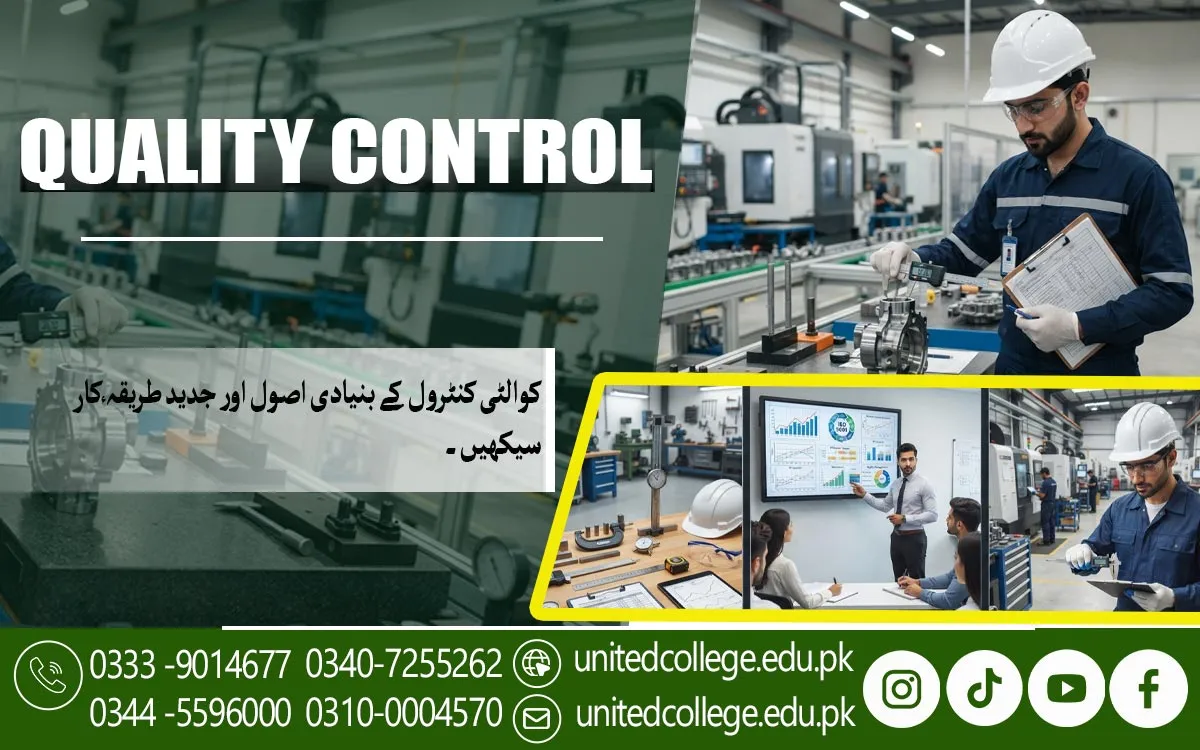
Maintaining consistent product quality is one of the biggest priorities for modern industries. Companies rely on qualified quality control professionals to inspect materials, monitor production, identify defects, and ensure every product meets industry standards before reaching customers. The Quality Control Course in Dera Ghazi Khan is designed to provide practical knowledge and technical expertise that help learners become valuable members of industrial quality teams.
This course combines classroom learning with practical training to develop the skills required for quality inspection, testing, documentation, and process monitoring. Students gain an understanding of how quality control improves productivity, reduces waste, and increases customer confidence. Whether you are beginning your professional journey or upgrading your technical skills, this course provides the knowledge needed to work confidently in today's competitive industries.
Why Quality Control Is Essential in Modern Industries?
Every industry depends on quality control to produce reliable products and maintain customer trust. A small manufacturing error can result in financial losses, safety concerns, and damage to a company's reputation. Quality control professionals play an important role in preventing these problems by inspecting products throughout the production process.
The Quality Control Course in Dera Ghazi Khan helps students understand how quality systems contribute to efficient production and long-term business success. Learners discover how quality standards improve product consistency while reducing defects and unnecessary production costs.
Students also learn that quality control is not limited to final inspections. Effective quality management begins with raw material inspection and continues throughout every stage of manufacturing, ensuring that problems are identified before they become expensive mistakes.
Develop Practical Inspection and Measurement Skills
Successful quality control professionals must know how to inspect products accurately using professional techniques and measuring instruments. This course provides hands-on training that helps students perform inspections with confidence.
Participants learn how to use measuring tools such as vernier calipers, micrometers, gauges, measuring tapes, and precision instruments commonly found in industrial workplaces. Accurate measurements allow inspectors to verify whether products meet required specifications and engineering drawings.
Practical sessions also teach students how to perform dimensional inspections, visual examinations, surface quality checks, and material verification. These activities build confidence while preparing learners for real industrial environments where precision is essential.
Learn Quality Assurance and Process Improvement
Quality assurance focuses on preventing defects before they occur rather than simply identifying problems after production. Understanding this approach helps organizations improve efficiency and maintain consistent product quality.
The Quality Control Course in Dera Ghazi Khan introduces learners to quality assurance principles, process monitoring techniques, and continuous improvement methods used by modern industries. Students understand how proper planning and monitoring reduce production errors and increase operational performance.
By studying process improvement strategies, learners develop the ability to identify production weaknesses, recommend practical solutions, and support organizational quality objectives that benefit both businesses and customers.
Master Documentation and Industrial Reporting
Documentation is an essential responsibility for every quality control professional. Inspection findings must be recorded accurately to maintain traceability and support future quality improvements.
Students learn how to prepare inspection reports, quality records, non-conformance reports, corrective action reports, and production documentation. Proper reporting ensures effective communication between production teams, supervisors, and management.
The course also explains the importance of maintaining organized quality records that help companies comply with industry regulations, customer requirements, and internal quality management systems.
Understand International Quality Standards
Many industries operate according to internationally recognized quality standards to ensure consistency and customer satisfaction. Understanding these standards increases employment opportunities for quality control professionals.
This course introduces students to the fundamentals of ISO-based quality management systems and explains how standardized procedures improve manufacturing performance. Learners understand the value of quality policies, documented procedures, and continuous improvement, serving both domestic and international markets while maintaining professional quality standards monitoring.
Knowledge of international quality standards enables graduates to work more effectively in organizations that serve both domestic and international markets while maintaining professional quality practices.
Gain Experience Through Practical Industrial Training
Practical experience is one of the most valuable parts of quality control education. Students develop confidence by participating in inspection exercises that simulate real industrial situations.
The Quality Control Course in Dera Ghazi Khan includes practical demonstrations, equipment handling, defect identification, sampling methods, and inspection planning. These activities allow learners to apply theoretical knowledge in realistic working conditions.
By practicing quality inspection procedures, students become familiar with workplace responsibilities and improve their ability to make accurate quality decisions under professional supervision.
Career Opportunities for Quality Control Professionals
Industries across Pakistan continue to seek trained quality control personnel who can maintain production standards and improve manufacturing efficiency. Graduates of this course have access to employment opportunities in a variety of industrial sectors.
Career options include Quality Control Inspector, QA/QC Technician, Quality Assurance Assistant, Production Inspector, Documentation Officer, Laboratory Technician, Quality Coordinator, and Industrial Quality Supervisor. These positions exist in manufacturing plants, construction companies, pharmaceutical organizations, engineering firms, food processing industries, textile factories, automotive companies, and oil and gas projects.
As industrial development continues to expand, professionals with quality control expertise remain valuable because every organization requires reliable systems to maintain product quality and customer satisfaction.
Build a Strong Professional Future with Quality Control Training
Professional quality control skills provide long-term career stability and continuous opportunities for growth. Companies value employees who can improve production quality, reduce waste, and ensure compliance with industry standards.
The Quality Control Course in Dera Ghazi Khan prepares students with practical inspection knowledge, quality assurance techniques, documentation skills, testing methods, and industrial best practices that employers actively seek. Graduates leave the course with greater confidence and a stronger understanding of modern quality management systems.
Choosing professional quality control training is an investment in a successful technical career. With the right knowledge and practical experience, students can contribute to safer production processes, better product quality, and improved organizational performance across multiple industries.
Frequently Asked Questions (FAQs)
Yes. The course is designed for both beginners and experienced individuals who want to develop professional quality control skills.
Students learn product inspection, measurement techniques, quality documentation, defect identification, testing procedures, and quality assurance practices.
Manufacturing, construction, engineering, pharmaceuticals, food processing, textiles, automotive, and oil and gas industries all require qualified quality control personnel.
Yes. Practical sessions include inspections, measuring instrument handling, reporting procedures, and real industrial quality control exercises.
Yes. Professional quality control skills increase employability and prepare graduates for a wide range of technical and industrial positions.
Admission Open: Start Your Professional Journey Today!
Join United College of Technology and build a career with practical training, recognized certifications, and Gulf job support. Seats are limited.
Apply Now via WhatsAppContact Information
- Address: Rawalpindi: F-272 Main New Katarian Stop, Old IJP Road | Lahore Campus: Lahore, Pakistan
- Phone/WhatsApp: 0333-9014677 / 0344-5596000 / 0310-0004570 / 0301-5044340 / 0340-7255262
- Website: unitedcollege.edu.pk
















Leave a Comment