



Quality Control Course in Mansehra for Technical Excellence
Explore the Foundations of Professional Quality Control
Quality control is a systematic process that ensures products and services meet specified requirements before reaching customers. Every stage of production requires careful monitoring to identify defects, maintain consistency, and improve overall performance. Organizations invest heavily in quality systems because delivering reliable products strengthens customer confidence and business growth.
The Quality Control Course in Mansehra introduces learners to the core principles of quality control and explains how these principles are applied in different industries. Students gain a clear understanding of inspection planning, production monitoring, quality objectives, and the importance of maintaining consistent standards throughout manufacturing operations.
The course also highlights the relationship between quality, safety, efficiency, and customer satisfaction. By understanding these connections, students develop a broader perspective of how quality professionals contribute to the success of industrial organizations.
Learn Advanced Product Inspection and Evaluation Methods
Inspection is one of the most important responsibilities of a quality control professional. Accurate inspections help organizations identify defects early, reduce production losses, and maintain product reliability. This Quality control course provides detailed knowledge of inspection procedures used in modern industrial environments.
Students learn how to inspect incoming materials, monitor products during manufacturing, and evaluate finished goods before delivery. They understand the purpose of visual inspection, dimensional verification, sampling techniques, and product evaluation methods that help maintain consistent quality throughout production.
Practical activities strengthen observation skills and teach participants how to identify manufacturing defects, classify quality issues, and prepare recommendations for improvement. These experiences prepare learners to perform inspections confidently in real workplace situations.
Master Industrial Measuring and Testing Techniques
Precision measurement is essential for ensuring that products meet technical specifications and customer requirements. Small measurement errors can lead to defective products, increased production costs, and customer complaints. For this reason, quality control professionals must understand how to use measuring equipment correctly.
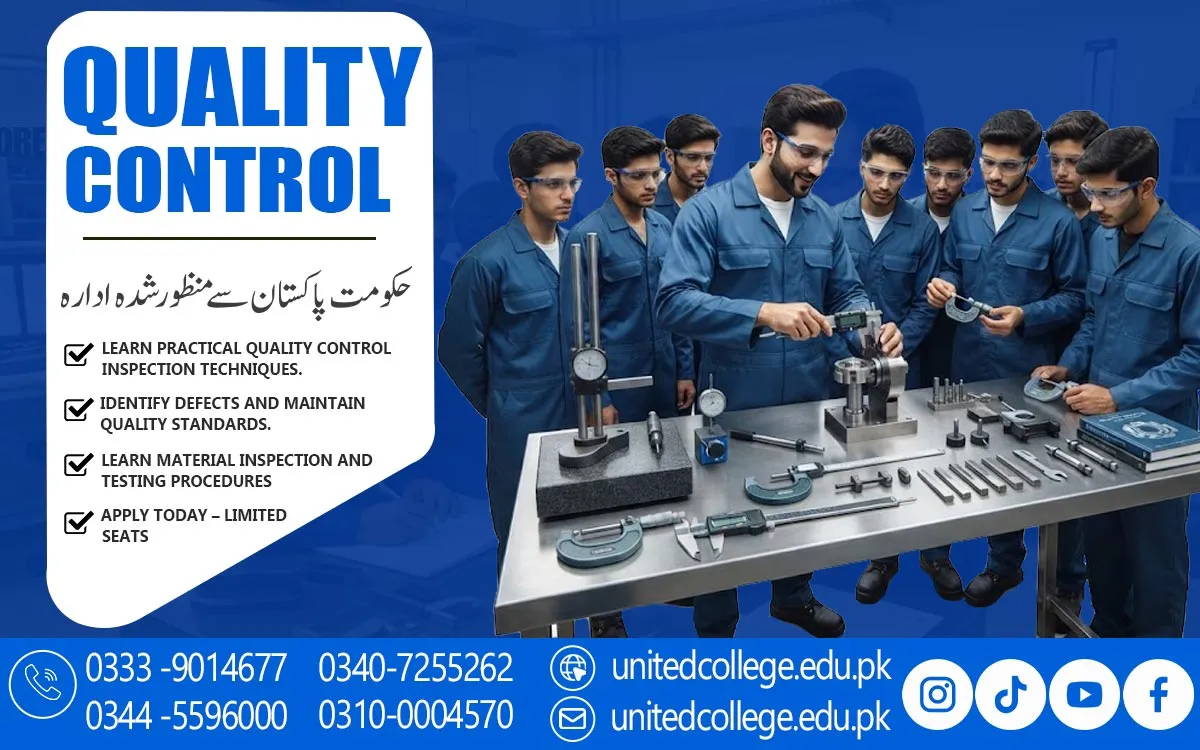
The Quality Control Course in Mansehra provides practical experience with measuring instruments such as vernier calipers, micrometers, dial indicators, gauges, steel rules, and other precision tools commonly used in industry. Students learn correct measuring procedures and understand how accurate measurements improve product quality and manufacturing efficiency.
The course also introduces basic testing techniques used to evaluate product performance and material quality. Through practical demonstrations, learners gain confidence in collecting accurate inspection data and making informed quality decisions.
Improve Process Monitoring and Defect Prevention Skills
Modern industries focus not only on detecting defects but also on preventing them before they occur. Process monitoring helps identify production problems at an early stage, allowing companies to take corrective action before quality is affected.
During the Quality Control Course in Mansehra, students learn how production processes are monitored and controlled using structured inspection methods. They understand how quality checkpoints, production records, and inspection schedules contribute to maintaining consistent manufacturing standards.
Participants also explore common causes of production defects and learn practical approaches for minimizing errors, reducing waste, and improving operational efficiency. These skills enable graduates to support continuous improvement initiatives within industrial organizations.
Develop Professional Quality Documentation Skills
Quality documentation provides evidence that products have been inspected according to established procedures. Accurate records also help organizations analyze quality performance, resolve customer complaints, and comply with regulatory requirements.
This course teaches students how to prepare inspection reports, quality checklists, non-conformance reports, corrective action reports, and production records. Learners understand how organized documentation supports effective communication between quality inspectors, production staff, and management teams.
Students also become familiar with document control practices and record management systems that improve traceability and simplify future quality audits. These documentation skills are highly valued across various industrial sectors.
Understand Quality Management Systems and Industry Standards
Organizations that maintain high-quality standards often operate under structured quality management systems. These systems establish procedures that help businesses deliver consistent products while continuously improving their operations.
The Quality Control Course in Mansehra introduces students to the fundamentals of quality management systems and internationally accepted quality practices. Learners understand the importance of standard operating procedures, quality policies, internal audits, and process standardization.
Knowledge of industry standards enables graduates to work more effectively within organizations that prioritize compliance, efficiency, and customer satisfaction. This understanding also supports future career growth in quality assurance and industrial management.
Discover Diverse Career Opportunities in Quality Control
Quality control professionals are required in nearly every industrial sector because maintaining product quality is essential regardless of the type of business. As industries continue to expand, qualified QA/QC personnel remain in high demand across Pakistan and internationally.
After completing the Quality Control Course in Mansehra, graduates can pursue careers as Quality Control Inspectors, QA/QC Technicians, Production Quality Officers, Laboratory Assistants, Documentation Coordinators, Quality Auditors, Process Inspectors, and Industrial Quality Supervisors.
Employment opportunities are available in construction companies, manufacturing plants, engineering firms, pharmaceutical industries, food processing facilities, textile factories, automotive production units, and oil and gas organizations. The practical knowledge gained during the course also provides a strong foundation for future professional certifications.
Achieve Long-Term Success Through Quality Control Training
A career in quality control offers stability, professional development, and opportunities to work in a wide range of industries. Employers value individuals who possess technical knowledge, analytical thinking, attention to detail, and the ability to maintain production standards.
The Quality Control Course in Mansehra equips students with practical inspection techniques, testing knowledge, documentation skills, and quality management principles required by modern industries. Through comprehensive training, learners become capable of supporting production teams, improving operational efficiency, and maintaining high-quality standards.
Whether your goal is to secure your first industrial job, enhance your existing technical skills, or prepare for future career advancement, this course provides the practical foundation needed to succeed in the growing field of quality control.
Frequently Asked Questions (FAQs)
The course aims to teach students how to inspect products, monitor production quality, identify defects, prepare quality documentation, and apply quality management practices in industrial environments.
Yes. Students receive practical training on commonly used measuring and inspection instruments, helping them perform accurate quality checks in professional workplaces.
Yes. The course is suitable for both beginners and experienced professionals who want to improve their QA/QC knowledge and develop industry-relevant skills.
Graduates can find opportunities in manufacturing, construction, engineering, pharmaceuticals, food processing, textiles, automotive, electronics, and many other industries that require quality control professionals.
Quality control professionals help organizations reduce defects, improve production efficiency, maintain industry standards, enhance customer satisfaction, and ensure products meet required quality specifications before reaching the market.
Admission Open: Start Your Professional Journey Today!
Join United College of Technology and build a career with practical training, recognized certifications, and Gulf job support. Seats are limited.
Apply Now via WhatsAppContact Information
- Address: Rawalpindi: F-272 Main New Katarian Stop, Old IJP Road | Lahore Campus: Lahore, Pakistan
- Phone/WhatsApp: 0333-9014677 / 0344-5596000 / 0310-0004570 / 0301-5044340 / 0340-7255262
- Website: unitedcollege.edu.pk
















Leave a Comment