


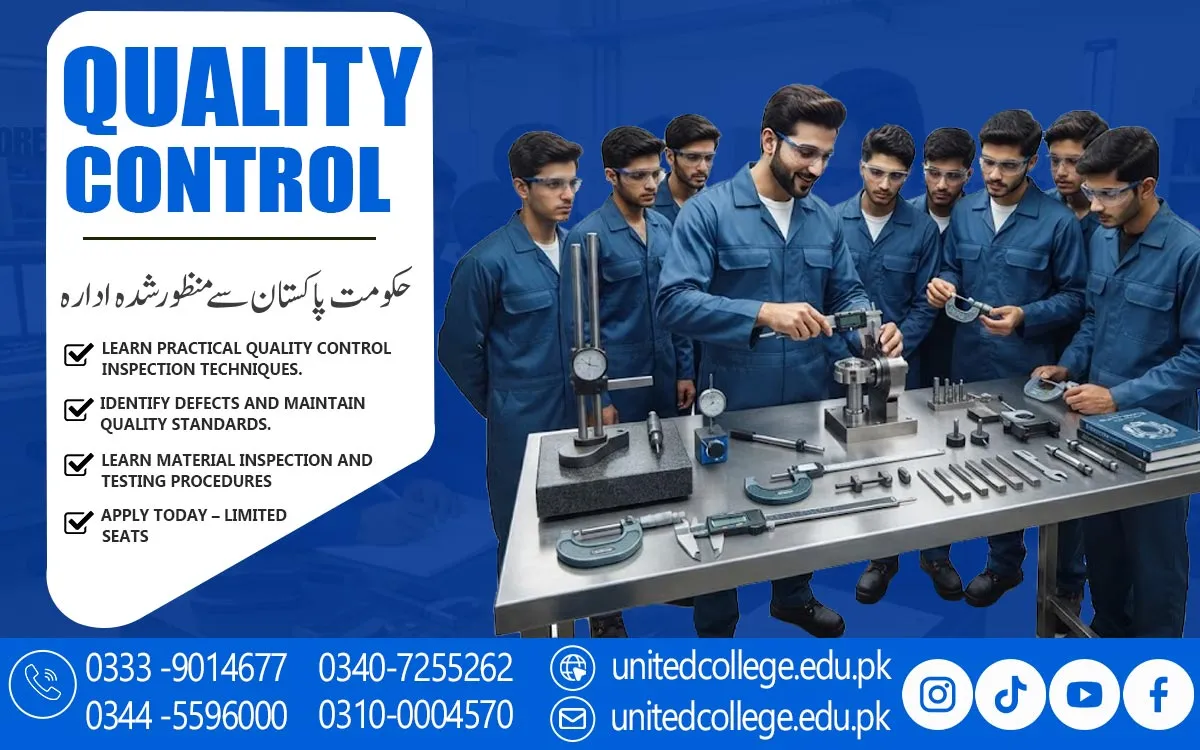

Quality Control Course in Okara – Build Practical QC Skills
One Small Defect Can Change the Quality of the Whole Product
Imagine buying a product that looks perfect at first, but after using it for a short time, you discover a loose part, incorrect measurement, weak finishing, or another small defect. What seemed like a minor issue can quickly become a bigger problem for both the customer and the business. In workplaces, quality cannot depend only on a final glance at the finished product. Materials, measurements, processes, workmanship, and final results all need proper attention. This is why quality control plays an important role in many practical industries.
A Quality Control Course in Okara can help beginners understand how quality inspection works and why careful checking is necessary at different stages of work. Through structured learning, students can become familiar with quality control procedures, inspection methods, defect identification, documentation, and workplace quality standards. United College of Technology offers this course as an opportunity for learners who want to understand the practical side of quality management and develop useful skills for quality-related work.
Learning to Notice Problems Before They Become Expensive
Have you ever wondered how a factory can produce hundreds of similar items while keeping their quality consistent? Careful inspection is one important part of the answer. Quality control helps workers identify problems before defective materials or products move further through the process. During a Quality Control Course, learners can develop the habit of checking work carefully rather than assuming everything is correct. They may learn how to compare a product or process with required specifications, notice visible defects, and recognize differences that could affect the final result.
For example, if a component has an incorrect size, a damaged surface, or poor finishing, identifying the issue early can make correction easier. Quality control is therefore not simply about finding mistakes after everything is finished. It involves regular checking and observation throughout the working process. This practical way of thinking can help beginners understand why businesses use inspection procedures to maintain product quality and reduce avoidable errors.
Quality Inspection Turns Careful Observation Into a Real Skill
A person may naturally have good observation skills, but professional quality inspection requires a more organized approach. An inspector needs to know what to check, how to check it, what result is expected, and how to record any difference that is found. A Quality Control Course in Okara can introduce learners to different inspection methods and explain how quality inspection can be carried out in a systematic way. Depending on the workplace, inspection may involve checking dimensions, appearance, materials, workmanship, performance, or other requirements.
Learners can also understand the importance of following a defined checking procedure instead of relying only on personal judgment. Defect identification is another important part of this learning process because some problems are easy to see while others may require measurement or testing. With practical quality control training, students can become more familiar with these tasks and understand how careful inspection contributes to better and more consistent work.
Quality Standards Give Workers Something Clear to Check Against
How can someone decide whether a product or piece of work is acceptable if there is no clear standard to compare it with? Quality standards provide the reference point that helps workers understand what is expected. In a workplace, these standards may relate to measurements, materials, appearance, performance, safety, procedures, or other specific requirements. During a Quality Control Course, learners can develop an understanding of why standards matter and how they guide inspection and decision-making. Instead of simply saying that something “looks fine,” a quality worker can compare the result with an established requirement.
This approach makes quality checking more consistent and reduces the chances of personal assumptions affecting the inspection. Workplace quality standards can also help different members of a team work toward the same expectations. For beginners, understanding this concept is important because quality control is based on consistency, accuracy, and following the correct procedures rather than making decisions without evidence.
Quality Control Finds Problems While Quality Assurance Helps Prevent Them
Quality control and quality assurance are closely connected, but they have different purposes. A simple way to understand the difference is to think of quality control as checking the actual work or product, while quality assurance focuses more on the processes used to maintain and improve quality. During a quality control course, learners can understand this difference through practical examples and workplace situations. For example, if an inspector finds that a product has an incorrect measurement, that inspection is part of quality control. Looking at why the same measurement problem keeps happening and improving the process to prevent it can be part of quality assurance and process improvement.
Through quality management training, beginners can learn why both approaches are useful. Quality assurance procedures may involve documented processes, workplace standards, checks, and systems that support consistent work. Understanding this difference can give learners a broader view of industrial quality management and show them that maintaining quality is not only about detecting defective products. It also involves creating better working methods that reduce the chances of repeated problems.
Testing and Defect Identification Require Accuracy and Patience
Not every quality problem can be identified simply by looking at a product. Sometimes testing or measurement is needed to determine whether something meets the required specification. Basic quality testing can help workers collect information about a product, material, or process and compare the result with expected requirements. During training, learners can understand why accuracy is important when taking measurements, recording results, or identifying defects. A small mistake in measurement or documentation can lead to an incorrect decision, so quality-related work requires patience and concentration.
Practical exercises can help beginners understand how inspection and testing work together. For instance, an item may appear acceptable visually but show a problem when its dimensions are checked properly. Learning these quality control techniques can help students develop a more careful approach to inspection. Over time, they can become more comfortable with measurement and inspection tasks and understand why evidence is important when making quality-related decisions.
Clear Documentation Helps Teams Act on Quality Problems
Finding a defect is only one part of the job. What happens after the defect is found can be just as important. If an inspection finding is not recorded properly, other team members may not know what happened, where the problem occurred, or what action is required. This is why quality documentation and reporting are important parts of quality control work. During a Quality Control Course in Okara, learners can become familiar with inspection reports, checklists, measurements, observations, and other records used to track quality. Good documentation does not mean creating unnecessary paperwork; it means recording useful information clearly and accurately.
Proper records can help teams identify repeated issues, compare inspection results, communicate with supervisors, and understand whether corrective actions are working. Communication skills are also important because a quality inspector may need to explain a problem to production workers, supervisors, engineers, or other team members. Learning to report findings in a clear and professional way can therefore become an important part of developing practical quality control skills.
Quality Control Skills Fit More Than One Type of Workplace
Quality control is not limited to one particular industry. In manufacturing, workers may check raw materials, production stages, finished products, measurements, and packaging. In construction, quality checks may involve materials, dimensions, workmanship, drawings, and site requirements. Factories, workshops, warehouses, production units, and engineering-related workplaces can also require regular inspection and quality monitoring. This makes quality control a practical field for learners who want to understand how standards are maintained in different working environments. A Quality Control Course in Okara can help students understand these different applications without assuming that every workplace follows exactly the same procedures.
The specific inspection methods and responsibilities can change according to the industry, but important skills such as attention to detail, accuracy, documentation, teamwork, and following standard operating procedures remain relevant. Learning about these applications can also help beginners develop a clearer picture of what quality-related work may involve before they decide which area they would like to explore further.
Building Practical Quality Control Skills for the Next Step
Learning quality control is not only about remembering definitions; it is about developing a careful way of working. A person who enjoys checking details, following procedures, identifying problems, keeping records, and finding practical solutions may find this field interesting. Through structured training at United College of Technology, learners can work toward understanding inspection methods, quality control procedures, quality assurance concepts, workplace standards, documentation, and practical quality-related tasks. After completing training, learners can continue improving through workplace experience, additional technical learning, and regular practice.
Depending on their qualifications and employer requirements, they may explore roles such as Quality Control Inspector, Quality Inspector, Quality Assurance Assistant, QC Technician, Production Quality Assistant, or Inspection Assistant. These career directions should be viewed realistically because responsibilities and requirements can differ from one workplace to another. The real value of a Quality Control Course in Okara is that it can give beginners a structured foundation for understanding quality work and help them develop the accuracy, observation, communication, and problem-solving skills needed to keep learning in a practical professional environment.
Frequently Asked Questions (FAQs)
A Quality Control Course in Okara helps learners understand quality inspection, defect identification, testing, measurements, documentation, and procedures used to maintain workplace standards.
Students, beginners, fresh learners, graduates, and job seekers interested in developing practical quality control skills can consider joining this type of training.
Learners may study quality inspection, inspection methods, defect identification, quality testing, measurements, documentation, quality standards, and quality control procedures.
Quality control focuses on checking products, materials, or work for defects, while quality assurance focuses on processes and systems that help maintain consistent quality.
Yes. Beginners can learn quality control concepts step by step and develop practical skills through inspection exercises, measurements, testing, documentation, and workplace examples.
Admission Open: Start Your Professional Journey Today!
Join United College of Technology and build a career with practical training, recognized certifications, and Gulf job support. Seats are limited.
Apply Now via WhatsAppContact Information
- Address: Rawalpindi: F-272 Main New Katarian Stop, Old IJP Road | Lahore Campus: Lahore, Pakistan
- Phone/WhatsApp: 0340-7255262 / 0333-9014677 / 0301-5044340 / 0310-0004570 / 051-8770756
- Website: unitedcollege.edu.pk
















Leave a Comment