


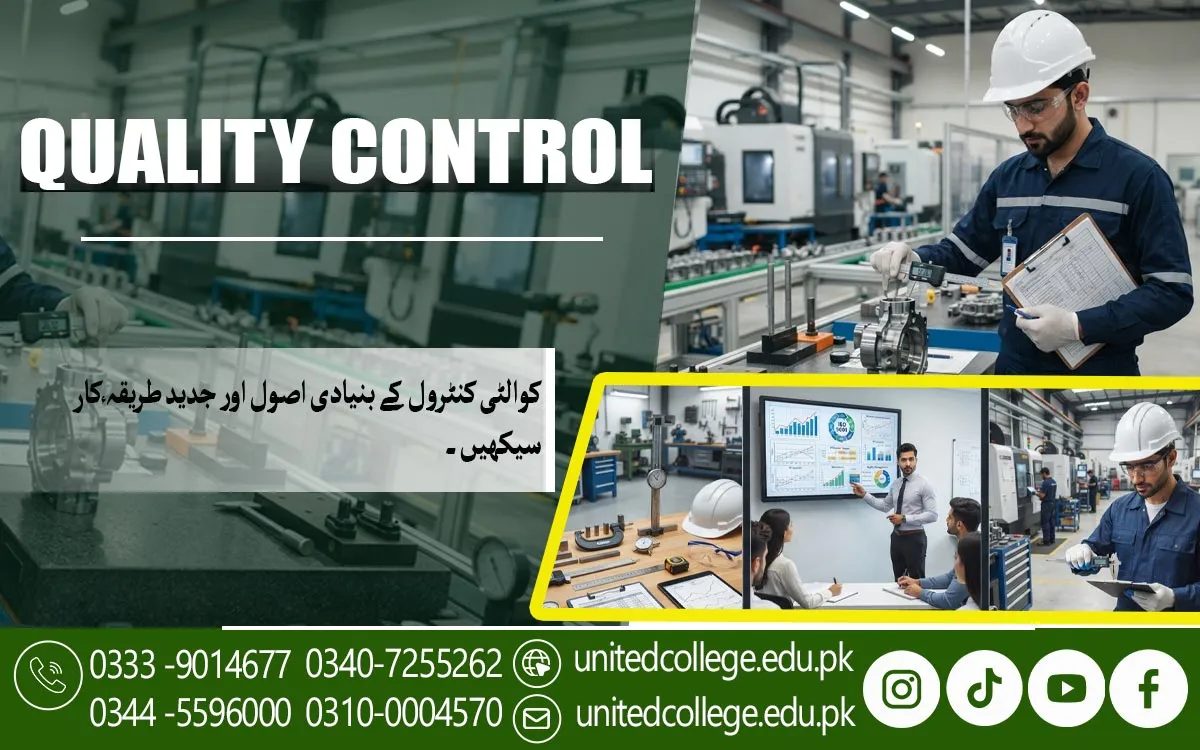

Quality Control Course in Khanewal – Learn Practical QC Skills
When One Small Defect Can Affect the Entire Product
Have you ever looked at a product and noticed that one small defect made the whole thing feel unreliable? A minor crack, incorrect measurement, weak material, poor finishing, or missing detail can sometimes create a much bigger problem than expected. In manufacturing, construction, workshops, warehouses, and production units, quality cannot depend only on a final visual check. Every stage needs attention so that problems can be identified before they affect the finished work. This is where quality control becomes an important practical field.
A Quality Control Course in Khanewal can introduce beginners to the skills used to inspect materials, products, processes, and completed work according to expected requirements. Instead of simply looking for mistakes, learners can understand how quality inspection works, why defects happen, how measurements are checked, and how proper records help workers make better decisions. United College of Technology provides a learning opportunity for people who want to develop these practical quality-related skills while building an understanding of workplace procedures and standards.
Learning to Look Beyond “Good Enough” at Work
Quality control is not simply about deciding whether something looks good or bad. A trained person needs to compare the actual result with a required specification, procedure, drawing, measurement, or workplace standard. For example, a manufactured component may appear perfectly fine but still have an incorrect measurement that affects how it works with another component. Similarly, construction work may look complete while certain materials, dimensions, or finishing details do not meet the required standard.
Through quality control training, beginners can learn to look at work more carefully and develop a habit of checking important details instead of making quick assumptions. A quality control course can introduce learners to inspection methods, product inspection, measurement and inspection, defect identification, and quality testing in a straightforward way. This approach is useful because quality-related work requires patience and consistency. The goal is not to find faults simply for the sake of finding them; it is to identify problems early, understand what needs attention, and help maintain consistent quality throughout a process.
Finding Defects Before They Become Bigger Problems
Imagine a production line where a small defect is ignored because it seems unimportant. If the same issue continues through several stages, dozens or even hundreds of products may eventually require correction. This is why defect identification is an important part of quality control procedures. During training, learners can become familiar with different ways of noticing defects, checking materials, comparing results with specifications, and identifying unusual changes in a product or process. Some defects may be visible, while others may become clear through measurements, testing, or careful inspection.
Quality inspection techniques help workers approach these situations systematically rather than relying only on personal judgment. Beginners can also learn why the cause of a defect matters. Fixing one damaged item may solve an immediate problem, but understanding why the defect occurred can help prevent similar issues from happening again. This connects quality control with process improvement, problem-solving, and better workplace practices.
Measurements and Inspection Tools Turn Guesswork Into Evidence
In quality-related work, saying that something “looks right” is often not enough. Measurements and inspection tools provide evidence that can be compared with an expected requirement. Depending on the workplace, these checks may involve dimensions, weight, alignment, thickness, temperature, finishing, or other measurable characteristics. A Quality Control Course in Khanewal can help beginners understand the purpose of measurement and inspection and why accuracy matters when checking products or processes.
Learners can become more comfortable with the idea of following a defined checking procedure rather than making random judgments. Practical exercises can also make technical concepts easier to understand because students can see how a measurement changes the inspection result. With repeated practice, learners can develop greater confidence in recording observations, identifying differences, and communicating findings. These skills are useful in environments where production quality depends on consistent measurements and where even a small variation may need to be investigated.
Quality Control Checks the Result While Quality Assurance Builds the Process
The terms quality control and quality assurance are often used together, but they do not mean the same thing. Quality control mainly focuses on checking work, products, or outputs to identify whether they meet specified requirements. Quality assurance, on the other hand, is more focused on the processes and systems used to prevent quality problems from occurring in the first place. For a beginner, a simple way to understand the difference is to think of quality control as checking the result and quality assurance as improving the process behind that result.
During quality assurance training, learners may explore procedures, standards, documentation, and systems that support consistent work. A quality management system can bring these activities together by creating organized methods for planning, checking, recording, and improving processes. Understanding this difference gives learners a wider view of quality management and shows them that good quality is not created by inspection alone. It depends on people, procedures, communication, materials, equipment, and consistent working practices.
Inspection Reports Make Quality Problems Easier to Understand
A quality inspector may identify an issue, but the work does not necessarily end there. The finding usually needs to be recorded clearly so that other people can understand what happened and decide what action may be needed. This is why quality documentation is an important part of quality control work. During a quality control course, learners can understand the purpose of inspection reports, checklists, observations, measurements, and other records used to track quality. Good documentation should make information easier to follow rather than creating unnecessary paperwork.
For example, an inspection report may describe what was checked, what problem was found, where it occurred, and what measurement or observation supported the finding. Clear records can also help teams compare repeated problems and identify patterns over time. Developing this habit can improve communication between inspectors, supervisors, production workers, engineers, and other team members. For someone entering this field, learning to record information accurately can be just as important as learning how to identify a defect.
Quality Skills Can Be Used Across Different Workplaces in Khanewal
Quality requirements can change from one workplace to another, but the need for careful inspection and consistent procedures remains important in many industries. A person with practical quality control skills may encounter these responsibilities in manufacturing facilities, construction projects, production units, warehouses, workshops, factories, engineering-related workplaces, and other environments where materials or finished work need to meet defined standards. In manufacturing quality control, attention may be given to raw materials, production stages, measurements, finished products, and packaging. In construction quality control, workers may focus on materials, dimensions, workmanship, specifications, and site procedures.
Warehouses and workshops may also require careful checking to ensure that items, equipment, or completed work meet the required condition. Learning about these different environments through a quality control course can help beginners understand that quality work is not limited to one industry. The exact duties can vary, but the underlying skills of observation, accuracy, documentation, communication, and following standard operating procedures remain valuable.
Practical Training Helps Turn Quality Knowledge Into Working Skills
Reading about inspection methods is useful, but quality control becomes much easier to understand when learners can connect information with practical situations. Hands-on practice can give students opportunities to work through checking procedures, examine examples of defects, take or compare measurements, complete inspection records, and think about what should happen after a problem is identified. This type of practical learning can make technical information less confusing for beginners because they are not only memorizing definitions; they are learning how those ideas can be applied. At United College of Technology, learners interested in a Quality Control Course in Khanewal can focus on developing an understanding of practical quality control skills alongside classroom knowledge.
The learning process can also introduce students to workplace quality standards, quality assurance procedures, inspection reports, and the importance of following established procedures. Regular practice is especially useful because quality-related work often requires consistency. A person may understand an inspection technique one day, but repeated practice helps make careful checking a more natural part of their working approach.
The Right Mindset Matters as Much as Technical Knowledge
Quality control can suit people who naturally notice details and prefer working with clear procedures, but technical knowledge alone is not enough. A good quality-related worker also needs patience, responsibility, communication skills, and the willingness to question something that does not appear correct. Sometimes a problem may be easy to see, while at other times it may require careful comparison, additional measurement, or discussion with another team member. Problem-solving is therefore an important part of quality work because identifying a defect is only the first step; understanding what happened and communicating the issue properly can be equally important.
After completing a Quality Control Course in Khanewal, learners may explore entry-level directions such as Quality Control Inspector, Quality Inspector, Quality Assurance Assistant, QC Technician, Production Quality Assistant, or Inspection Assistant, depending on their education, practical skills, and the requirements of individual employers. These roles can have different responsibilities, so gaining workplace experience and continuing to improve technical knowledge can be important. Ultimately, quality control is a field where careful thinking, accurate work, teamwork, and a consistent approach can help a learner build useful professional skills over time.
Frequently Asked Questions (FAQs)
A Quality Control Course in Khanewal helps learners understand quality inspection, defect identification, measurements, testing, documentation, and procedures used to maintain workplace standards.
Students, beginners, fresh graduates, job seekers, and individuals interested in developing practical quality control skills can consider joining this type of training.
Learners may study quality inspection, defect identification, inspection methods, measurements, quality testing, documentation, quality standards, and quality control procedures.
Quality control focuses mainly on checking products, materials, or work for defects, while quality assurance focuses on processes and systems designed to maintain consistent quality.
Yes. Beginners can learn quality control concepts step by step and develop practical skills through inspection exercises, measurements, documentation, and workplace-related examples.
Admission Open: Start Your Professional Journey Today!
Join United College of Technology and build a career with practical training, recognized certifications, and Gulf job support. Seats are limited.
Apply Now via WhatsAppContact Information
- Address: Rawalpindi: F-272 Main New Katarian Stop, Old IJP Road | Lahore Campus: Lahore, Pakistan
- Phone/WhatsApp: 0340-7255262 / 0333-9014677 / 0301-5044340 / 0310-0004570 / 051-6770756
- Website: unitedcollege.edu.pk
















Leave a Comment