


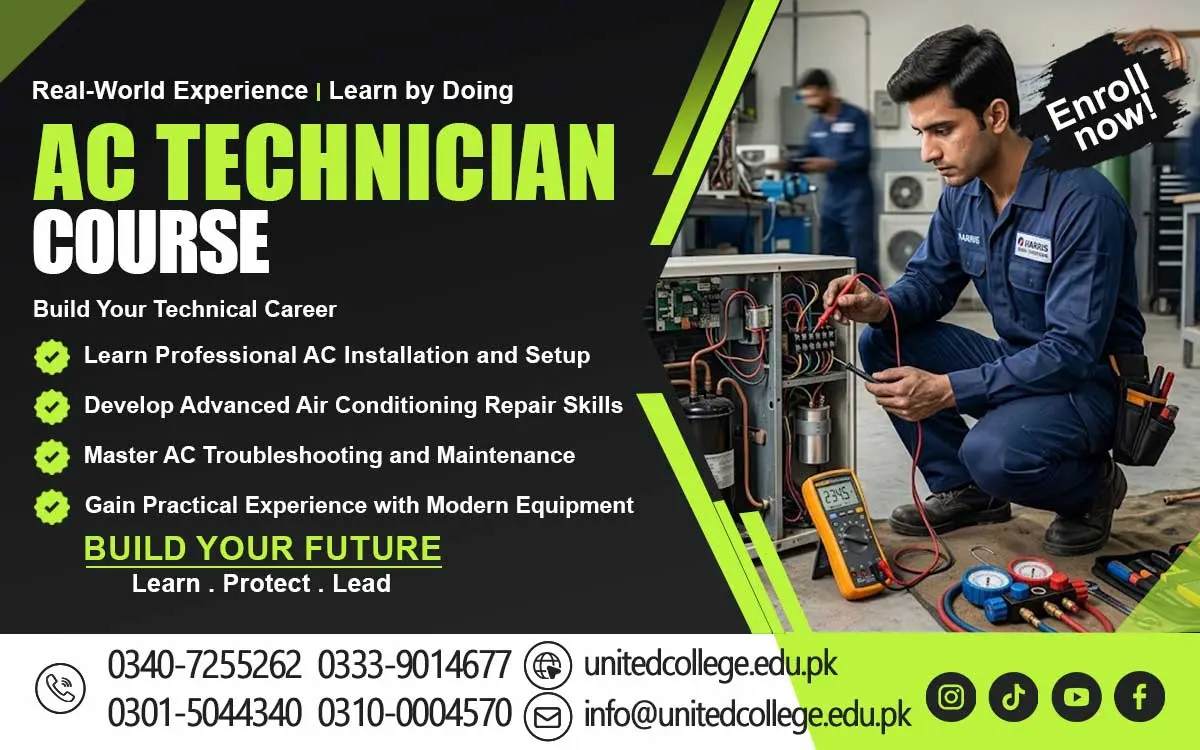

AC Technician Course in Bannu for Practical System Knowledge
AC Technician Course in Bannu to Turn Technical Interest Into Practical Cooling Skills
An air conditioner may look simple from the outside, but its cooling performance depends on several connected parts working together. When an AC stops cooling, makes unusual sounds, or develops an electrical fault, understanding the system becomes essential. The AC Technician Course in Bannu can be a useful learning path for beginners, students, and fresh learners who want to understand air conditioning installation, maintenance, and repair.
Through an Air Conditioning Course, learners can build their knowledge step by step, discover how cooling systems operate, and begin developing practical skills for technical work. Learning the basics also helps students understand why careful inspection, correct tools, and safe working habits matter during AC servicing.
Explore the Hidden Process That Keeps Indoor Spaces Cool
Air conditioners do more than blow cold air into a room. They transfer heat from indoor air to the outside environment through a cooling cycle. During this process, refrigerant moves through different components and changes pressure and temperature. The evaporator absorbs heat from indoor air, while the condenser releases that heat outdoors. The compressor helps move refrigerant through the system, and an expansion device controls its flow into the lower-pressure part of the cycle.
A thermostat monitors room temperature and helps control when the unit operates. Understanding these parts gives learners a strong foundation in HVAC Basic Skills. Through the AC Technician Course in Bannu, students can become familiar with common air conditioner designs, learn the purpose of each major component, and understand how one faulty part can affect overall cooling performance.
Turn Installation Knowledge Into Reliable Servicing Techniques
Correct installation plays an important role in an air conditioner’s performance and service life. Learners need to understand how technicians choose a suitable installation position, check mounting requirements, consider drainage, and follow manufacturer instructions. Split AC systems also require correct connections between indoor and outdoor units. Other important topics include suitable pipe routing, electrical supply requirements, and checks before the unit begins operating.
An AC Installation and Maintenance Training program can introduce these tasks in a structured way, helping beginners understand why careful planning matters before tools are used. Students can also learn the difference between installing a new unit and servicing an existing one. Refrigerant piping, evacuation, leak testing, and refrigerant charging require appropriate training and equipment, so beginners should study these procedures under qualified supervision rather than attempting them without preparation.
Learn to Spot Small Faults Before They Become Bigger Problems
An air conditioner can show several signs when something is wrong. Weak airflow may point to a dirty filter or an obstruction, while water dripping indoors can indicate a drainage problem or another fault that needs inspection. Unusual sounds, repeated shutdowns, poor cooling, and unexpected changes in operation may also require attention. A useful AC Technician Course teaches learners to observe these symptoms instead of guessing at the cause.
Students can learn to gather information, inspect accessible components safely, compare observations with the unit’s instructions, and identify when an issue requires an experienced technician. Cooling System Troubleshooting is not simply about replacing parts; it involves checking possible causes in a logical order. This approach helps learners avoid unnecessary part replacement and understand why a correct diagnosis should come before a repair.
Build a Practical Understanding of AC Tools and Equipment
AC technicians use different tools for inspection, cleaning, measurement, and installation. Common examples include screwdrivers, spanners, pliers, cleaning brushes, suitable fin-cleaning equipment, and measuring instruments. A multimeter can help trained users check electrical values, while manifold gauges are used for appropriate refrigerant-pressure measurements. Vacuum pumps support specific installation and servicing procedures, and leak-detection equipment helps identify possible refrigerant leaks.
Each tool has a particular purpose and must be used correctly. During Air Conditioner Technician Training, learners should understand how to select the right tool, inspect it before use, and follow the instructions provided by its manufacturer. They should also learn that some tools require specialist knowledge. Using equipment without understanding its limits can damage an AC system or create a safety risk, so guided demonstrations and supervised practice are important parts of skill development.
Make Electrical and Refrigerant Safety Part of Every Task
Air conditioning work involves electrical components, moving parts, pressurized refrigerant systems, and equipment installed at height. Safety must therefore come before speed. Before cleaning or inspecting a unit, technicians should follow the correct isolation procedure and verify that the equipment is safe to work on. Electrical checks should only be performed by people with suitable training and the right protective equipment. Learners must also understand that capacitors can retain an electrical charge even after power has been disconnected.
Refrigerants require careful handling because contact with escaping refrigerant can cause cold burns, and some refrigerants present additional risks under certain conditions. Never release refrigerant deliberately into the atmosphere. Proper recovery, leak control, ventilation, and manufacturer-approved procedures are essential. Good AC Technician Skills include recognizing when a task exceeds a beginner’s abilities and asking a qualified professional for help.
Improve Maintenance Skills Through Careful, Repeated Practice
Routine maintenance can help an air conditioner operate more effectively and make some problems easier to identify. Depending on the model and manufacturer’s instructions, maintenance may include cleaning or replacing accessible filters, inspecting air inlets and outlets, checking drainage, and looking for visible damage around the unit. Outdoor coils may also need appropriate cleaning when dirt or debris restricts airflow. Learners should understand that delicate fins can bend easily and that cleaning methods must suit the equipment.
A structured AC Technician Training in Bannu approach can help beginners build a maintenance checklist, record observations, and compare a unit’s condition before and after approved servicing tasks. Repeated practice makes it easier to notice unusual conditions, follow a consistent process, and keep track of work completed. Students should also learn when a problem requires advanced testing instead of routine cleaning.
Develop Confidence Through Guided Learning and Technical Observation
Beginners do not need to understand every repair procedure at once. A stronger approach starts with basic cooling principles, component identification, tool awareness, and safety rules before moving toward more complex tasks. Students can improve by observing experienced technicians, asking clear questions, reviewing equipment manuals, and practising approved activities under supervision.
The training offered by United College of Technology may be relevant to learners exploring structured technical education, but prospective students should confirm the current course content, practical arrangements, and other details directly with the institution. A good learning routine focuses on understanding why a procedure works, not simply copying someone else’s actions. This foundation helps learners approach unfamiliar equipment with greater care and develop the confidence to recognize their own limits.
Use Your New Knowledge as a Starting Point for Technical Growth
Learning air conditioning repair can open several possible directions for further skill development. After gaining suitable knowledge and practical experience, a learner may assist an experienced technician, take part in basic maintenance tasks within their competence, or continue developing installation and diagnostic abilities. Some may eventually consider offering servicing or repair work independently, provided they have the necessary experience, equipment, and understanding of applicable safety requirements.
Progress depends on practice, reliability, customer communication, and the ability to diagnose faults correctly; completing training alone does not guarantee employment or income. For anyone interested in technical work, the AC Technician Course in Bannu offers a subject worth exploring because it connects scientific principles with practical equipment and everyday cooling needs. By choosing training carefully, practising safely, and continuing to learn, beginners can build a useful foundation for long-term technical development.
Frequently Asked Questions (FAQs)
Correct airflow direction helps distribute cooled air more evenly and reduces uncomfortable hot spots within a room.
Servicing usually involves routine inspection and maintenance, while overhauling involves more extensive examination or dismantling when a system requires major work.
Leaves, dust, and other obstructions can restrict airflow around the outdoor unit, making heat release more difficult and potentially reducing cooling performance.
Damaged or missing insulation can cause unwanted heat transfer and condensation, which may affect system efficiency and create moisture problems.
Useful records may include the reported problem, inspection findings, maintenance performed, replaced parts, and any further work recommended.
Filter types differ in design, maintenance needs, and filtration performance. Understanding these differences helps technicians follow the correct cleaning or replacement instructions for each unit.
Admission Open: Start Your Professional Journey Today!
Join United College of Technology and build a career with practical training, recognized certifications, and Gulf job support. Seats are limited.
Apply Now via WhatsAppContact Information
- Address: Rawalpindi: F-272 Main New Katarian Stop, Old IJP Road | Lahore Campus: Lahore, Pakistan
- Phone/WhatsApp: 0340-7255262 / 0333-9014677 / 0301-5044340 / 0310-0004570 / 051-8770756
- Website: unitedcollege.edu.pk
















Leave a Comment