


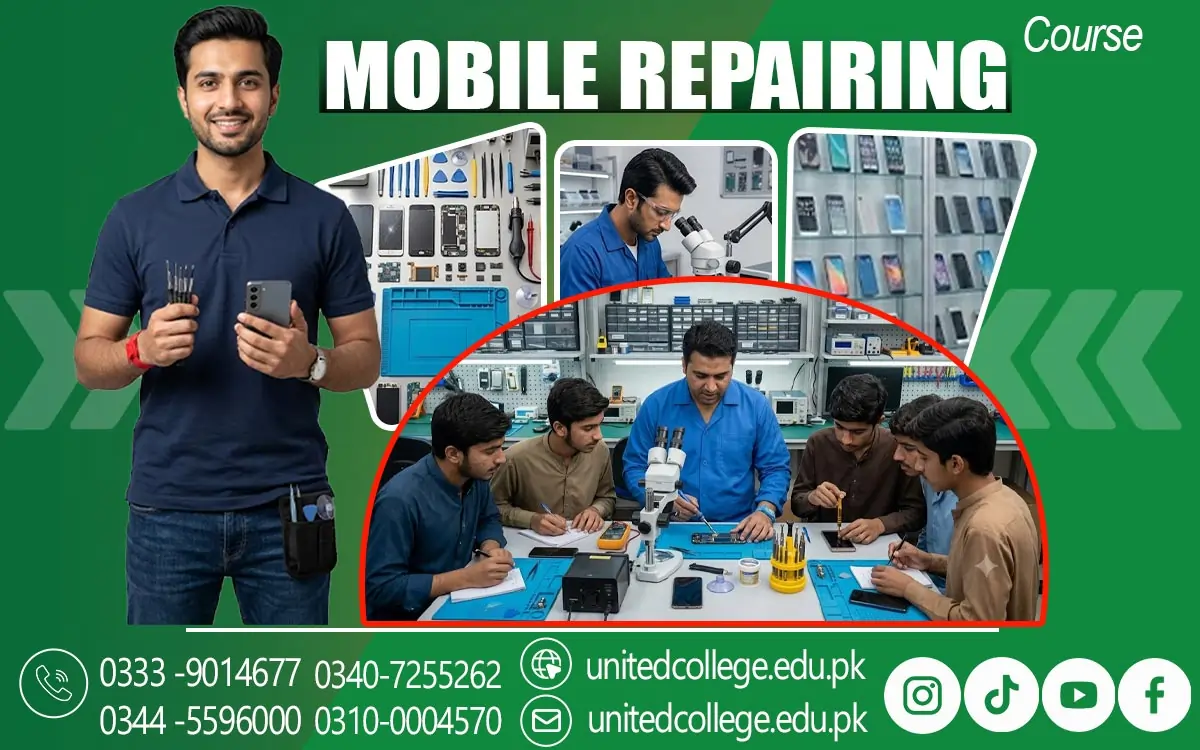

Mobile Repairing Course in Mandi Bahauddin for Technical Expertise
Make Technical Skill Your Strength
A smartphone can stop working at the most inconvenient time. A charging port may fail, the screen may stop responding, the battery may drain quickly, or a phone may develop a software problem after an update. Behind every such issue is a technical problem that needs careful checking rather than guesswork. This makes mobile repairing a useful practical skill for people who want to work with technology.
For students, beginners, and job seekers in Mandi Bahuddin, learning how smartphones function can open the door to a hands-on technical field. The Mobile Repairing Course in Mandi Bahuddin offered by United College of Technology allows learners to build knowledge through structured instruction and practical repair work.
A Smartphone Is More Than a Screen and Battery
Modern smartphones contain many interconnected parts, and understanding these components is an important starting point for effective repair work. A Mobile Repairing Course in Mandi Bahauddin can help students learn about the motherboard, PCB, battery, display, charging connector, camera, microphone, speaker, buttons, sensors, and other electronic components.
The purpose is not simply to memorize the names of different components. Learners need to understand the function of each part and how its failure can affect the overall performance of a phone. Through practical learning, students can develop a clearer understanding of mobile hardware and common faults.
Real Repair Work Begins When the Device Comes Apart
Mobile repairing is a hands-on field, so learners need experience working with actual tools and components. During training, beginners can learn how to open devices carefully, identify internal parts, disconnect connectors, and reassemble phones correctly.
Proper handling matters because smartphone components can be small and delicate. A learner can develop better control by practicing disassembly and assembly step by step. This type of mobile repair training turns theoretical information into practical experience and helps students become familiar with the workflow of a repair task.
Tools Become Easier When You Know Their Purpose
A repair technician works with different tools for different jobs. Depending on the task, these may include precision screwdrivers, tweezers, testing equipment, opening tools, soldering equipment, and other workshop items.
Students can learn how to select and handle tools appropriately instead of treating every repair problem in the same way. Safe tool use also protects the device and the technician. Developing this discipline is an important part of practical mobile repair training.
Fault Finding Is Where Technical Thinking Takes Over
A phone that does not turn on does not automatically have one specific fault. The cause may be related to the battery, power section, charging system, motherboard, connection, or software. A Mobile Repairing Course in Mandi Bahauddin can help students understand the importance of proper fault diagnosis and teach them to investigate a problem instead of immediately replacing parts. Students can practice basic fault diagnosis by observing symptoms, checking relevant components, and using suitable testing methods.
This approach can be applied to display failures, touch issues, speaker problems, microphone faults, camera errors, and network-related difficulties. For example, if a phone is not charging, a technician may examine the charging connector, battery condition, charging section, and related circuitry before deciding what action is required.
Charging, Display, and Battery Problems Need Different Approaches
Common smartphone problems can look similar from the outside but require different repair methods. A damaged display may need careful inspection before display replacement, while a battery problem requires attention to the condition and safe handling of the battery. Charging section repair may involve checking the charging connector and related circuitry. Speaker and microphone issues require another line of examination.
Network faults can also involve several possible causes, including settings, connections, antenna-related areas, software, or hardware. Learning these differences helps students avoid the habit of treating every damaged phone in the same way. A good mobile repair technician learns to connect the symptoms with the appropriate technical area.
Software Problems Need a Different Set of Skills
Hardware is only one side of smartphone servicing. Phones depend heavily on operating systems and software, so learners also need basic knowledge of software-related problems. A smartphone repair course can introduce students to software installation, updates, basic software troubleshooting, and mobile software flashing where appropriate. They can learn how software issues may affect performance, startup, applications, or other functions.
Understanding mobile software repair alongside hardware knowledge gives learners a broader view of smartphone servicing. It also helps them recognize when a problem may be software-related rather than caused by a physical component.
United College of Technology Turns Learning Into Practical Experience
The Mobile Repairing Course in Mandi Bahuddin at United College of Technology is designed as a practical learning path for people who want to understand the technical side of smartphones. Beginners can study basic concepts while gradually becoming familiar with tools, components, repair procedures, and troubleshooting methods.
Structured learning can make the process easier for fresh learners because they can develop skills step by step. Instead of trying to understand advanced motherboard repair or software work immediately, students can first build a solid foundation and then move toward more demanding tasks.
A Skill Can Grow Into Different Types of Work
Once learners develop useful mobile repairing skills, they can explore different ways of using them. Some may look for work as a mobile phone repair technician, while others may prefer assisting an experienced technician to gain additional practical exposure. With experience, a learner may also consider freelance servicing or developing a small mobile repair shop.
Running an independent setup requires more than repair ability; it can also involve customer communication, job organization, parts management, pricing decisions, and responsible handling of devices. The course does not guarantee a particular job or income, but it can provide a technical foundation that learners can continue developing through practice and experience.
The Right Learner Does Not Need to Know Everything on Day One
A person does not have to be an electronics expert before starting. Students, fresh learners, job seekers, and people interested in practical vocational training can begin by learning basic concepts and becoming comfortable with simple repair tasks. Curiosity can be useful because mobile repairing involves continuous problem-solving. Someone who enjoys understanding how things work may find the field particularly engaging. Consistent practice is more important than expecting to master every repair immediately.
Building a habit of learning can help a technician stay familiar with newer smartphone designs, components, software systems, and repair techniques. For learners in Mandi Bahuddin, the Mobile Repairing Course in Mandi Bahuddin can be a starting point for developing a practical technical ability. Through hardware knowledge, software understanding, tool handling, fault diagnosis, soldering practice, and safe repair methods, learners can begin turning an interest in smartphones into a useful skill.
Frequently Asked Questions (FAQs)
Yes, the field involves working with devices, tools, components, and repair tasks, making it suitable for learners who enjoy hands-on activities.
Training can help beginners recognize the difference between basic servicing, component-level tasks, software work, and more advanced technical repairs.
Regular practice, careful observation, proper tool handling, and reviewing completed repair tasks can help learners gradually strengthen their technical ability.
Yes, depending on experience and working arrangements, these skills can support independent servicing, freelance repair tasks, or assistance-based technical work.
Practice remains valuable because every device can present different conditions, helping technicians become more familiar with repair situations over time.
Yes, learners may later expand into related areas of electronics and device servicing as their technical knowledge and practical experience grow.
Admission Open: Start Your Professional Journey Today!
Join United College of Technology and build a career with practical training, recognized certifications, and Gulf job support. Seats are limited.
Apply Now via WhatsAppContact Information
- Address: Rawalpindi: F-272 Main New Katarian Stop, Old IJP Road | Lahore Campus: Lahore, Pakistan
- Phone/WhatsApp: 0340-7255262 / 0333-9014677 / 0301-5044340 / 0310-0004570 / 051-8770756
- Website: unitedcollege.edu.pk
















Leave a Comment