


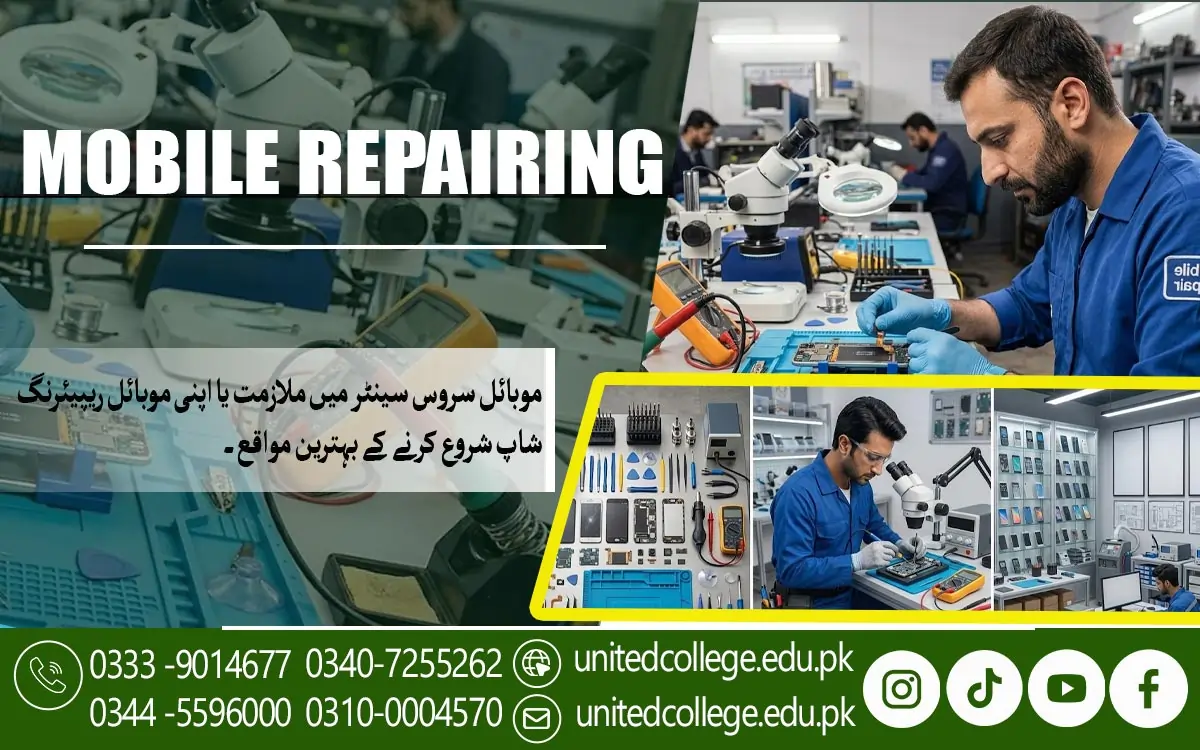

Mobile Repairing Course in Khushab to Master Smartphone Repair
Turn Phone Problems Into Technical Expertise
A mobile phone has become part of almost every area of daily life. People use smartphones for communication, study, online payments, business, entertainment, and many other tasks. When a phone stops charging, loses network signals, develops a display fault, or refuses to start, skilled repair work becomes necessary. This is why trained mobile technicians continue to have an important place in the technical service field.
For students and beginners in Khushab, learning mobile repairing can be a practical way to develop electronic repair skills. Instead of only using smartphones, learners can understand what happens inside them and how different faults can be examined. A Mobile Repairing Course in Khushab offered by United College of Technology can introduce beginners to this field through technical concepts, practical exercises, tools, and repair procedures.
The First Step Is Learning What a Smartphone Really Contains in Khushab
Before working on a damaged device, students need to understand its main parts and how they work together. A smartphone contains many small components, including the motherboard or PCB, battery, display, charging connector, camera modules, speakers, microphones, buttons, antennas, and other electronic parts. A Mobile Repairing Course in Khushab can introduce learners to these components in simple and understandable language.
Students can learn the purpose of each part and explore how one component can affect the performance of another. This basic knowledge creates a strong foundation for practical repair work. For learners in Khushab, understanding smartphone components can make later hardware troubleshooting easier. Instead of guessing the cause of a problem, students can learn to connect specific symptoms with possible component-related faults and approach repair tasks in a more systematic way.
From Opening a Phone to Putting It Back Together
Disassembly may look simple, but opening a smartphone without proper care can damage delicate parts. Learners need to understand how to use appropriate tools, remove covers safely, handle connectors, and keep small screws and components organized.
During mobile repair training in Khushab, practical exercises can help students become familiar with the process of taking a device apart and assembling it again. They can also learn how to avoid unnecessary pressure on flexible cables, connectors, screens, and other sensitive areas. This practical experience develops useful phone repair skills that cannot be gained from theory alone.
Where Circuits Start Making Sense
The PCB is one of the most important areas of a smartphone. Beginners do not need to become advanced electronics engineers immediately, but they should understand basic circuit concepts, connections, components, and common board-level terms.
A mobile technician course can introduce learners to simple PCB identification and basic electronic testing. With guided practice, students can understand how power moves through a device and how certain components contribute to its operation. This creates a foundation for mobile hardware repair and more focused troubleshooting later.
A Dead Battery and a Bad Charging Port Are Not the Same Problem
Charging faults are common reasons people take phones to repair shops. However, a device that does not charge may have several possible causes. The problem could involve the charging connector, cable connection, battery, charging circuit, software, or another component.
Students can learn to approach such faults systematically rather than replacing parts without checking them. Battery-related issues also require careful handling because batteries store electrical energy and must not be punctured, overheated, or mishandled. Learning safe procedures is an important part of practical mobile repairing and prepares learners to work more responsibly.
Screens, Sound, Cameras, and Signals Each Tell a Different Story
A smartphone can develop many visible or functional problems. A damaged display may show lines, unusual colors, or no image at all. Touch problems can affect only part of the screen or the entire touch function. Similarly, a weak speaker, faulty microphone, or camera failure can have different causes.
Network and signal problems require another type of examination. A technician may need to consider the SIM connection, antenna-related areas, settings, software, or hardware. A Mobile Repairing Course in Khushab helps beginners understand that every symptom should be examined according to the function that has stopped working. This develops better smartphone troubleshooting habits.
Software Can Change the Way a Phone Behaves
Not every mobile problem comes from physical damage. Smartphones depend on operating systems and software to control many functions. A phone may become slow, show errors, restart repeatedly, or experience other unusual behavior because of software-related issues.
Learners can be introduced to software installation, system updates, basic software troubleshooting, and appropriate maintenance procedures. They may also study the basics of flashing where it is suitable and technically safe. Understanding the difference between mobile software repair and hardware faults helps a technician choose a more suitable troubleshooting direction.
Tools Turn Technical Knowledge Into Practical Work
A technician needs more than knowledge of smartphone parts. Different repair tasks require different tools. Depending on the training level, learners may become familiar with screwdrivers, tweezers, testing equipment, opening tools, soldering equipment, and other mobile repair tools.
Soldering is another useful practical area. Beginners can learn the purpose of controlled heating, proper handling of soldering equipment, and basic connection work under supervision. They also need to understand safe handling of electronic components, workspace organization, and precautions against accidental damage. These habits support both technical accuracy and safer repair practices.
A Better Technician Learns to Test Before Handing the Phone Back
Repairing a component is only one part of the job. A technician also needs to check whether the phone actually works after the repair. Depending on the issue, testing may include charging, touch response, display output, sound, microphone operation, camera function, buttons, SIM recognition, or network performance.
This final checking stage teaches an important professional habit: do not assume a repair is complete simply because one component has been changed. Students at United College of Technology can use practical learning to become familiar with this step-by-step approach. It can help turn basic knowledge into dependable smartphone repair skills.
Khushab Learners Can Turn a Technical Skill Into a Working Ability
For someone in Khushab, mobile repairing can provide a practical technical direction without requiring the learner to begin with advanced knowledge. A student can start with basic components, gradually understand common faults, and become more comfortable with tools and repair procedures. The skill can be useful in different working environments.
Depending on experience and further learning, a person may work in a mobile repair workshop, assist an experienced mobile phone technician, or eventually explore independent service work. The important point is that progress depends on practice, technical understanding, careful work, and continued improvement rather than simply completing a course.
Technology Changes, So the Learning Should Continue
Smartphones continue to change in design, software, components, and repair methods. New devices may introduce different connectors, board layouts, security systems, and technical challenges. A person entering this field therefore needs a habit of learning instead of depending only on the techniques learned at the beginning. A Mobile Repairing Course in Khushab can provide the starting point for that journey.
Through mobile repairing training, learners can develop a stronger understanding of hardware, software, tools, testing, and repair procedures. United College of Technology can help beginners approach these areas through structured practical learning rather than trying to understand everything at once. Learning mobile repairing is ultimately about developing an ability that can be used beyond the classroom.
Frequently Asked Questions (FAQs)
Students can learn how to assess a repair task, arrange the required tools, and plan the work according to its technical difficulty.
Yes, learners can understand why components, software versions, and replacement parts need to match the particular smartphone model.
A responsible technician recognizes complex work and avoids unnecessary experimentation, especially when a fault requires advanced equipment or knowledge.
Basic tool care can be included, helping learners keep equipment organized, clean, functional, and ready for repeated technical tasks.
Recognizing components makes it easier to understand their purpose and select the correct area for inspection during a repair task.
Yes. With continued practice, a learner can focus more deeply on areas such as hardware work, software servicing, board-level repair, or diagnostics.
Admission Open: Start Your Professional Journey Today!
Join United College of Technology and build a career with practical training, recognized certifications, and Gulf job support. Seats are limited.
Apply Now via WhatsAppContact Information
- Address: Rawalpindi: F-272 Main New Katarian Stop, Old IJP Road | Lahore Campus: Lahore, Pakistan
- Phone/WhatsApp: 0340-7255262 / 0333-9014677 / 0301-5044340 / 0310-0004570 / 051-8770756
- Website: unitedcollege.edu.pk
















Leave a Comment