


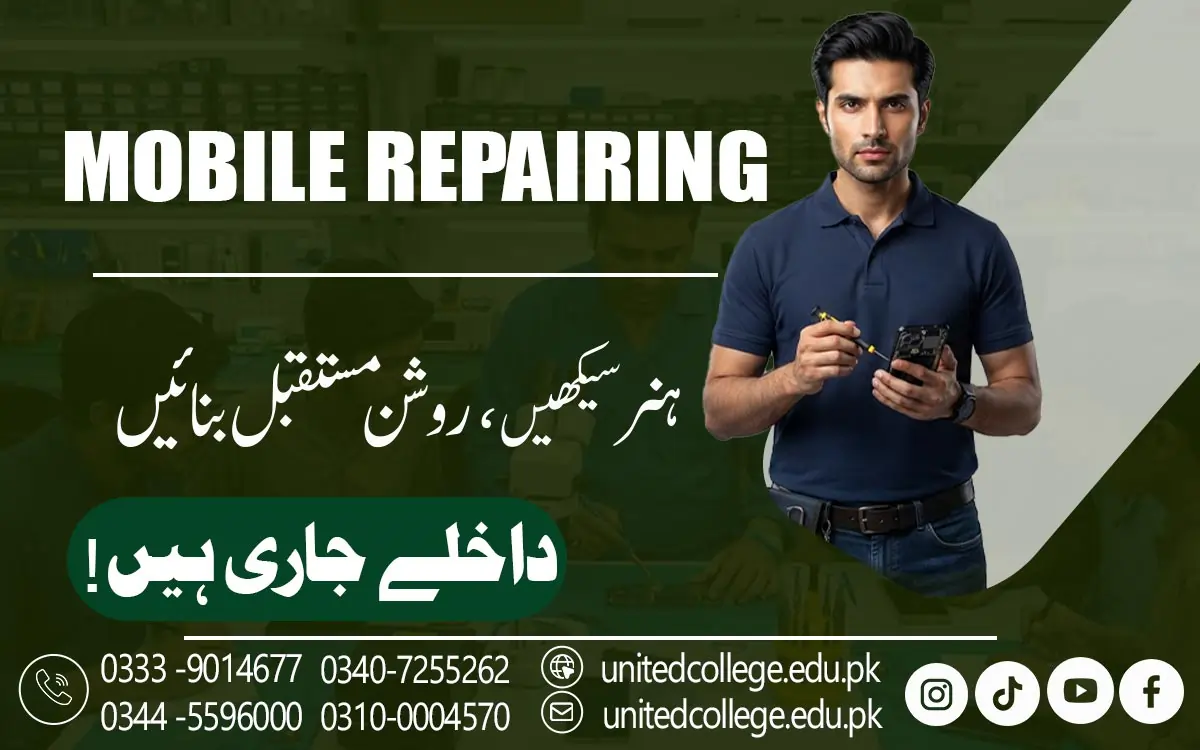

Mobile Repairing Course in Chiniot to Learn Modern Phone Repair
Turn Technical Interest Into Real Skill
A damaged smartphone rarely arrives with a simple explanation. One phone may refuse to charge, another may show a blank screen, while a third may work normally except for a weak microphone or unstable software. For the owner, these are frustrating problems. For a trained technician, they are opportunities to apply knowledge and practical skill.
As smartphones become important for communication, education, business, banking, and everyday tasks, the need for capable repair professionals continues to matter. For learners in Chiniot, developing this skill can provide a practical direction for technical learning. The Mobile Repairing Course in Chiniot offered by United College of Technology helps beginners explore mobile technology through repair knowledge, troubleshooting practice, and hands-on skill development.
When Everyday Phone Problems Become Technical Lessons in Chiniot
A person does not need to be an electronics expert to begin learning mobile repair. The right starting point is understanding how a smartphone is organized and what its major components are designed to do. A Mobile Repairing Course in Chiniot can introduce students to important parts such as batteries, displays, speakers, microphones, cameras, charging systems, connectors, and circuit boards. Mobile repairing training is more than simply following a collection of repair instructions.
Through practical learning, students can begin to understand how different components work together and how one faulty part can affect the overall performance of a device. Learners also develop the habit of identifying the possible reasons behind a fault instead of making quick guesses. For students in Chiniot, a Mobile Repairing Course can provide a practical way to build technical knowledge gradually while gaining experience with common smartphone problems and repair procedures.
The Real Challenge Is Discovering What Went Wrong
Imagine a customer brings a phone that will not turn on. Replacing the battery immediately may seem like the easiest answer, but the actual issue could be somewhere else. A technician needs to inspect the device and work through possible causes. This is where fault diagnosis becomes important. Students can learn to observe symptoms, perform basic checks, and narrow down the possible source of a problem before attempting a repair.
Common cases may include charging failures, battery problems, touch or display faults, speaker and microphone issues, camera difficulties, faulty buttons, and connectivity concerns. Each case can teach learners a different way of thinking about repair work.
Small Components Can Teach Big Technical Ideas
Mobile hardware repair requires careful handling because modern smartphones contain compact and delicate parts. A learner may begin with basic component identification before progressing toward practical procedures involving replacement and repair. Students can practise tasks such as safe disassembly and assembly, screen replacement, battery replacement, charging-port work, and inspection of connectors.
These activities help them understand how physical components are fitted together inside a smartphone. Basic circuit knowledge can also be introduced in a beginner-friendly way. Learners can understand that the motherboard or circuit board contains pathways and components that help different functions operate.
Software Can Create Problems Without Leaving a Mark
A phone does not have to be physically damaged to stop working correctly. Software errors can cause freezing, application failures, slow performance, update problems, boot issues, or other unusual behavior. A smartphone repair course can introduce students to the difference between physical and software faults. This helps learners decide whether a problem should be investigated through hardware inspection or software troubleshooting.
Students may also explore basic mobile software installation, updates, and flashing procedures where appropriate. Android phone repair can involve different software situations, while iPhone repair basics may require understanding a different device environment. The key is to learn safe and suitable procedures rather than applying the same solution to every phone.
The Right Tool Can Change the Way You Repair in Chiniot
A technician's tools are not simply accessories; they are an important part of the repair process. Using an unsuitable tool can damage a component, while the right equipment can make delicate repair work safer and more controlled. During a Mobile Repairing Course in Chiniot, learners can become familiar with the purpose, selection, and proper handling of common mobile repair tools.
Proper tool handling also helps develop discipline and patience. Learners can practice organizing their workspace, protecting small components, avoiding unnecessary force, and handling electronic parts carefully. For students in Chiniot, practical training through a Mobile Repairing Course can help build not only technical repair skills but also the professional habits needed to work carefully and confidently with mobile devices.
Practice Creates the Confidence Theory Alone Cannot Give
Reading a repair procedure may help a student understand the idea, but real confidence develops when the learner actually performs the task. Hands-on practice allows beginners to experience the small challenges that cannot always be understood from written instructions. At United College of Technology, practical-focused training can help learners connect technical lessons with actual repair activities.
Instructor guidance can be useful when a student is unfamiliar with a tool, component, or repair procedure. Repeated practice also teaches patience. A repair may not always work on the first attempt, and a learner may discover that the suspected fault was not the real problem. These experiences encourage better observation and more careful decision-making.
A Good Technician Learns to Listen Before Reaching for a Tool
Technical ability is only one part of professional repair work. Understanding the customer's complaint can help a technician begin the inspection from a more informed position. A customer might say that a phone's battery is “finished” because it loses power quickly. After checking the device, the technician may find another factor contributing to the problem.
Learning to ask clear questions and inspect the phone properly can prevent assumptions. This communication skill can become useful for anyone who plans to work in a mobile repair shop. A professional technician needs to explain problems in simple language, handle devices responsibly, and communicate clearly about the work being considered.
One Skill Can Grow Into Different Working Possibilities
Mobile repairing can support several professional directions once a learner develops sufficient knowledge and practical experience. Someone may begin by working with an experienced technician, where daily repair cases can provide valuable exposure. Another possibility is employment in a repair shop or electronics-related business.
With stronger skills and practical confidence, a person may also consider providing independent repair services. Some learners may eventually establish a small mobile repair setup. However, starting such work responsibly requires more than completing a course. Technical accuracy, suitable tools, experience with different devices, customer trust, and responsible service all matter.
Keep Moving as Mobile Technology Changes
Smartphones do not remain the same for long. New models introduce different designs, software environments, components, and repair challenges. A technician who stops learning may eventually find unfamiliar devices difficult to handle. For this reason, mobile repairing skills should continue developing after formal training. Learners can practise with different models, study updated repair methods, observe experienced technicians, and improve their understanding of both hardware and software.
For students, job seekers, and fresh learners in Chiniot, this makes mobile repair a skill worth approaching with a long-term mindset. The Mobile Repairing Course in Chiniot at United College of Technology can provide a starting point for learning the fundamentals and developing practical abilities through guided training. The goal is not to master every complicated repair immediately. Start with the basics, understand each task properly, practise carefully, and learn from every mistake.
Frequently Asked Questions (FAQs)
Keeping repair notes helps a technician remember replaced parts, observed faults, and testing results for future reference.
Yes, learners can understand how to match suitable components with a device instead of choosing parts only by appearance.
Testing confirms that the repaired functions are working properly and helps detect any issue before the device is handed back.
Basic documentation can help technicians organize device details, repair steps, replaced components, and final testing results.
Strong technical skills can help a learner provide organized repair services, manage different jobs, and gradually develop a professional work setup.
The technician should consider the actual fault, component compatibility, repair complexity, and whether replacement is technically worthwhile.
Admission Open: Start Your Professional Journey Today!
Join United College of Technology and build a career with practical training, recognized certifications, and Gulf job support. Seats are limited.
Apply Now via WhatsAppContact Information
- Address: Rawalpindi: F-272 Main New Katarian Stop, Old IJP Road | Lahore Campus: Lahore, Pakistan
- Phone/WhatsApp: 0340-7255262 / 0333-9014677 / 0301-5044340 / 0310-0004570 / 051-8770756
- Website: unitedcollege.edu.pk
















Leave a Comment