


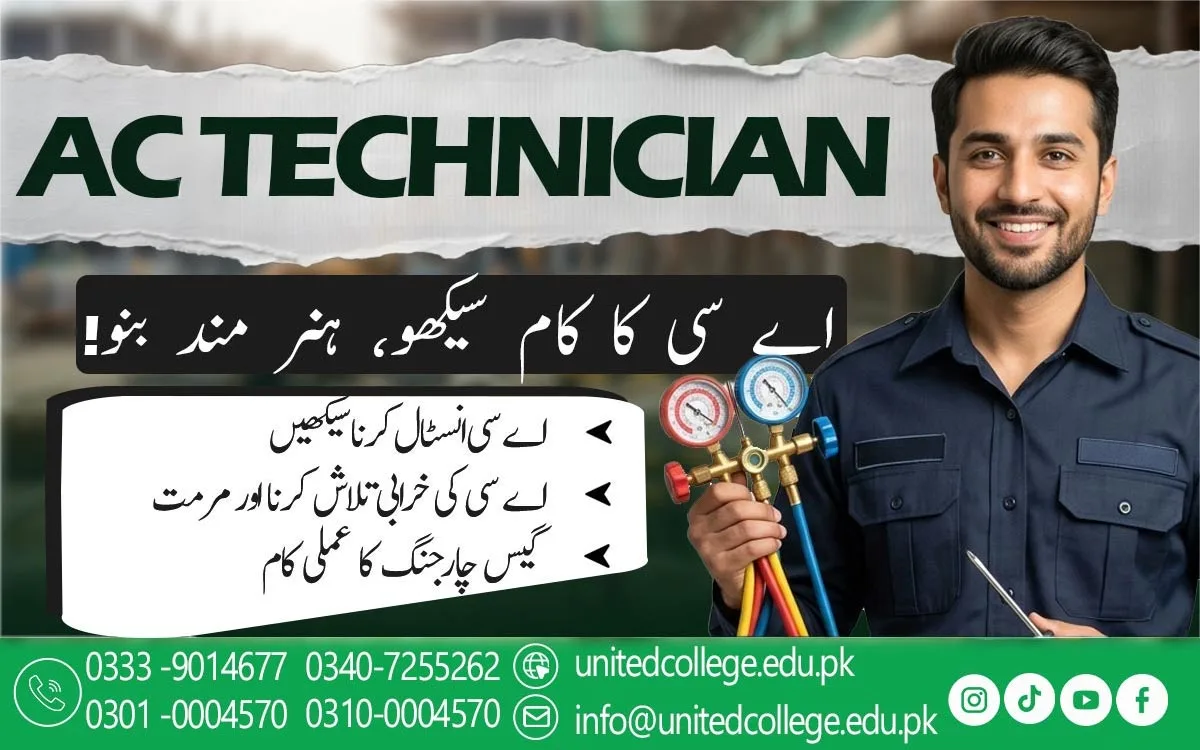

AC Technician Course in Hangu to Explore AC Maintenance
Turn Your Interest in Cooling Technology Into Practical Knowledge
Air conditioners have become an important part of comfortable indoor spaces, but keeping them in good working condition requires more than pressing a button or adjusting the temperature. When a unit stops cooling, produces unusual sounds, or develops a maintenance problem, a technician needs to understand how the system works before deciding what to check. The AC Technician Course in Hangu is a useful subject to explore for beginners, students, fresh learners, and job seekers interested in practical technical education.
Learning about air conditioning can help learners understand equipment, recognize common faults, and develop a careful approach to maintenance. These skills require patience, regular practice, and respect for safety procedures. By starting with basic concepts and gradually moving towards more advanced topics, learners can build a foundation for further technical learning and understand the work involved in servicing different air conditioning systems.
Uncover the Working Principles Behind Indoor Cooling
An air conditioner does not simply create cold air. It removes heat from an indoor area and transfers it outside through a refrigeration cycle. Several components work together to complete this process. The compressor circulates refrigerant and raises its pressure, while the condenser helps release heat outdoors. An expansion device reduces refrigerant pressure, allowing the refrigerant to absorb heat as it passes through the evaporator coil.
An AC Technician Course introduces these functions in beginner-friendly language. Learners can study how filters affect airflow, how thermostats respond to room temperature, and how indoor and outdoor units work together. They may also explore differences between split, window, and inverter air conditioners. Understanding these basics helps learners develop HVAC Basic Skills before studying detailed inspection and repair procedures.
Build Useful Skills Through AC Servicing and Installation Practice
Technical knowledge becomes more meaningful when learners understand how it applies to real equipment. AC Technician Training in Hangu can be explored by people interested in learning about routine servicing, component identification, filter cleaning, airflow inspection, and basic maintenance procedures. These tasks help explain why an air conditioner needs regular care and why technicians should follow the manufacturer's instructions.
AC Installation and Maintenance Training may cover installation principles, suitable unit positioning, drainage arrangements, pipe routing, and the importance of secure connections. Learners can also become familiar with the purpose of common tools and the precautions required when working around electrical components. Proper installation involves more than placing a unit on a wall; technicians must consider airflow, drainage, equipment requirements, and safe working practices.
Recognize Cooling Problems Through Careful Observation
An air conditioner may show several warning signs when something is not working correctly. Weak cooling can result from restricted airflow, dirty coils, incorrect settings, or a fault within the refrigeration system. Water around an indoor unit may indicate a drainage problem or another issue that requires inspection. Unusual vibration or noise may relate to loose components, fan operation, or mechanical wear.
AC Technician Course in Hangu helps learners understand cooling system troubleshooting by observing equipment, gathering information, and following suitable inspection procedures. Learners can practise describing symptoms clearly and understanding which checks are appropriate for their training level. They should never handle energized electrical parts or pressurized refrigeration systems without suitable training and equipment.
Make Safe Working Habits Part of Every Technical Task
Air conditioning systems contain electrical components, moving parts, and refrigerants that require careful handling. Safety training helps learners understand the risks before they attempt maintenance. They should learn appropriate electrical isolation procedures, recognize damaged cables, use suitable protective equipment, and follow the manufacturer's safety instructions.
Good safety habits also include keeping tools organized, checking equipment before use, and stopping when a task exceeds one's abilities. Beginners should seek guidance instead of attempting unfamiliar repairs independently. Air Conditioner Technician Training should develop an understanding of both technical procedures and personal responsibility. A careful technician knows that protecting people, equipment, and the environment is just as important as restoring cooling performance.
Connect Technical Lessons With Real Equipment and Practical Exercises
Learning from explanations alone may not be enough to understand how air conditioners behave in different situations. Practical exercises help learners connect technical ideas with equipment and maintenance procedures. For example, studying airflow can explain why a blocked filter affects cooling, while learning about temperature sensors can help learners understand how some modern systems monitor operating conditions.
The AC Technician Training in Hangu, offered by United College of Technology, may be worth considering for people interested in structured technical learning. Before enrolling, prospective learners should contact the institution to confirm the current course content, practical learning arrangements, safety instruction, and other relevant details. This helps them understand what the training includes and whether it matches their learning goals.
Strengthen Your Learning Routine Before Moving to Advanced Repairs
Beginners can make steady progress by learning one topic at a time. Start by understanding the main components of an air conditioner, then study how air moves through the unit and how the refrigeration cycle transfers heat. Keeping a notebook of technical terms, drawing simple diagrams, and reviewing lesson notes can help learners remember what they study.
As their knowledge improves, learners may explore inverter technology, electronic controls, energy-efficient operation, and more advanced HVAC maintenance. Further HVAC Technician Training can help build on the basic concepts, provided learners continue to follow appropriate safety requirements and gain practical experience under suitable supervision.
Use Technical Knowledge to Explore Future Learning and Work Options
Air conditioning skills can support several possible directions for further development. After gaining suitable knowledge and experience, learners may seek opportunities to assist an experienced technician, work under supervision in an AC service shop, or learn maintenance procedures within a repair business. Some may eventually consider offering services independently after developing the necessary competence, tools, experience, and understanding of applicable requirements.
The AC Technician Course in Hangu provides a starting point for people who want to understand air conditioning technology and develop practical knowledge. By learning system fundamentals, studying maintenance procedures, practising safe inspection methods, and improving troubleshooting abilities, beginners can prepare for continued technical development. A thoughtful training choice and consistent effort can help turn curiosity about cooling systems into a stronger foundation of useful technical skills.
Frequently Asked Questions (FAQs)
A manifold gauge set helps trained technicians measure refrigerant-system pressures during appropriate diagnostic procedures. Learners study its purpose and safe use under proper guidance.
Air conditioners can remove some moisture from indoor air as they cool it. Understanding humidity helps learners explore the relationship between temperature, moisture, and comfort.
Error codes can indicate detected faults or operating conditions in some systems. Technicians must consult the correct manufacturer documentation before interpreting a code.
Energy ratings help explain how efficiently an air conditioner uses electricity under specified testing conditions, allowing learners to understand the importance of efficient equipment selection.
Suitable support helps keep the unit secure and correctly positioned. Proper mounting also contributes to drainage, stable operation, and compliance with installation instructions.
Clear communication helps technicians describe observed faults, explain recommended work, discuss safety concerns, and help customers understand maintenance requirements.
Admission Open: Start Your Professional Journey Today!
Join United College of Technology and build a career with practical training, recognized certifications, and Gulf job support. Seats are limited.
Apply Now via WhatsAppContact Information
- Address: Rawalpindi: F-272 Main New Katarian Stop, Old IJP Road | Lahore Campus: Lahore, Pakistan
- Phone/WhatsApp: 0340-7255262 / 0333-9014677 / 0301-5044340 / 0310-0004570 / 051-8770756
- Website: unitedcollege.edu.pk
















Leave a Comment