


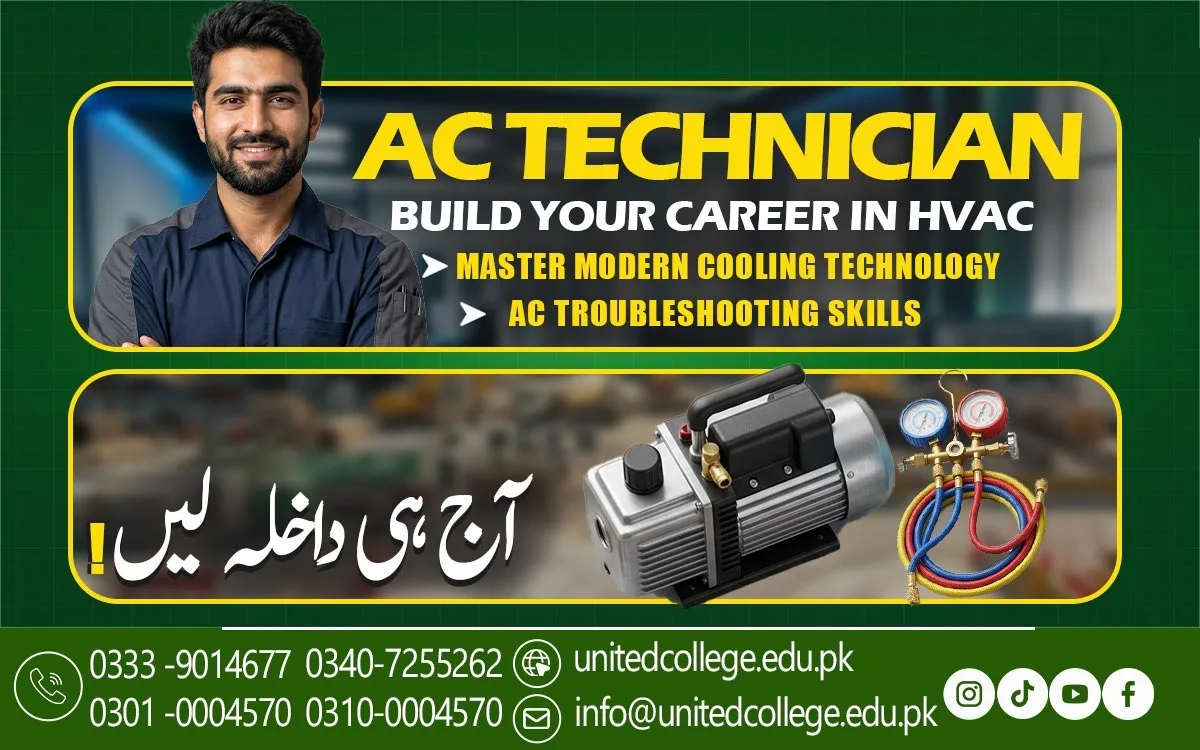

AC Technician Course in Batagram for Technical Advancement
Turn Everyday AC Problems Into Valuable Technical Knowledge
An air conditioner may look simple from the outside, but its cooling performance depends on several components working together correctly. A blocked filter, a faulty control, or a problem inside the refrigeration system can affect how well the unit operates. Understanding these issues requires knowledge, observation, and practical training rather than guesswork. The AC Technician Course in Batagram is a relevant topic for beginners, students, fresh learners, and job seekers who want to explore air conditioning repair and maintenance.
Learning about cooling systems can help people understand how technicians inspect equipment, recognize common faults, and follow suitable servicing procedures. With a strong foundation, learners can gradually build practical knowledge and prepare for more advanced technical learning. The goal is not simply to learn how to repair an AC, but to understand why problems occur and how to approach them safely.
Explore the Hidden Process That Makes an AC Cool a Room
Air conditioning works by transferring heat from one place to another. Instead of creating cold air directly, the system removes heat from indoor air and releases it outside. This process depends on a refrigeration cycle involving refrigerant, a compressor, a condenser, an expansion device, and an evaporator. Each component performs a different role, and a problem in one area can affect the entire system.
An AC Technician Course introduces these principles in simple language so beginners can understand how the parts connect. Learners can also explore the differences between split, window, and inverter AC systems. This knowledge provides a foundation for HVAC Basic Skills and helps learners understand why different units may require different inspection and maintenance methods.
Develop Hands-On Skills Through Installation and Servicing Practice
Knowing the names of AC components is only the beginning. A technician must also understand how to inspect equipment, recognize signs of wear, and follow proper maintenance procedures. AC Technician Training in Batagram can be explored by learners interested in practical topics such as filter cleaning, airflow inspection, drainage checks, component identification, and basic servicing methods.
An AC Repairing Course can help learners understand how technicians approach faults systematically. For example, when an AC provides weak cooling, a technician considers several possible causes instead of immediately replacing a component. Through suitable instruction and supervised exercises, learners can develop Air Conditioning Repair Skills and a clearer understanding of routine maintenance.
Read the Warning Signs Before a Minor Fault Becomes a Bigger Problem
Different AC problems can produce similar symptoms, which makes careful inspection essential. Weak cooling may result from restricted airflow, dirty coils, incorrect thermostat settings, or a fault involving the refrigeration system. Water dripping from an indoor unit may indicate a drainage issue, while excessive vibration or unusual sounds may suggest loose parts, fan problems, or other mechanical concerns.
A unit that starts and stops repeatedly may have a control issue, an airflow restriction, or another operating fault. An AC that does not start at all may require an inspection of its power supply, controls, or electrical components by a qualified person. Through an AC Technician Course in Batagram, students can learn to identify these symptoms, perform appropriate checks, and understand how to diagnose AC problems safely and effectively.
Make Electrical Protection and Refrigerant Safety Part of Every Task
Air conditioning work involves electricity, moving machinery, and refrigerants that require responsible handling. Beginners should learn safety procedures before attempting maintenance. These include understanding how equipment is safely isolated from its power source, recognizing damaged cables, using appropriate protective equipment, and following manufacturer guidance. Refrigerants also require special attention.
Safe working habits also include keeping tools organized, avoiding unsuitable shortcuts, and stopping when a task exceeds one's training. A technician should know when a problem needs help from an experienced professional. Air Conditioner Technician Training should build an understanding of both technical procedures and personal responsibility.
Combine Technical Theory With Structured Practical Exercises
Theory helps learners understand why a system behaves in a certain way, while practical exercises show how that knowledge applies to real equipment. For example, studying airflow can help explain why a dirty filter may reduce cooling performance. Learning about temperature controls can clarify how an AC responds to the selected room temperature. These connections make technical concepts easier to remember.
The AC Technician Training in Batagram, offered by United College of Technology, may be worth exploring for people interested in structured learning about air conditioning technology. Before enrolling, prospective learners should confirm the current syllabus, practical training arrangements, safety instruction, and available learner support directly with the institution. Checking these details helps them understand whether the training matches their interests and learning needs.
Choose a Learning Path That Supports Steady Technical Progress
Before joining an Air Conditioning Course, beginners should consider what they want to learn and how the training will support that goal. A useful programme should explain the basic working principles of AC systems, introduce relevant tools, cover maintenance procedures, and give appropriate attention to safety. Learners should also ask how practical exercises are organized and whether the topics match their current level of knowledge.
Patience and regular practice are important throughout technical learning. Beginners can review component names, draw simple system diagrams, keep notes about new terms, and study manufacturer instructions with guidance. They should focus on understanding each process instead of trying to memorize repair steps without knowing their purpose.
Turn New Knowledge Into a Practical Plan for the Future
Training in air conditioning can introduce several possible directions for future development. After gaining suitable knowledge and practical experience, learners may seek opportunities to assist an experienced technician, support a repair workshop, or gain experience with installation and maintenance tasks. Some may later consider independent servicing after developing the necessary competence, tools, experience, and understanding of applicable requirements.
The AC Technician Course in Batagram offers a useful subject to explore for anyone interested in cooling technology and hands-on technical education. By building a foundation in refrigeration principles, servicing methods, fault diagnosis, and safe working practices, learners can prepare themselves for further development. A thoughtful choice of training, combined with patience and consistent practice, can help turn an interest in air conditioning into meaningful technical knowledge.
Frequently Asked Questions (FAQs)
Proper insulation helps reduce unwanted heat transfer along refrigerant pipes, supporting efficient system operation and reducing condensation on suitable pipe surfaces.
A thermistor senses temperature changes and helps electronic controls monitor system conditions. Understanding its function can help learners study modern AC control systems.
Manuals provide model-specific information about operating limits, maintenance schedules, component specifications, and safety precautions that technicians should follow.
An unsuitable unit size may cause uneven temperature control, frequent cycling, or insufficient cooling. Proper sizing considers room conditions and relevant technical requirements.
A vacuum pump helps remove air and moisture from a properly prepared refrigeration circuit before charging, following the manufacturer's procedure and applicable safety requirements.
Corrosion can weaken metal surfaces and affect connections or heat-transfer components. Early recognition helps technicians identify areas that may need further inspection.
Admission Open: Start Your Professional Journey Today!
Join United College of Technology and build a career with practical training, recognized certifications, and Gulf job support. Seats are limited.
Apply Now via WhatsAppContact Information
- Address: Rawalpindi: F-272 Main New Katarian Stop, Old IJP Road | Lahore Campus: Lahore, Pakistan
- Phone/WhatsApp: 0340-7255262 / 0333-9014677 / 0301-5044340 / 0310-0004570 / 051-8770756
- Website: unitedcollege.edu.pk
















Leave a Comment