


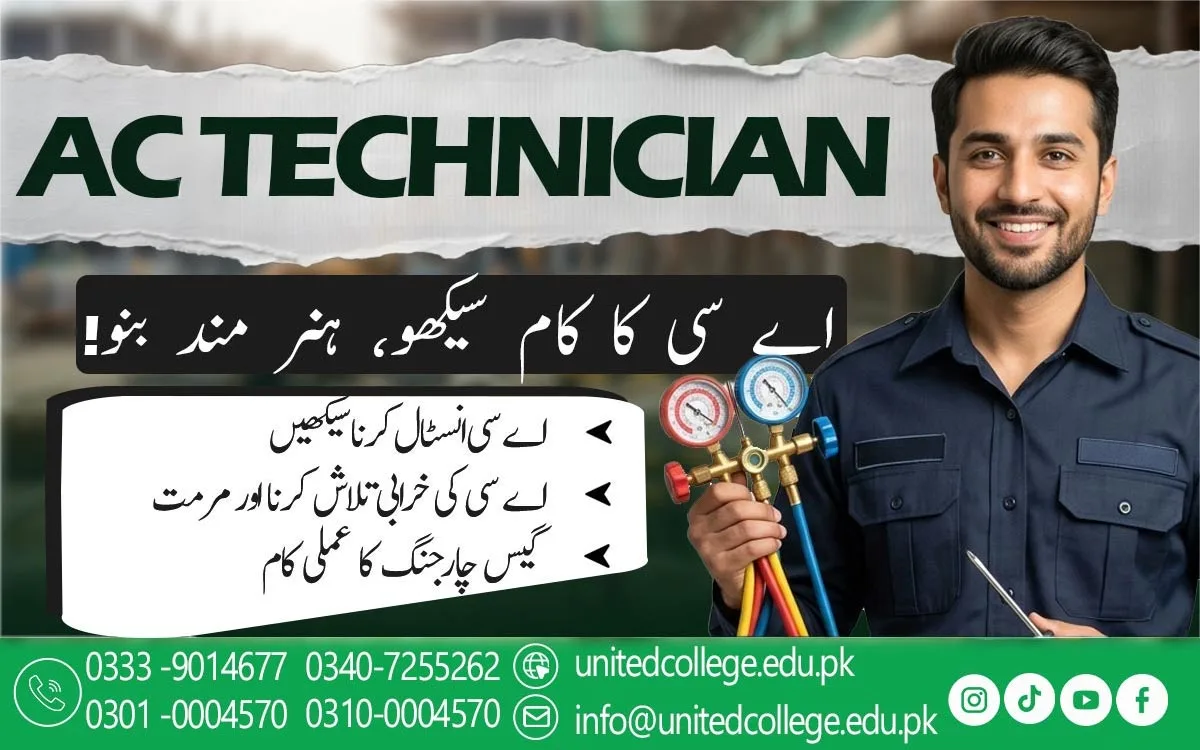

AC Technician Course in Balakot – Master AC Repair Skills
When an Air Conditioner Stops Cooling, Skilled Technicians Make the Difference
Imagine a family sitting in a room during a hot summer afternoon when their air conditioner suddenly stops cooling. The fan may continue running, but warm air comes from the vents. In another home, water starts dripping from the indoor unit, while a nearby shop struggles with an AC that makes unusual noises. These problems can affect comfort, interrupt daily activities, and create difficulties for businesses. A trained technician can investigate the cause, identify the faulty component, and recommend an appropriate repair. This is why air conditioning repair and maintenance skills are useful in homes, offices, shops, hotels, and other buildings.
The AC Technician Course in Balakot is a relevant training option for people who want to understand how air conditioners work and learn the practical skills needed to maintain them. Offered by United College of Technology (UCT), the course introduces learners to the technical knowledge involved in air conditioning systems and their common problems. Students interested in this field can begin by learning about cooling principles, electrical components, installation procedures, and routine servicing. They can also develop an understanding of how technicians approach different faults instead of replacing parts without checking the actual problem.
What Students Can Learn Through AC Technician Training in Balakot
Learning to repair an air conditioner involves more than opening a unit and cleaning its filters. A technician needs to understand how different components work together, how cooling problems develop, and how to inspect equipment safely. The AC Technician Course in Balakot, offered by United College of Technology (UCT), provides a relevant starting point for learners who want to explore air conditioning repair and maintenance. Students can build their understanding of air conditioning systems by studying their operating principles, common components, basic electrical concepts, and routine maintenance requirements.
These subjects help beginners understand why an air conditioner may stop working properly and what information is needed before attempting a repair. For example, weak cooling might result from restricted airflow, dirty coils, an incorrect thermostat setting, an electrical fault, or a problem within the refrigeration system. Each possibility requires a different inspection method. Air conditioning technician training can also introduce learners to the tools used for servicing, the importance of following manufacturer instructions, and the need to identify faults before replacing parts. Practical learning is particularly valuable because it helps students connect classroom knowledge with real equipment.
Understand the Components That Keep an Air Conditioner Running
An air conditioner contains several connected components, and understanding their functions is an important part of technical training. The compressor circulates refrigerant through the system by helping maintain the pressure differences needed for the cooling process. The condenser releases heat from the refrigerant, while the evaporator absorbs heat from indoor air. A fan moves air across the coils, helping the system transfer heat efficiently. The thermostat or temperature sensor helps regulate operation according to the selected temperature and the system's control settings. Filters capture dust and other airborne particles before air passes through the equipment.
Depending on the model, an air conditioner may also contain circuit boards, capacitors, relays, sensors, expansion devices, and other electrical or mechanical parts. During air conditioning technician training, students can learn the purpose of these components and how their condition affects overall performance. For example, a dirty filter can restrict airflow, while a faulty sensor may cause irregular operation. A technician must investigate the symptoms carefully because similar problems can have different causes. Learning about air conditioner electrical components also helps students understand why safe inspection procedures are necessary.
Learn the Right Way to Install and Set Up Split Air Conditioners
Correct installation has a direct effect on an air conditioner's performance, efficiency, and reliability. Even a good-quality unit may develop problems if it is installed in an unsuitable location, mounted incorrectly, or connected without following the manufacturer's instructions. Split AC systems generally contain an indoor unit that delivers cooled air and an outdoor unit that releases heat. These units are connected through refrigerant piping, electrical connections, and a drainage arrangement. During AC installation training, learners can study how technicians assess installation locations, select suitable mounting positions, plan drainage, and understand the purpose of connecting pipes and cables.
Incorrect drainage arrangements may cause water leakage inside a room, while poorly installed piping can affect system operation. The installation process may also involve specialised procedures, such as checking pipe connections, performing required leak tests, evacuating the refrigerant circuit, and commissioning the equipment according to manufacturer specifications. These tasks require suitable tools, training, and supervision. The AC Technician Course in Balakot can be a starting point for learners interested in understanding these procedures and developing their installation knowledge. Rather than focusing only on mounting equipment, students should learn why each step matters and how installation quality can influence future servicing needs.
Identify Common Cooling Problems Through Servicing and Maintenance
Sometimes, a simple maintenance issue is responsible, but the technician must inspect the equipment before deciding what action is appropriate. Common complaints include weak cooling, reduced airflow, unusual smells, water dripping from the indoor unit, and longer operating times. Dirty filters can block airflow, while dust on coils may reduce heat transfer. A blocked drain line can prevent condensation water from leaving the unit properly. In other cases, the problem may involve a fan, sensor, electrical component, or refrigerant circuit. Students learning air conditioner repair and maintenance can develop a systematic approach to these situations by observing symptoms, checking basic operating conditions, and following appropriate diagnostic procedures.
Preventive maintenance is equally important because regular inspection and cleaning can help identify developing problems before they cause equipment failure. Depending on the unit and its maintenance instructions, servicing may include cleaning filters, inspecting accessible coils, checking drainage, examining visible connections, and confirming that airflow is not obstructed. The AC Technician Course in Balakot is relevant to learners who want to understand these practical tasks and the reasoning behind them. A good technician does not assume that every cooling issue requires refrigerant, a new compressor, or an expensive replacement part. Instead, the technician checks possible causes in a logical order and explains the findings clearly.
Explore Inverter AC Technology and Electrical Troubleshooting
Modern air conditioners often use electronic controls and inverter technology to manage compressor operation according to cooling demand. Unlike conventional systems that commonly switch the compressor on and off to regulate temperature, inverter systems can adjust compressor speed within their designed operating range. This can help maintain more consistent temperatures and improve energy efficiency under suitable conditions. However, diagnosing an inverter AC fault may require a different approach from troubleshooting a simpler system. Problems can involve sensors, wiring, circuit boards, power supply conditions, communication between components, or other parts specified by the manufacturer.
A technician must not assume that a displayed error code automatically identifies a failed component; the code usually provides information that needs to be checked against the service documentation. Training in AC troubleshooting techniques can help students understand how to observe symptoms, review error indicators, inspect accessible parts, and follow a logical diagnostic process. Basic electrical knowledge is also important for understanding switches, protective devices, wiring diagrams, and electrical measurements. During the AC Technician Course in Balakot, learners interested in inverter AC repair can build a foundation for understanding these systems and their maintenance requirements.
Understand Refrigeration Principles and Safe Refrigerant Handling
Cooling an indoor space involves moving heat rather than simply creating cold air. In a typical air conditioning system, refrigerant circulates through a closed circuit and changes pressure and state as it moves through different components. The evaporator absorbs heat from indoor air, and the condenser releases that heat outdoors. The compressor helps circulate the refrigerant and maintain the operating conditions needed for this process. Understanding these refrigeration system basics allows students to make better sense of common faults and the purpose of individual components. For example, poor cooling does not automatically mean that refrigerant is low.
Refrigerant handling and safety deserve special attention because some refrigerants can create risks through pressure, contact, inhalation, or flammability, depending on their properties. Refrigerants must not be deliberately released into the atmosphere, and applicable environmental rules must be followed. The AC Technician Course in Balakot can help interested learners begin understanding the principles behind cooling systems and the care required during maintenance. Any refrigerant recovery, charging, or pressure-testing work should be carried out by properly trained personnel using approved equipment and the manufacturer's specified procedures.
Build Practical Skills With the Correct Tools and Safety Procedures
Technical knowledge becomes more useful when learners understand how to apply it carefully in practical situations. Air conditioning technicians use different tools depending on the task, including screwdrivers, spanners, pliers, cleaning equipment, multimeters, temperature-measuring devices, and specialised refrigeration service instruments. Each tool has a specific purpose, and using the wrong equipment can damage components or create safety risks. For example, a multimeter can help an appropriately trained person check electrical values, while temperature measurements can provide useful information about system performance. Refrigeration service equipment is used for particular tasks that require additional knowledge and precautions.
Students need to understand that identifying a tool is only the first step; knowing when to use it, how to operate it, and how to interpret its results is equally important. The AC Technician Course in Balakot, offered by United College of Technology (UCT), is relevant to learners seeking an introduction to practical air conditioning work. When evaluating training, students should look for clear explanations, appropriate demonstrations, and supervised opportunities to practise skills wherever these are available. Electrical isolation, suitable protective equipment, safe lifting, proper handling of sharp edges, and careful use of cleaning products are all important parts of responsible workshop practice.
Explore Career Paths After Learning AC Repair and Maintenance Skills
Air conditioning systems are used in houses, shops, offices, restaurants, hotels, schools, healthcare facilities, and many other buildings. As a result, people with suitable technical knowledge may explore different types of work related to installation, servicing, and equipment maintenance. Some technicians work with AC repair businesses, while others assist installation teams or building maintenance departments. With additional experience and the necessary practical competence, a technician may choose to specialise in inverter systems, commercial cooling equipment, or other areas of HVAC work. HVAC stands for heating, ventilation, and air conditioning, a wider technical field that includes systems designed to manage indoor temperature and air movement.
Learners in Balakot may find it useful to understand how residential cooling systems operate and how maintenance needs can differ between small homes and larger commercial buildings. The AC Technician Course in Balakot offered by United College of Technology (UCT) can serve as a starting point for people interested in exploring this technical field. However, completing a course does not automatically guarantee employment or make someone qualified for every type of repair. Employers and customers may expect practical experience, safe working habits, problem-solving ability, and further training depending on the equipment and job responsibilities.
Frequently Asked Questions (FAQs)
The AC Technician Course in Balakot, offered by United College of Technology (UCT), introduces students to air conditioning installation, servicing, maintenance, and troubleshooting.
Students can learn about AC components, split AC installation, inverter AC systems, electrical troubleshooting, refrigeration principles, and preventive maintenance.
Yes, beginners interested in technical work can explore AC technician training to develop foundational knowledge and practical skills, subject to the course's admission requirements.
Training may cover split air conditioners, inverter AC systems, and their common maintenance and repair procedures, depending on the course curriculum.
Practical training helps learners understand how tools work, recognise common faults, follow repair procedures, and apply electrical and refrigerant safety practices.
Admission Open: Start Your Professional Journey Today!
Join United College of Technology and build a career with practical training, recognized certifications, and Gulf job support. Seats are limited.
Apply Now via WhatsAppContact Information
- Address: Rawalpindi: F-272 Main New Katarian Stop, Old IJP Road | Lahore Campus: Lahore, Pakistan
- Phone/WhatsApp: 0340-7255262 / 0333-9014677 / 0301-5044340 / 0310-0004570 / 051-8770756
- Website: unitedcollege.edu.pk
















Leave a Comment