


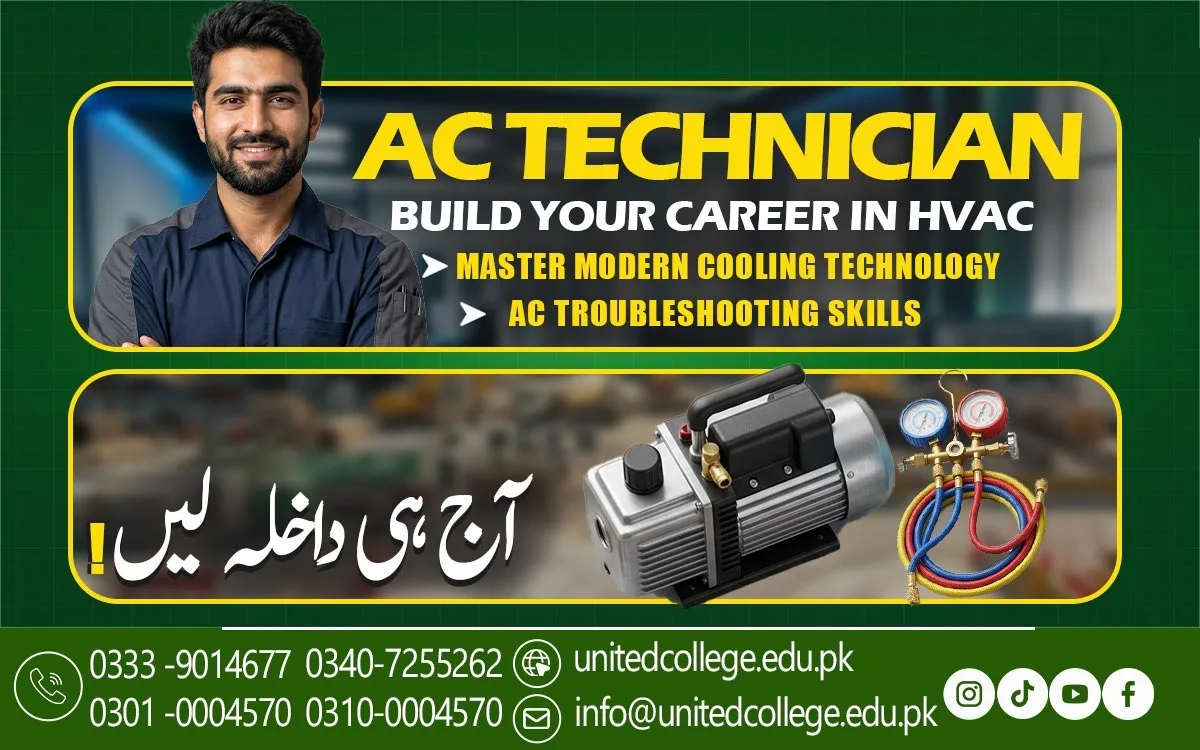

AC Technician Course in Kohat – Master Practical AC Repair Skills
When an Air Conditioner Stops Cooling on a Hot Day
Imagine coming home after a long, tiring day and switching on your air conditioner, only to find that it blows warm air instead of cooling the room. You lower the temperature, check the remote, and wait, but nothing changes. The problem might be a dirty filter, a faulty sensor, an electrical issue, or a problem with the cooling system. Situations like this show why trained air conditioning technicians are important in homes, offices, shops, and other buildings. The AC Technician Course in Kohat, offered by United College of Technology (UCT), introduces learners to the knowledge and practical skills needed to understand air conditioning systems and their common problems.
This training field can be suitable for students, beginners, fresh learners, and job seekers who want to develop technical abilities. Instead of guessing why an AC is not working, a trained person learns how to inspect the equipment, identify possible causes, and follow suitable repair procedures. Air conditioning systems contain electrical and mechanical parts that must be handled carefully, so proper training is important. For people in Kohat who are interested in technical work, learning about air conditioner repair can provide a useful starting point. By understanding how cooling systems operate and why faults occur, learners can begin developing the confidence and problem-solving approach required for AC servicing and maintenance.
What an AC Technician Does During Repair and Maintenance Work
An AC technician is responsible for checking, installing, servicing, and repairing air conditioning systems. The work involves more than simply switching an appliance on and off or cleaning its outer surface. A technician may inspect filters, check airflow, examine electrical connections, clean accessible components, and investigate why a room is not reaching the required temperature. For example, an air conditioner in a small shop may run for hours without cooling properly. The technician must check possible causes instead of immediately assuming that the compressor is damaged. Similarly, an office AC might produce an unusual sound because of a loose part, a fan problem, or another mechanical issue.
During an AC servicing course, learners can study common maintenance procedures and understand how regular inspections help identify developing faults. They can also learn why dirty filters and coils may reduce airflow and affect cooling performance. Technicians may work with split air conditioners, window units, and other cooling systems, depending on their training and experience. In homes, they may handle routine servicing, while commercial buildings can require more detailed inspections because several units may operate together. The AC Technician course in Kohat can help interested learners understand the responsibilities associated with this technical field.
How Air Conditioning Systems Work and Why Cooling Problems Occur
Have you ever wondered why an air conditioner can cool a room even when the weather outside is extremely hot? It works by transferring heat from indoor air to the outside environment. Several important components work together to complete this process. The evaporator absorbs heat from indoor air, while the compressor helps circulate refrigerant through the system. The condenser releases heat outside, and an expansion device helps control the refrigerant's flow and pressure. A thermostat or temperature sensor helps the unit respond to the room's cooling needs. If one component does not work correctly, the entire system may perform poorly. However, not every cooling problem means that an expensive part has failed.
Other issues may involve refrigerant leakage, a malfunctioning fan, or an electrical fault. Through air conditioning technician training, learners can develop a clearer understanding of these components and their functions. They can learn to observe symptoms, check simple causes first, and follow appropriate diagnostic procedures. This knowledge is useful when learning AC troubleshooting because replacing parts without identifying the real fault can waste time and money. Understanding how an air conditioner works also helps learners communicate problems more clearly and recognize when a fault requires advanced testing or the attention of an experienced technician.
Learning AC Installation, Electrical Wiring, and Safe Connections
Installing an air conditioner correctly is important for its performance, safety, and long-term operation. Even a good-quality unit may struggle if it is positioned poorly, connected incorrectly, or installed without following the manufacturer's instructions. Split AC installation requires attention to the indoor and outdoor units, suitable mounting locations, drainage arrangements, pipe connections, and electrical requirements. Learners also need to understand the purpose of AC electrical wiring, circuit protection, grounding, and secure connections. These subjects are especially important because electrical faults can cause equipment damage, electric shock, or fire. During technical training, students can learn how to identify common electrical components and understand the information shown in basic wiring diagrams.
For example, if an air conditioner does not start, a technician must investigate the possible cause using safe procedures rather than repeatedly switching the unit on and off. Before opening equipment or checking internal electrical components, the power supply must be isolated, and the absence of dangerous voltage must be verified using suitable equipment by a trained person. Refrigerant piping and other installation tasks also require correct methods to prevent leaks and poor performance. The AC Technician Course in Kohat can be a starting point for learners who want to understand these procedures in a structured way. Safe installation is not simply about making the unit run; it is about ensuring that the equipment operates according to technical requirements and does not create unnecessary risks for people or property.
Finding Faults in Compressors, Fans, Capacitors, and Thermostats
An air conditioner may stop working for several different reasons, and finding the actual cause is one of the most important parts of repair work. A compressor problem, for example, may prevent the system from cooling properly, but a compressor should not be declared faulty without suitable checks. The issue could involve a power supply problem, a starting component, wiring, or a control system. Fans also play an important role because they move air across the coils. If an indoor fan is not operating correctly, airflow may decrease, while an outdoor fan problem can affect the system's ability to release heat. Capacitors help certain motors start and run, so a damaged capacitor can cause starting difficulties or unusual operation. Thermostats and sensors provide temperature information that helps control the cooling process.
When these components give incorrect readings or stop working, the AC may cool unevenly or fail to respond properly. Through air conditioning repair training, learners can study these common faults and learn why checking symptoms systematically is better than replacing parts based on guesses. A technician may begin by listening to the unit, checking visible conditions, reviewing error indicators, and carrying out suitable electrical measurements. Advanced checks should only be performed by people with the necessary training and equipment. Learning compressor and condenser repair principles also helps students understand when a problem requires specialist attention.
Using AC Repair Tools for Testing, Cleaning, and Diagnosis
The right tools help technicians inspect air conditioners more accurately and complete maintenance tasks safely. A multimeter is commonly used to measure electrical values such as voltage, resistance, and continuity, while a clamp meter can measure current without disconnecting a conductor when used correctly. A thermometer helps check air temperatures and compare the unit's performance under suitable testing conditions. Technicians may also use screwdrivers, pliers, cleaning brushes, coil-cleaning equipment, and other hand tools for routine servicing. For refrigerant-system diagnosis, a manifold gauge set and suitable leak-detection equipment may be needed, depending on the system and the procedure being performed.
For example, a technician should not assume that a compressor is damaged simply because an air conditioner is not cooling. Appropriate checks must be carried out in a safe order, with the results interpreted according to the equipment's specifications. During practical AC maintenance training, learners can become familiar with common tools and understand how to select suitable equipment for different tasks. They should also learn to inspect tools for damage, use protective equipment when required, and follow manufacturer instructions. Refrigerant testing and handling require suitable training, approved equipment, and compliance with applicable rules. Developing good tool-handling habits is an important part of practical technical training in Kohat because reliable diagnosis depends on both technical knowledge and careful measurement.
Understanding Refrigerants, Energy Efficiency, and Modern AC Technology
An air conditioner can appear to be working while still using more electricity than necessary or delivering less cooling than expected. This is why technicians need to understand energy efficiency, refrigerants, and modern cooling technology during an AC Technician Course. Refrigerant is the substance that circulates through the cooling system and absorbs and releases heat as its pressure and condition change. The correct refrigerant type and charge are important for safe, effective operation. Adding refrigerant without finding the cause of a suspected leak is not a proper long-term solution. Technicians must follow the manufacturer's instructions, use suitable equipment, and avoid releasing refrigerant into the atmosphere.
Inverter air conditioners add another area of learning because they can adjust compressor operation to match cooling demand rather than operating in the same way as many traditional fixed-speed systems. Their electronic controls and components may require specific diagnostic procedures. Through HVAC technician skills development, learners can explore how maintenance supports efficient operation and why modern equipment sometimes needs more advanced troubleshooting. Preventive AC maintenance may include cleaning filters, inspecting accessible components, checking drainage, and identifying unusual operating conditions before they become larger problems.
Building Practical Skills Through AC Technician Training in Kohat
Reading about air conditioning is useful, but practical learning helps students connect technical information with real equipment and common repair situations. Someone may know the names of the compressor, condenser, and evaporator but still need practice understanding how these parts work together in an operating system. Structured training can help learners move from recognizing components to following inspection steps, using tools correctly, understanding wiring diagrams, and identifying possible faults. The AC Technician Course in Kohat, offered by United College of Technology (UCT), is relevant to people who want to explore air conditioning installation, servicing, maintenance, and troubleshooting.
For example, cleaning a filter is a straightforward maintenance task, while investigating a compressor that will not start may require electrical knowledge, appropriate testing equipment, and supervised practice. Learning should progress according to the student's ability and the level of risk involved. Beginners can benefit from asking questions, reviewing technical instructions, practising under suitable supervision, and learning from mistakes without taking unsafe shortcuts. Anyone considering an AC repair course in Kohat should confirm the available course content, practical arrangements, duration, and admission details directly with the institute rather than relying on assumptions.
Applying AC Repair Skills in Homes, Workshops, and Commercial Settings
Air conditioning systems are used in homes, offices, shops, educational buildings, workshops, and many other settings where indoor comfort matters. As a result, people with relevant technical knowledge may explore different paths related to installation, servicing, and repair. A beginner who develops practical AC maintenance techniques may eventually assist with routine cleaning, inspections, and basic servicing under suitable supervision. With further training and experience, a technician may work toward more complex troubleshooting, split AC installation, or maintenance of inverter systems. Some people may seek opportunities with repair workshops or service providers, while others may eventually consider operating a small service business if they have the necessary skills, tools, resources, and understanding of local requirements.
Employers and customers may also consider practical ability, reliability, safety awareness, communication, and experience. In Kohat, learners can start by understanding the types of air conditioning systems commonly used in their area and the maintenance problems that household and commercial users may face. They should also develop professional habits, such as explaining a fault clearly, keeping work areas organized, following safety procedures, and avoiding repairs beyond their competence. The AC Technician Course in Kohat can introduce learners to a technical field where continued practice and updated knowledge are important. As air conditioning technology develops, technicians must be willing to learn new equipment and diagnostic methods.
Frequently Asked Questions (FAQs)
The AC Technician Course in Kohat is a technical training option for people who want to learn about air conditioner installation, repair, servicing, and maintenance. It introduces learners to cooling systems and common AC problems.
Students can learn about AC components, electrical wiring, split AC installation, cooling system diagnosis, cleaning procedures, fault detection, and the use of common AC repair tools.
Students, beginners, fresh learners, and job seekers interested in air conditioning repair and maintenance can explore this course. Contact United College of Technology (UCT) to confirm the current admission requirements.
Technical AC training may include practical activities such as identifying components, understanding wiring diagrams, using testing tools, and learning maintenance procedures. Contact UCT to confirm the practical training included in its current course.
The course duration depends on the institute's training schedule and syllabus. Contact United College of Technology (UCT) for the latest information about course duration.
Admission Open: Start Your Professional Journey Today!
Join United College of Technology and build a career with practical training, recognized certifications, and Gulf job support. Seats are limited.
Apply Now via WhatsAppContact Information
- Address: Rawalpindi: F-272 Main New Katarian Stop, Old IJP Road | Lahore Campus: Lahore, Pakistan
- Phone/WhatsApp: 0340-7255262 / 0333-9014677 / 0301-5044340 / 0310-0004570 / 051-8770756
- Website: unitedcollege.edu.pk
















Leave a Comment