


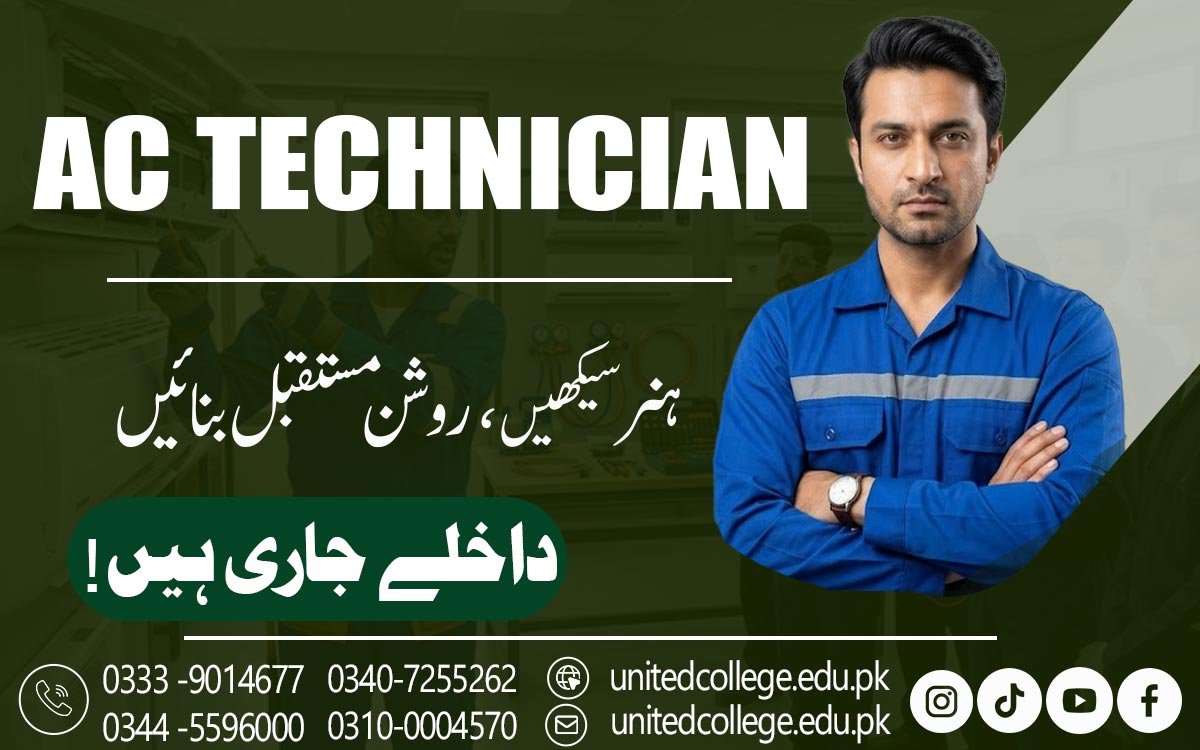

AC Technician Course in Khurram Agency – Master AC Repair Skills
When an Air Conditioner Stops Cooling, Skilled Technicians Make the Difference
Imagine a hot summer afternoon when an air conditioner suddenly stops cooling a room. The fan is running, but warm air keeps coming out, or water starts dripping from the indoor unit. These problems can make homes, shops, offices, and workplaces uncomfortable, especially during the hottest months of the year. An AC technician helps identify the cause of such problems and finds a suitable way to repair the system. This work requires technical knowledge, careful inspection, and practical experience. The AC Technician Course in Khurram Agency introduces learners to the skills involved in air conditioner installation, repair, servicing, and maintenance.
For students, beginners, and job seekers interested in technical work, learning how cooling systems operate can be a useful starting point. Air conditioning systems contain electrical parts, refrigerant lines, motors, and other components that must work together correctly. When one part develops a fault, the entire system may stop working efficiently. Through an air conditioning course, learners can begin to understand these systems and the methods technicians use to identify common faults. Offered by United College of Technology (UCT), this course provides a learning pathway for people interested in refrigeration and air conditioning.
Discover the Practical Skills Taught in AC Technician Training
Learning to repair an air conditioner involves much more than switching a unit on and off or cleaning its filter. A technician needs to understand how cooling systems operate, how their parts connect, and how to identify faults without creating additional problems. The AC Technician Course in Khurram Agency introduces learners to the essential knowledge used in air conditioner repair training. Beginners can explore how split air conditioners work, why proper airflow matters, and how electrical and refrigeration components support the cooling process. Training may also introduce common workshop tools, measurement instruments, installation methods, and basic maintenance procedures.
With suitable supervision, learners can gradually connect classroom knowledge with real technical tasks. United College of Technology offers training opportunities for individuals who want to develop their understanding of air conditioning and related technical work. Students should learn to follow instructions carefully, ask questions when a procedure is unclear, and understand the importance of safe working practices. Technical training also encourages patience because diagnosing a fault may require several checks rather than one quick guess. By developing these habits, beginners can build a stronger foundation for more advanced refrigeration and air conditioning training and gain a clearer understanding of the responsibilities involved in AC servicing.
Understand How Compressors, Coils, and Refrigerants Keep Rooms Cool
Have you ever wondered why an air conditioner can make a room cooler even when the weather outside is extremely hot? The answer lies in the way its components work together to transfer heat from inside a building to the outdoor environment. The compressor is one of the main parts of a typical air conditioning system. It moves refrigerant through the system and raises its pressure so that the cooling cycle can continue. The condenser helps release heat outdoors, while the evaporator absorbs heat from indoor air. Refrigerant is the substance that circulates through these components and changes between liquid and gas under suitable operating conditions.
A fan motor helps move air across the coils, and a thermostat or temperature sensor helps the system regulate cooling according to the required temperature. During HVAC technician training, learners can study the purpose of these parts and how a problem in one component may affect the performance of the entire unit. For example, a dirty evaporator coil can restrict heat transfer, while a faulty fan may reduce airflow. The AC Technician Course in Khurram Agency can introduce students to these important concepts and help them understand why correct diagnosis matters.
Learn the Right Way to Install a Split Air Conditioner
A newly purchased air conditioner cannot perform properly if it is installed carelessly. An indoor unit placed in an unsuitable location may distribute cool air unevenly, while a poorly positioned outdoor unit may struggle to release heat. Correct installation therefore requires planning, accurate measurements, suitable tools, and attention to the manufacturer's instructions. During AC installation and maintenance training, learners can become familiar with choosing appropriate locations for indoor and outdoor units, checking wall strength, planning pipe routes, and understanding the importance of proper drainage.
Split AC installation also involves connecting refrigerant pipes, managing electrical connections, securing brackets, and checking that the system operates correctly after installation. These tasks must be completed according to the equipment specifications and applicable safety requirements. Poorly fitted pipes, incorrect electrical connections, or unsuitable drainage arrangements can cause leaks, reduced cooling, equipment damage, or electrical hazards. The AC Technician Course in Khurram Agency introduces learners to the knowledge required to understand these installation procedures and the importance of supervised practical work.
Identify Common AC Faults Before They Become Bigger Problems
An air conditioner may show several warning signs before it stops working completely. Perhaps the room takes longer to cool, the indoor unit begins dripping water, or the outdoor unit produces an unusual noise. Each symptom can have different causes, so an AC technician must inspect the system rather than assume that every problem has the same solution. Poor cooling may result from a dirty filter, restricted airflow, an incorrectly set thermostat, a blocked outdoor coil, or a fault that requires professional diagnosis. Water leakage may be linked to a blocked drain, incorrect installation, or another issue affecting condensation removal.
Refrigerant leaks and compressor faults require particular care because they cannot be resolved simply by cleaning the unit. Through an AC repair course, learners can develop an understanding of basic troubleshooting techniques, including observing symptoms, checking accessible settings, inspecting filters, and following a logical diagnostic process. The AC Technician Course in Khurram Agency can help beginners understand why a technician should identify the actual cause before recommending a repair. Students can also learn to distinguish simple maintenance tasks from problems that require specialised equipment or an experienced professional. This approach reduces guesswork and encourages responsible repair practices.
Follow Electrical Safety and Refrigerant Handling Procedures
Electrical components can cause serious shocks, and capacitors may retain an electrical charge even after the power supply has been disconnected. Refrigerant systems can also be dangerous if handled incorrectly because pressurised refrigerants may cause cold burns, and some refrigerants present additional environmental or flammability risks. Safe AC electrical troubleshooting begins with proper training, suitable protective equipment, and approved procedures for isolating power and verifying that equipment is safe to work on. Learners should understand the purpose of insulated tools, appropriate gloves, eye protection, and other personal protective equipment required for a particular task.
Refrigerant handling and safety also involve using compatible equipment, preventing accidental releases, and following the rules applicable to the refrigerant being used. During the AC Technician Course in Khurram Agency, safety should be treated as an essential part of technical learning rather than an optional extra. Beginners need to recognise when a task is beyond their current skills and when an experienced technician must take responsibility. They should never open a pressurised system, work on live electrical parts, or attempt refrigerant recovery without the required competence and equipment. Developing safe habits from the beginning helps protect technicians, customers, and nearby people.
Keep Cooling Systems Efficient With Regular AC Servicing
Even a well-installed air conditioner can lose performance when dust, dirt, and neglected maintenance begin to affect its operation. A clogged air filter restricts airflow, forcing the system to work harder to circulate air through a room. Dirty condenser or evaporator coils can reduce heat transfer, while a blocked drainage line may cause water to collect and leak from the indoor unit. Regular air conditioner servicing helps technicians identify these problems before they lead to larger repair needs. Routine maintenance may include cleaning or replacing filters as recommended, inspecting coils, checking drainage, examining visible electrical connections while the equipment is safely isolated, and looking for signs of wear or damage.
Technicians may also assess airflow and operating performance to determine whether further investigation is necessary. The AC Technician Course in Khurram Agency can introduce learners to preventive AC maintenance and explain why servicing should follow the manufacturer's instructions. Students can learn that maintenance requirements vary according to the type of air conditioner, its operating conditions, and the amount of dust in the surrounding environment. For example, a unit used every day in a dusty workshop may need more frequent filter attention than one used occasionally in a relatively clean room. Proper servicing does not mean adding refrigerant whenever cooling becomes weak; refrigerant levels should be assessed correctly, and leaks must be investigated when suspected.
Explore Where AC Repair and Maintenance Skills Can Be Used
Air conditioning is used in many different environments, from small homes and local shops to offices, educational buildings, workshops, hotels, and larger commercial facilities. Each environment creates its own maintenance requirements. A household technician may regularly deal with split AC servicing, drainage problems, and basic cooling complaints, while a commercial setting may involve several units that need planned inspections and coordinated maintenance. Some workplaces also use refrigeration equipment, although refrigeration systems can require additional knowledge beyond standard room air conditioners.
Learning the fundamentals of air conditioning repair can help beginners understand the different tasks involved in these environments and identify areas in which they may wish to develop further expertise. The AC Technician Course in Khurram Agency provides a starting point for people interested in practical technical work related to cooling systems. Training can help learners become familiar with tools, components, fault identification, installation principles, and maintenance procedures. These skills may be relevant when exploring entry-level technical roles, assisting an experienced technician, or continuing into more specialised training, depending on the learner's competence and the requirements of individual employers.
Build Your Technical Confidence Through Guided Practice at UCT
A learner may understand how an air conditioner works in theory but still feel uncertain when faced with a real unit that is not cooling properly. This is why continued practice, feedback, and careful guidance are important parts of technical development. Beginners can strengthen their knowledge by learning to identify components, use tools correctly, read equipment labels, understand basic wiring diagrams, and follow inspection procedures under suitable supervision. They can also practise explaining a fault clearly, recording what they observe, and distinguishing between a confirmed problem and a possible cause. These habits help develop a systematic approach to technical work.
The AC Technician Course in Khurram Agency, offered by United College of Technology (UCT), is relevant to learners who want to explore air conditioning repair, installation, servicing, and maintenance. Before enrolling, prospective students should confirm the current course outline, practical training arrangements, entry requirements, duration, and any applicable assessment or certification details directly with the college. Learners should also remember that air conditioning technology continues to develop, so further learning may be needed as equipment and refrigerants change. After gaining foundational knowledge, they can build their understanding through supervised workshop practice, appropriate technical manuals, and experience with different types of cooling systems.
Frequently Asked Questions (FAQs)
The AC Technician Course in Khurram Agency introduces learners to air conditioner installation, repair, servicing, troubleshooting, and maintenance. It helps beginners understand how air conditioning systems work and how common faults can be identified.
Students can learn about AC components, compressors, condensers, evaporators, refrigerants, electrical safety, split AC installation, filter cleaning, and common troubleshooting methods.
Students, beginners, fresh learners, and job seekers interested in technical work can explore this course. Contact United College of Technology to confirm the current admission requirements.
Practical training is important for learning AC installation and repair techniques. Contact United College of Technology to confirm the practical activities and training arrangements offered in the current course.
Regular AC servicing helps maintain airflow, remove dust from filters and coils, identify drainage problems, and detect potential faults. Proper maintenance can support efficient system operation and reduce avoidable repair issues.
Admission Open: Start Your Professional Journey Today!
Join United College of Technology and build a career with practical training, recognized certifications, and Gulf job support. Seats are limited.
Apply Now via WhatsAppContact Information
- Address: Rawalpindi: F-272 Main New Katarian Stop, Old IJP Road | Lahore Campus: Lahore, Pakistan
- Phone/WhatsApp: 0340-7255262 / 0333-9014677 / 0301-5044340 / 0310-0004570 / 051-8770756
- Website: unitedcollege.edu.pk
















Leave a Comment