


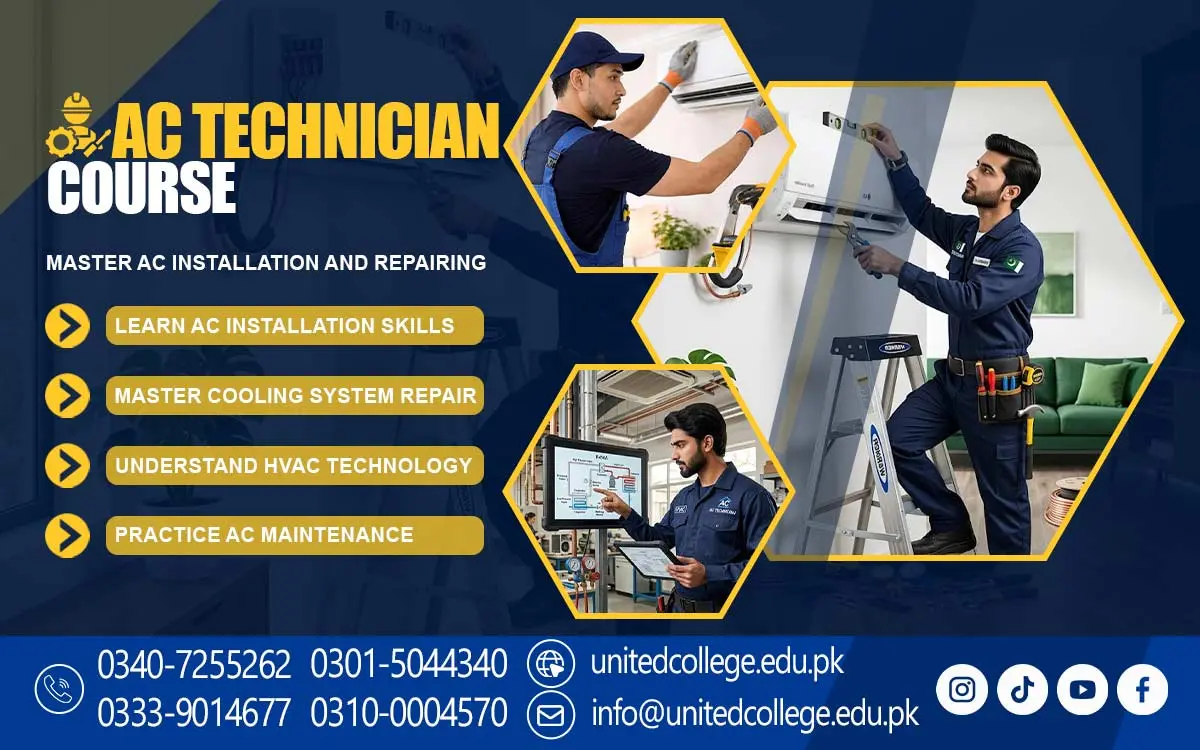

AC Technician Course in Malakand – Learn AC Repair Skills
Why Common AC Problems Create a Need for Skilled Technicians
Imagine a hot summer afternoon when an air conditioner suddenly stops cooling, even though it is running continuously. The room becomes uncomfortable, and nobody knows whether the problem is a dirty filter, a refrigerant issue, or an electrical fault. Situations like this show why trained air conditioning technicians are important in everyday life. Air conditioners are commonly used in homes, shops, offices, schools, and commercial buildings, but they need proper installation, regular servicing, and timely repairs to work efficiently. The AC Technician Course in Malakand offered by United College of Technology (UCT) introduces learners to the knowledge and practical skills involved in air conditioning repair and maintenance.
Instead of replacing parts without checking the actual fault, a skilled technician learns to inspect the equipment, identify possible causes, and choose a suitable repair method. Students can also learn why regular cleaning and maintenance are important for system performance. For example, a blocked air filter may reduce airflow, while a damaged electrical component can prevent an air conditioner from starting. Understanding these problems is a useful starting point for anyone interested in technical education. With proper instruction, supervised practice, and a willingness to learn, beginners can gradually develop the skills needed to work with air conditioning equipment and understand the responsibilities of an AC technician.
How AC Systems Work and What Learners Need to Understand
Have you ever wondered how an air conditioner makes a room cool when the outdoor temperature is extremely high? The AC Technician Course in Malakand helps learners understand this process by introducing the main parts of an air conditioning system and the role each component performs. An air conditioner removes heat from indoor air and transfers it outside. The evaporator coil absorbs heat from the room, while the refrigerant carries that heat through the system. The compressor moves the refrigerant through the cooling cycle and helps maintain the pressure needed for the process. The condenser releases heat outdoors, and fans help move air across the coils.
A thermostat measures the temperature and controls cooling according to the selected setting. Filters also play an important role because they collect dust and other particles before air passes through the system. During an air conditioning technician course, learners can develop an understanding of these components and how they work together. They can also become familiar with the differences between split air conditioners, window units, and other cooling systems. Learning these concepts helps students understand why an AC may run without cooling properly or why airflow may become weak. The AC Technician Course in Malakand provides a suitable learning topic for beginners who want to explore refrigeration and air conditioning.
Which Practical Skills Students Can Develop During AC Training
Knowing the names of AC components is useful, but understanding how to inspect and maintain them is what makes technical learning more practical. During AC repair and maintenance training, students can study tasks such as cleaning air filters, checking drainage systems, inspecting visible wiring, examining indoor and outdoor units, and identifying signs of poor cooling. These activities help learners understand the routine work involved in maintaining air conditioning equipment. For example, when an air conditioner produces weak airflow, a technician may begin by checking the filter for dust and inspecting the air passages for blockages.
Learners can also become familiar with common air conditioning tools and equipment, including screwdrivers, spanners, cleaning brushes, multimeters, and appropriate measuring instruments. Each tool has a specific purpose, and students need to understand how to use it correctly. Practical training may also introduce split AC installation, basic fault diagnosis, electrical connection checks, and maintenance planning. These activities should be completed under suitable supervision, particularly when electrical components or pressurised refrigerant systems are involved. Through the AC Technician Course in Malakand, beginners can explore the practical side of technical education and understand how classroom knowledge connects with real equipment.
How to Identify Cooling Problems, Water Leaks, and Unusual Noises
An air conditioner can show several warning signs before a small problem develops into a more serious fault. A room that takes too long to cool, water dripping from the indoor unit, unusual buzzing sounds, or repeated automatic shutdowns may indicate that the system needs inspection. However, the same symptom can have different causes, so a technician should avoid making assumptions without checking the equipment. For instance, weak cooling may result from a dirty filter, restricted airflow, a thermostat setting, a refrigerant leak, or a problem with a major component. Water leakage may be connected to a blocked drain line, incorrect installation, or ice forming on the evaporator coil.
Unusual noises can sometimes point to loose parts, fan problems, or other mechanical issues. AC troubleshooting techniques involve observing the symptoms, checking the operating conditions, and testing the relevant components using suitable procedures. Learners should also understand the importance of recording their findings instead of replacing parts unnecessarily. During the AC Technician Course in Malakand, students can study common fault patterns and learn how a systematic inspection helps narrow down possible causes. For example, checking the air filter and thermostat settings may be an appropriate first step when cooling performance declines, while electrical testing should only be carried out by someone with the necessary training and safety precautions.
Learning AC Installation, Servicing, and Routine Maintenance
Correct installation and regular servicing can make a significant difference to the performance and reliability of an air conditioner. Even a good-quality unit may struggle if it is installed incorrectly, receives insufficient airflow, or is not maintained according to the manufacturer's instructions. AC installation involves more than simply mounting an indoor unit on a wall. A technician must consider the location of the indoor and outdoor units, suitable drainage, electrical requirements, secure mounting, and the manufacturer's installation guidelines. Refrigerant piping and connections must also be handled correctly to prevent leaks and protect system performance.
During an AC servicing course, learners can study routine tasks such as cleaning filters, inspecting coils, checking drain lines, examining accessible connections, and observing the condition of fans and other components. They can also learn why outdoor units need enough space for proper airflow and why neglected maintenance may contribute to poor cooling. Split AC installation and repair can be an important area of technical learning because these systems are widely used in residential and commercial settings. The AC Technician Course in Malakand can introduce students to the principles behind these tasks and the importance of supervised practical experience.
Understanding Compressors, Condensers, Evaporators, and Refrigerants
When an air conditioner fails to cool properly, the cause may involve one of the main components responsible for moving heat through the system. The compressor is often described as the heart of the cooling cycle because it circulates refrigerant and raises its pressure. The condenser then helps release heat into the outdoor environment, while the evaporator absorbs heat from indoor air. Refrigerant is the substance that moves through these components and changes between liquid and vapour states as it transfers heat. Understanding these parts helps learners recognise how different faults can affect cooling performance.
Compressor-related faults can also cause serious performance problems, but they must be diagnosed carefully because other electrical or system issues may produce similar symptoms. Students learning refrigeration and air conditioning can explore the purpose of each component, the basic cooling cycle, and the importance of maintaining clean coils and suitable airflow. They may also study why refrigerant charging must follow the equipment manufacturer's specifications rather than guesswork. The AC Technician Course in Malakand can help beginners understand these technical subjects in a more approachable way. Refrigerants require particular care because some can cause frostbite on contact, displace oxygen in enclosed spaces, or present other hazards depending on their type.
Using AC Repair Tools and Following Electrical Safety Practices
Working with air conditioning equipment requires the right tools, careful inspection, and a strong understanding of safety procedures. A technician may use screwdrivers and spanners for suitable mechanical tasks, cleaning brushes for maintenance, and a multimeter to measure electrical values when qualified to do so. More specialised work may require temperature-measuring instruments, refrigerant leak detectors, pressure gauges, vacuum pumps, or refrigerant recovery equipment. Knowing the purpose of a tool is just as important as knowing how to use it. For example, a multimeter can help a trained person investigate certain electrical faults, but incorrect use around live circuits can cause electric shock, burns, or equipment damage.
Before maintenance begins, the equipment must be isolated from its power source according to the correct safety procedure, and the absence of dangerous voltage must be verified by a competent person using suitable equipment. Learners should also understand the need for appropriate protective equipment, safe ladder use, good ventilation, and an organised work area. Refrigerant cylinders must be handled and stored correctly, while leaks should never be investigated using unsafe methods. During AC repair and maintenance training, students can learn why following instructions and recognising personal limits are essential parts of professional work. The AC Technician Course in Malakand can introduce beginners to these responsibilities alongside technical subjects.
How Technical Training at United College of Technology Supports Practical Learning
Starting a technical subject can feel challenging when a learner has never opened an air conditioner or used repair tools before. The important step is to build knowledge gradually, beginning with simple concepts and progressing towards more specialised tasks as skills improve. United College of Technology offers the AC Technician Course in Malakand for individuals interested in learning about air conditioning repair and maintenance. The subject provides an opportunity for beginners to explore how cooling systems operate, why common faults occur, and which procedures technicians use to inspect equipment. Useful areas of study include air conditioner components, split AC servicing, routine maintenance, basic troubleshooting, electrical safety, and responsible refrigerant handling.
For example, understanding how an evaporator coil absorbs heat becomes easier when students can relate the explanation to the components of an actual cooling system. Similarly, learning about drainage problems becomes more meaningful when learners understand how condensate water forms and why a clear drain line matters. The course topic is relevant to people in Malakand who want to develop technical knowledge and explore a practical trade. Before enrolling, prospective students should confirm the current course duration, fees, entry requirements, practical training arrangements, and any certificate or recognition details directly with the college. Training alone does not guarantee employment or business success, so learners should focus on developing their skills, following safety procedures, and gaining suitable experience.
Where AC Repair and Maintenance Skills Can Be Useful in Everyday Work
Air conditioning systems are used in many places, including homes, retail shops, offices, educational institutions, restaurants, clinics, and commercial buildings. Their regular use creates a need for people who understand basic maintenance, common faults, and the importance of proper installation. Someone with relevant technical training may explore different paths, such as assisting an experienced AC technician, supporting maintenance work, gaining experience with a repair business, or eventually considering independent services when properly qualified and equipped. The work may involve cleaning filters, inspecting units, helping with installation, identifying cooling problems, or carrying out approved maintenance procedures.
More advanced tasks, such as compressor replacement, refrigerant leak repair, and electrical fault diagnosis, require the appropriate competence, tools, and safety measures. The AC Technician Course in Malakand can help learners understand the knowledge involved in this field and the practical skills they may need to develop over time. For example, a technician working in a shop may need to investigate weak cooling before business hours, while someone maintaining residential units may focus on scheduled cleaning and seasonal servicing. Good communication also matters because customers need clear explanations of the problem, the proposed repair, and any maintenance requirements.
Frequently Asked Questions (FAQs)
The AC Technician Course in Malakand, offered by United College of Technology, introduces students to air conditioner installation, repair, servicing, maintenance, and basic troubleshooting techniques.
Beginners, students, fresh learners, and individuals interested in technical work can explore this course. Contact United College of Technology to confirm the current admission requirements.
Students can learn about split AC installation, filter cleaning, cooling system maintenance, electrical components, fault diagnosis, refrigerant handling, and safe repair practices.
Practical learning is important in AC technician training because it helps students understand tools, components, and maintenance procedures. Contact United College of Technology to confirm the practical training arrangements for the current course.
An AC technician may learn to identify weak cooling, water leakage, unusual noises, blocked filters, airflow problems, and certain electrical faults through systematic inspection.
Admission Open: Start Your Professional Journey Today!
Join United College of Technology and build a career with practical training, recognized certifications, and Gulf job support. Seats are limited.
Apply Now via WhatsAppContact Information
- Address: Rawalpindi: F-272 Main New Katarian Stop, Old IJP Road | Lahore Campus: Lahore, Pakistan
- Phone/WhatsApp: 0340-7255262 / 0333-9014677 / 0301-5044340 / 0310-0004570 / 051-8770756
- Website: unitedcollege.edu.pk
















Leave a Comment