


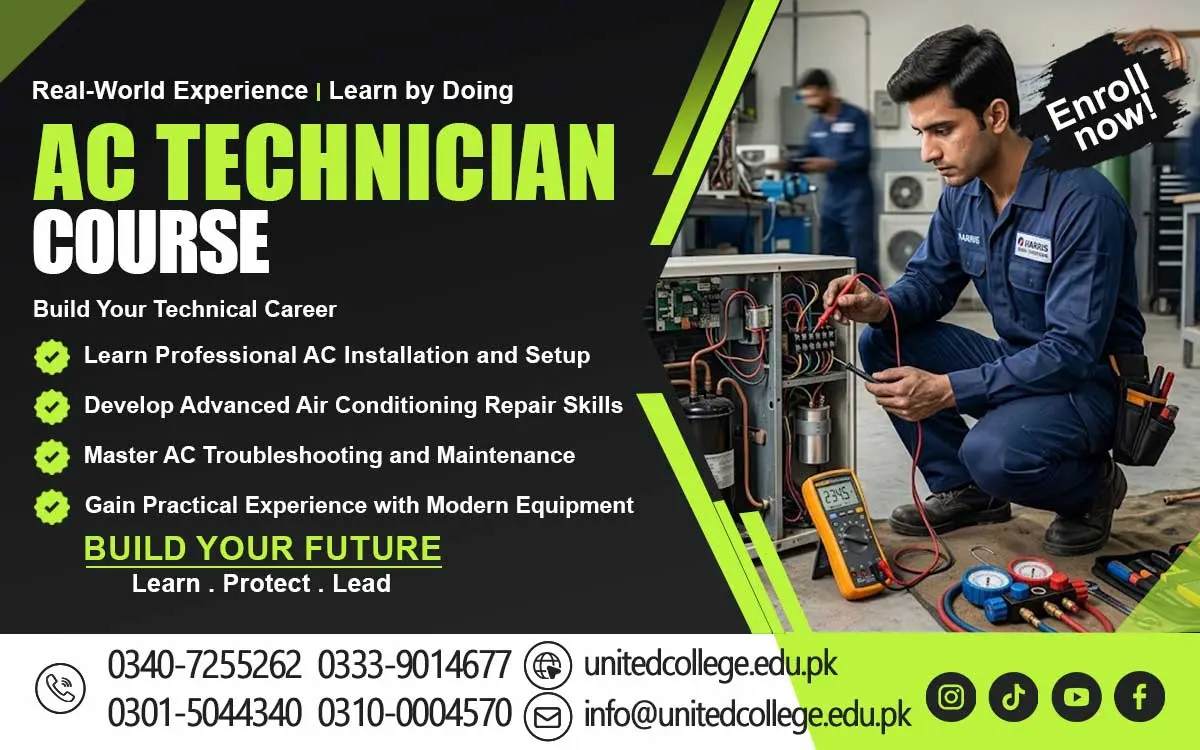

AC Technician Course in Haripur – Learn Repair and Cooling Skills
When an Air Conditioner Stops Cooling, Skilled Technicians Make a Difference
Imagine a hot summer afternoon when an air conditioner suddenly stops cooling a room. The fan is running, but warm air keeps coming out, and the temperature continues to rise. In another home, water begins dripping from an indoor unit, while a shop owner struggles with an AC that repeatedly switches off. These problems are common, but finding their causes requires the right knowledge and practical skills. An air conditioning technician understands how cooling systems work, how different components operate, and how to identify faults safely. For students and job seekers interested in technical work, learning these skills can be a useful step towards a practical career.
The AC Technician Course in Haripur introduces learners to the field of air conditioning repair, servicing, installation, and maintenance. It can help beginners understand how household and commercial cooling systems operate and what technicians do when equipment develops a fault. As demand for comfortable indoor environments continues in homes, offices, shops, and other buildings, knowledge of air conditioning systems remains useful in many settings. However, successful technical work requires more than simply knowing how to switch an AC on or off. Learners need to understand equipment, use tools correctly, follow safety procedures, and develop a careful approach to problem-solving.
How AC Technicians Keep Cooling Systems Working Properly
Technicians may install new units, inspect existing equipment, clean important components, check electrical connections, identify performance problems, and carry out regular maintenance. Their work helps air conditioning systems operate efficiently and can reduce the risk of unexpected breakdowns. The AC Technician Course helps learners understand these responsibilities and develop knowledge of air conditioning systems. To perform these tasks properly, a technician needs to understand both mechanical and electrical parts of an AC system. For example, if an air conditioner is running but not producing enough cool air, the problem could involve a dirty filter, restricted airflow, an electrical fault, or an issue with the refrigeration system.
This approach is an important part of air conditioner troubleshooting. Learners exploring an air conditioning course in Haripur can benefit from understanding how different faults affect system performance and why careful inspection matters. They can also learn the importance of following manufacturer instructions, using suitable tools, and explaining problems clearly to customers. In residential settings, technicians may work with split AC units, while commercial environments may contain larger or more complex cooling systems. Although the equipment can differ, the basic principles of inspection, maintenance, and safe working practices remain important.
Practical Skills Learners Can Develop During AC Technician Training
Learning a technical skill becomes easier when theoretical information is connected with practical examples. Instead of only reading about air conditioners, learners need to understand what individual components look like, what each part does, and how the complete system operates. An AC technician course can introduce beginners to common air conditioning tools and equipment, including screwdrivers, pliers, spanners, measuring instruments, and other tools used for inspection and servicing. Learners may also study how to recognise different types of air conditioners, understand basic wiring diagrams, identify system components, and follow a logical troubleshooting process.
Basic diagnostic knowledge helps narrow down the possibilities safely and systematically. Practical AC technician skills also include maintaining a clean work area, organising tools, recording observations, and communicating clearly about repair requirements. During suitable supervised exercises, learners can develop familiarity with routine servicing tasks and equipment handling. These abilities are relevant to air conditioner repair training because they connect classroom learning with the situations technicians may encounter during actual work. People considering an HVAC technician course should also understand that advanced tasks require additional knowledge and experience.
Understanding the Main Components Inside an Air Conditioner
An air conditioner may look like a simple appliance from the outside, but several components work together to remove heat from indoor air. Understanding these parts is an important step in refrigeration and air conditioning training. The compressor moves refrigerant through the system and raises its pressure, allowing the cooling cycle to continue. The condenser releases heat from the refrigerant into the outside air, while the evaporator absorbs heat from indoor air. A fan helps move air across the relevant coils, and filters catch dust and other particles before they build up inside the equipment. The thermostat or temperature sensor helps the system respond to the selected temperature.
Refrigerant lines carry refrigerant between different components, allowing the cooling cycle to operate. If one component develops a fault, the entire system may struggle to cool properly. For example, a dirty air filter can restrict airflow, while a damaged fan can affect the movement of air across the coils. Compressor and condenser repair requires a more detailed understanding because these components are connected to important mechanical and refrigeration processes. Learners should also become familiar with indoor and outdoor units, drain pipes, control boards, and common electrical connections. In split AC installation, the indoor and outdoor units must be connected correctly according to the manufacturer's requirements.
Learning AC Installation, Cleaning, Servicing, and Maintenance
Proper installation and regular maintenance play important roles in the performance of an air conditioner. A poorly installed unit may experience drainage problems, restricted airflow, unwanted vibration, or other operating difficulties. During AC maintenance training, learners can explore the steps involved in preparing an installation site, identifying suitable equipment, checking the manufacturer's instructions, and understanding the connections required between indoor and outdoor units. Split AC installation may involve mounting both units securely, arranging refrigerant piping and drainage, completing suitable electrical connections, and performing the required checks before operation.
Routine AC servicing focuses on keeping the system clean and checking its condition. Dust on filters and coils can interfere with airflow and heat transfer, so cleaning is an important maintenance activity when performed according to the manufacturer's guidance. However, not every maintenance task is suitable for an untrained person. Refrigerant handling, specialised pressure testing, and electrical work require appropriate training and equipment. Learners interested in the AC Technician Course in Haripur should understand the difference between routine cleaning and more advanced technical procedures. Regular maintenance can help identify developing problems before they become major faults, although it cannot prevent every breakdown.
Finding the Causes of Poor Cooling, Water Leakage, and Other AC Problems
When an air conditioner develops a fault, the visible symptom does not always reveal the actual cause. An AC that produces weak cooling, for example, may have a dirty filter, blocked airflow, an incorrect setting, a faulty sensor, or a problem within the refrigeration system. Water leaking from an indoor unit may indicate a blocked drain, an incorrectly installed drain pipe, or another issue that needs inspection. Unusual noises can result from loose components, fan problems, vibration, or mechanical damage. An AC that fails to start may have a control issue, a power supply problem, or a faulty electrical component.
Learning air conditioner troubleshooting means understanding how to examine these symptoms methodically. A technician begins with a safe visual inspection, checks the reported problem, and follows suitable diagnostic procedures before recommending a repair. For example, if a customer reports that an AC has stopped cooling, the technician may first confirm the settings and airflow, inspect accessible filters, and then determine whether further testing is needed. More advanced checks must be carried out by someone qualified to perform them. Learners studying air conditioning repair training can develop an understanding of why guessing can waste time and lead to unnecessary part replacements.
Why Electrical Safety and Responsible Refrigerant Handling Matter
Technical knowledge is valuable only when it is applied safely. Air conditioners contain electrical components, moving fans, pressurised refrigerant circuits, and parts that may become hot during operation. A small mistake during inspection or repair can cause electric shock, burns, equipment damage, or other serious injuries. The AC Technician Course helps learners understand the importance of safety while working with air conditioning systems. Anyone learning AC electrical wiring should understand the importance of isolating the power supply before working on equipment and verifying that it is safe to proceed. Protective equipment, suitable tools, manufacturer instructions, and appropriate supervision are essential parts of responsible technical work.
Refrigerants are substances used to transfer heat through the cooling cycle, and different systems may use different refrigerants with specific handling requirements. Releasing refrigerant into the atmosphere can harm the environment, while incorrect handling can create health and safety risks. Technicians must follow applicable regulations, use suitable equipment, and receive appropriate training before carrying out refrigerant-related procedures. Other safety practices include securing ladders, keeping tools organised, avoiding contact with moving components, and maintaining a clean work area. During AC technician training in Haripur, understanding these responsibilities is just as important as learning how to clean filters or identify system components.
Where Air Conditioning Repair and Maintenance Skills Can Be Used
Air conditioning systems are used in many places, including homes, retail shops, offices, schools, clinics, restaurants, hotels, workshops, and commercial buildings. Each environment has its own cooling requirements, which creates different maintenance and servicing needs. In a home, a technician might inspect a split AC that is not cooling properly, clean accessible filters, or investigate a drainage problem. In a shop, keeping the cooling system working reliably may be important for customer comfort and daily business activities. Offices and larger buildings may contain multiple units that require scheduled inspections and maintenance.
Learners who develop suitable skills may explore entry-level opportunities with AC service providers, maintenance teams, installation businesses, or technicians who carry out repair work. Some may eventually consider self-employment after gaining sufficient experience, learning customer service, understanding local requirements, and obtaining the tools needed for their work. However, completing training alone does not guarantee employment or business success. Employers and customers may expect practical experience, safe working habits, reliability, and the ability to diagnose problems correctly.
Explore Technical Learning Through the AC Technician Course in Haripur
Choosing a technical training programme is an opportunity to turn an interest in repairing appliances into a more organised learning process. The AC Technician Course in Haripur offered by United College of Technology (UCT) is relevant to learners who want to explore air conditioning systems, servicing methods, maintenance practices, and the responsibilities of an AC technician. Before enrolling in any programme, prospective students should understand its syllabus, practical training arrangements, course duration, fees, and any entry requirements directly from the institution. It is useful to ask how the training covers component identification, common AC faults, installation procedures, electrical safety, and routine maintenance.
After completing suitable training, further supervised practice and real-world experience may help learners improve their abilities and explore relevant entry-level work. Those interested in an air conditioning course in Haripur can use their training period to ask questions, revise technical concepts, and become familiar with the tools and procedures used in the field. With patience, continued practice, and responsible learning, the AC Technician Course in Haripur can serve as a starting point for understanding refrigeration and air conditioning work and deciding which technical skills to develop next.
Frequently Asked Questions (FAQs)
The AC Technician Course in Haripur helps learners understand air conditioning systems, AC installation, repair, servicing, maintenance, and basic troubleshooting.
Students, beginners, fresh learners, and job seekers interested in technical work can explore this course. Contact United College of Technology for specific admission requirements.
Learners can develop knowledge of AC components, cooling systems, split AC installation, routine maintenance, fault identification, and electrical safety.
Practical training may include learning about AC tools, component identification, servicing procedures, and troubleshooting. Contact United College of Technology to confirm the practical training available in its programme.
AC repair involves identifying and fixing faults, while maintenance includes regular cleaning, inspection, and servicing to help an air conditioner work properly.
Admission Open: Start Your Professional Journey Today!
Join United College of Technology and build a career with practical training, recognized certifications, and Gulf job support. Seats are limited.
Apply Now via WhatsAppContact Information
- Address: Rawalpindi: F-272 Main New Katarian Stop, Old IJP Road | Lahore Campus: Lahore, Pakistan
- Phone/WhatsApp: 0340-7255262 / 0333-9014677 / 0301-5044340 / 0310-0004570 / 051-8770756
- Website: unitedcollege.edu.pk
















Leave a Comment