


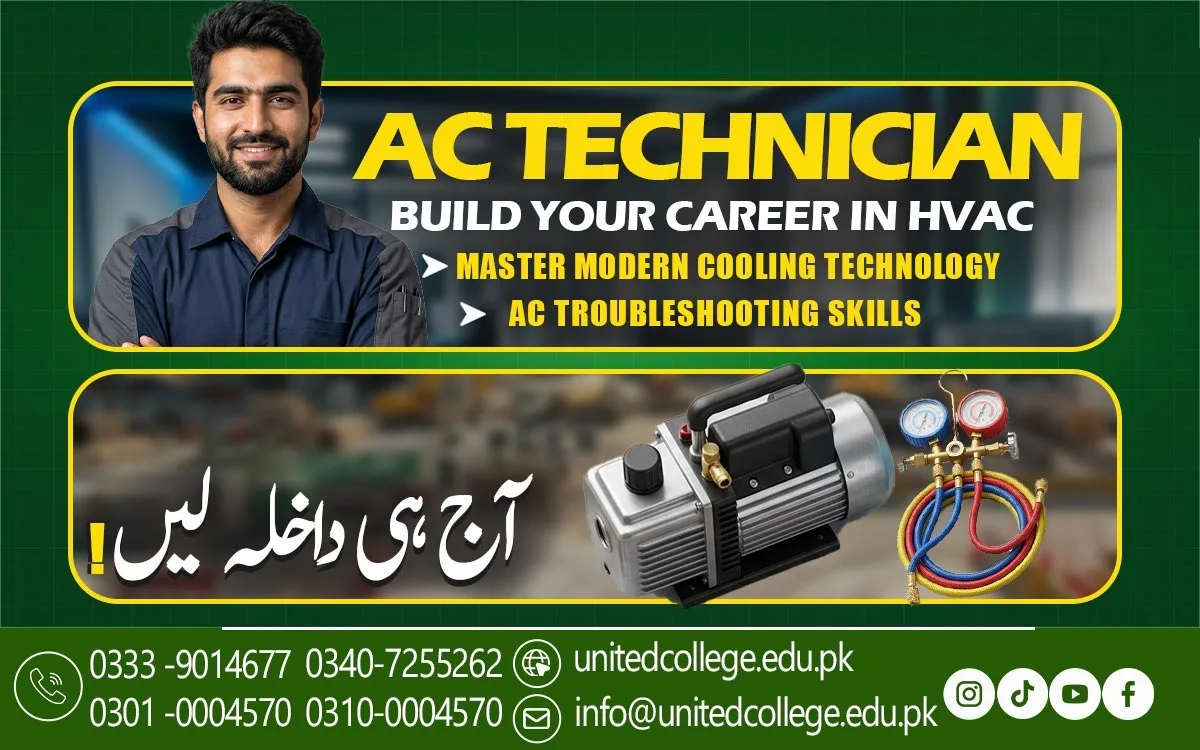

AC Technician Course in Swat – Learn Practical Repair Skills
When an Air Conditioner Stops Cooling, Skilled Technicians Make the Difference
Imagine coming home on a hot summer day in Swat, turning on your air conditioner, and finding it running but not cooling the room. Sometimes, the problem may be a dirty filter, a faulty electrical connection, a damaged component, or an issue with the refrigerant system. These situations can be frustrating for homeowners and businesses, especially when the weather is warm. A trained AC technician understands how to identify such problems and determine the appropriate repair method. This is where learning professional air conditioning skills becomes valuable for students and beginners interested in technical work.
The AC Technician Course in Swat introduces learners to the knowledge and practical skills associated with air conditioner installation, servicing, maintenance, and repair. Offered by United College of Technology (UCT), this training option is relevant to people who want to understand how cooling systems work and how technicians maintain them. An AC technician does more than repair machines; the role also involves checking equipment, following safety procedures, using tools correctly, and explaining technical problems to customers. As air conditioners are used in homes, offices, shops, hotels, and other buildings, understanding their operation can provide a useful foundation for technical learning.
How AC Technician Training Develops Practical Repair Skills
Understanding an air conditioner from the outside is easy, but repairing one requires knowledge of its internal components and operating process. AC technician course helps learners move beyond simply switching a unit on and off by introducing them to the systems that make cooling possible. During air conditioning technician training, students may learn how to recognise different AC parts, understand their functions, identify common faults, and follow suitable maintenance procedures. For example, a learner may discover why a blocked air filter reduces airflow or how a faulty capacitor can prevent certain motors from starting properly. These lessons help beginners connect technical information with real situations they may encounter during servicing work.
An AC servicing course may also introduce learners to inspection routines, cleaning methods, basic electrical testing, and the correct use of tools. Practical learning is particularly important because technicians need to recognise differences between faults that appear similar. An air conditioner that fails to cool might have an airflow problem, a thermostat issue, a refrigerant leak, or an electrical fault, so replacing parts without proper diagnosis can waste time and money. The AC Technician Course in Swat can help interested learners explore these technical areas and understand the importance of step-by-step troubleshooting. By developing knowledge gradually and practising under appropriate supervision, beginners can build confidence, improve their problem-solving abilities, and develop a clearer understanding of air conditioner repair and maintenance.
Understanding the Components Behind Refrigeration and Air Conditioning
An air conditioner may look like a single machine, but its cooling performance depends on several components working together. Learning about these parts is an important part of refrigeration and air conditioning training. The compressor helps circulate refrigerant through the system, while the condenser releases heat from the refrigerant to the surrounding air. The evaporator absorbs heat from indoor air, helping the room become cooler, and the expansion device regulates refrigerant flow into the evaporator. A fan supports airflow, while a thermostat or electronic temperature sensor helps control the cooling process. Beginners also need to understand how refrigerant changes pressure and temperature as it moves through the system.
Learning these functions makes it easier to understand why a problem in one component can affect the entire unit. A suitable HVAC technician course may cover different types of air conditioning systems, basic cooling cycles, electrical components, and routine inspection methods. Learners can also become familiar with the differences between split air conditioners, window units, and other cooling equipment. Through the AC Technician Course in Swat, students can explore the technical concepts behind these systems and develop a foundation for further practical learning. Understanding components before attempting repairs is essential because correct diagnosis depends on knowing what each part does and how the complete system operates.
Learning Split AC Installation and Maintenance Procedures
A poorly installed air conditioner may experience drainage problems, weak cooling, unusual vibration, or unnecessary energy consumption. Correct installation is therefore an important skill for anyone learning to work with cooling equipment. Split AC installation involves positioning the indoor and outdoor units, selecting suitable mounting locations, connecting refrigerant pipes, arranging drainage, and completing the required electrical connections according to manufacturer instructions. Each step requires attention because small mistakes can affect performance and reliability. For example, an incorrectly arranged drainpipe may cause water to leak indoors, while unsuitable pipe connections can lead to refrigerant leakage.
Proper clearances, secure mounting, suitable electrical protection, and appropriate commissioning checks are all important. Alongside installation, routine air conditioning system maintenance helps keep equipment working efficiently. Cleaning or replacing filters as recommended, inspecting accessible components, checking airflow, and keeping outdoor units free from obstructions can support normal operation. More advanced tasks, including refrigerant circuit work and electrical repairs, require suitable training and precautions. The AC Technician Course in Swat is relevant to learners who want to understand these installation and maintenance activities as part of their technical development.
Identifying Cooling Faults Through Systematic AC Troubleshooting
When an air conditioner stops working properly, the first challenge is finding the actual cause of the problem. Replacing a component without checking the system can make repairs more expensive and may leave the original fault unresolved. AC troubleshooting techniques help technicians investigate problems systematically instead of guessing. If an air conditioner produces weak airflow, for instance, the technician may begin by checking the filter, air inlet, fan operation, and condition of accessible components. If the unit runs but does not cool sufficiently, other possibilities may include incorrect temperature settings, restricted airflow, a sensor fault, or a problem within the refrigerant circuit.
Unusual sounds may indicate loose parts, vibration, or a mechanical issue, while water dripping from an indoor unit can point towards a drainage or condensation problem. These symptoms are clues rather than definite diagnoses, so each possibility needs to be assessed carefully. Cooling system diagnosis may involve visual inspections, reviewing the unit's operating behaviour, and using suitable testing equipment. Learners also need to understand when a problem requires a qualified or experienced technician, particularly when it involves live electrical circuits, pressure systems, or refrigerants. Through an AC repair course in Swat, beginners can explore common faults and learn why a logical inspection process matters.
Using HVAC Tools and Equipment Correctly During Repair Work
Even a knowledgeable technician needs suitable tools to inspect, maintain, and repair air conditioning systems. Learning to identify HVAC tools and equipment is therefore an important part of developing AC technician practical skills. Common tools may include screwdrivers, spanners, pliers, wire strippers, measuring tapes, and other hand tools used for basic installation and maintenance. Depending on the task, technicians may also use a multimeter to check electrical measurements, a clamp meter to measure current, and temperature-measuring instruments to assess system performance. More specialised equipment, such as manifold gauges, vacuum pumps, and refrigerant recovery machines, is used for particular refrigerant-system procedures by trained personnel.
Each tool has a specific purpose, and using the wrong equipment can damage components or create safety risks. For example, a multimeter must be set up correctly for the measurement being performed, and its leads and ratings must be suitable for the circuit. Similarly, tools should be inspected before use, kept clean, and stored properly after the task is complete. During air conditioner repair training, beginners can learn the names, functions, and limitations of common tools before progressing to more advanced procedures. The AC Technician Course in Swat offers a relevant subject area for learners interested in understanding how technical equipment supports installation, servicing, and fault diagnosis.
Electrical Safety and Refrigerant Handling in Air Conditioning Work
Air conditioning repair requires careful attention to safety because electrical components, moving parts, pressurised refrigerant systems, and heavy equipment can create hazards. A technician who understands the repair process but ignores safety precautions may put themselves and others at risk. Electrical safety begins with identifying the power source and isolating the equipment before work is carried out. The technician must follow appropriate isolation procedures and verify that the circuit is safe before touching electrical components. Suitable personal protective equipment, such as safety glasses and protective gloves appropriate to the task, may also be necessary. Refrigerant handling requires separate precautions because refrigerants can cause cold burns, and some types may present additional hazards if released or handled incorrectly.
Beginners should not attempt these tasks independently without the necessary training and supervision. Good working practices also include keeping the work area organised, ensuring adequate ventilation where required, and following manufacturer instructions. During an AC Technician Course in Swat, learners should seek to understand these safety principles alongside the technical side of air conditioning and refrigeration. Safety knowledge is not an optional extra; it is part of professional competence. By learning to recognise hazards, use equipment correctly, and follow established procedures, students can build a more responsible approach to technical work and understand why safe working practices matter during every stage of installation and repair.
How United College of Technology Connects Learning With Technical Skills
Choosing suitable training can help beginners organise their learning and understand which technical skills they need to develop. United College of Technology (UCT) offers the AC Technician Course in Swat for people interested in air conditioning installation, servicing, maintenance, and repair. For students who are new to the field, learning in a structured way can make unfamiliar technical subjects easier to approach. Rather than trying to understand every component at once, learners can build their knowledge step by step, beginning with the functions of basic AC parts and progressing towards maintenance procedures and fault diagnosis.
An effective learning approach should also connect theory with practical examples, because knowing the name of a component is different from understanding how it behaves when a system develops a fault. Learners can benefit from asking questions, reviewing technical instructions, practising safe tool handling, and observing how experienced technicians inspect equipment. Before enrolling, prospective students should confirm the current course syllabus, duration, fees, admission requirements, practical training arrangements, and certificate details directly with UCT rather than relying on assumptions. It is also helpful to ask which air conditioning systems are covered and what level of practical work is included. For people in Swat who want to develop technical knowledge, choosing training that matches their learning needs is an important decision.
Building Long-Term Confidence Through Consistent AC Technician Practice
Real improvement comes from understanding why a procedure is necessary, recognising when something is wrong, and knowing how to respond safely. For someone studying through an AC Technician Course in Swat, regular practice can help turn classroom knowledge into useful technical understanding. A beginner might start by identifying AC components, learning basic maintenance procedures, and understanding the purpose of common measuring instruments. With appropriate supervision, the learner can gradually move towards more complex activities, such as interpreting wiring diagrams, checking operating conditions, and investigating common cooling faults.
Technicians often need to explain a fault in simple language, describe the work required, and help customers understand how regular maintenance may reduce avoidable problems. Professional habits such as arriving prepared, keeping tools organised, respecting property, and following safety rules can also improve the quality of service. For students and job seekers in Swat, technical training can provide a foundation, but personal commitment remains essential. By combining suitable instruction from United College of Technology, supervised practice, continued study, and responsible working habits, learners can develop a clearer understanding of air conditioning systems and prepare to explore relevant technical opportunities as their skills and experience grow.
Frequently Asked Questions (FAQs)
The AC Technician Course in Swat is a technical training option offered by United College of Technology (UCT) for learners interested in air conditioner installation, servicing, maintenance, troubleshooting, and repair.
Students may learn about AC components, refrigeration systems, split AC installation, electrical wiring, routine maintenance, fault diagnosis, HVAC tools, and workplace safety.
Yes, beginners interested in technical work can explore this course to develop foundational knowledge and practical skills in air conditioning systems.
An AC technician needs problem-solving abilities, attention to detail, basic electrical knowledge, tool-handling skills, patience, and an understanding of safety procedures.
Depending on their skills and experience, learners may explore opportunities with AC repair workshops, installation teams, maintenance services, or eventually consider self-employment.
Admission Open: Start Your Professional Journey Today!
Join United College of Technology and build a career with practical training, recognized certifications, and Gulf job support. Seats are limited.
Apply Now via WhatsAppContact Information
- Address: Rawalpindi: F-272 Main New Katarian Stop, Old IJP Road | Lahore Campus: Lahore, Pakistan
- Phone/WhatsApp: 0340-7255262 / 0333-9014677 / 0301-5044340 / 0310-0004570 / 051-8770756
- Website: unitedcollege.edu.pk
















Leave a Comment