


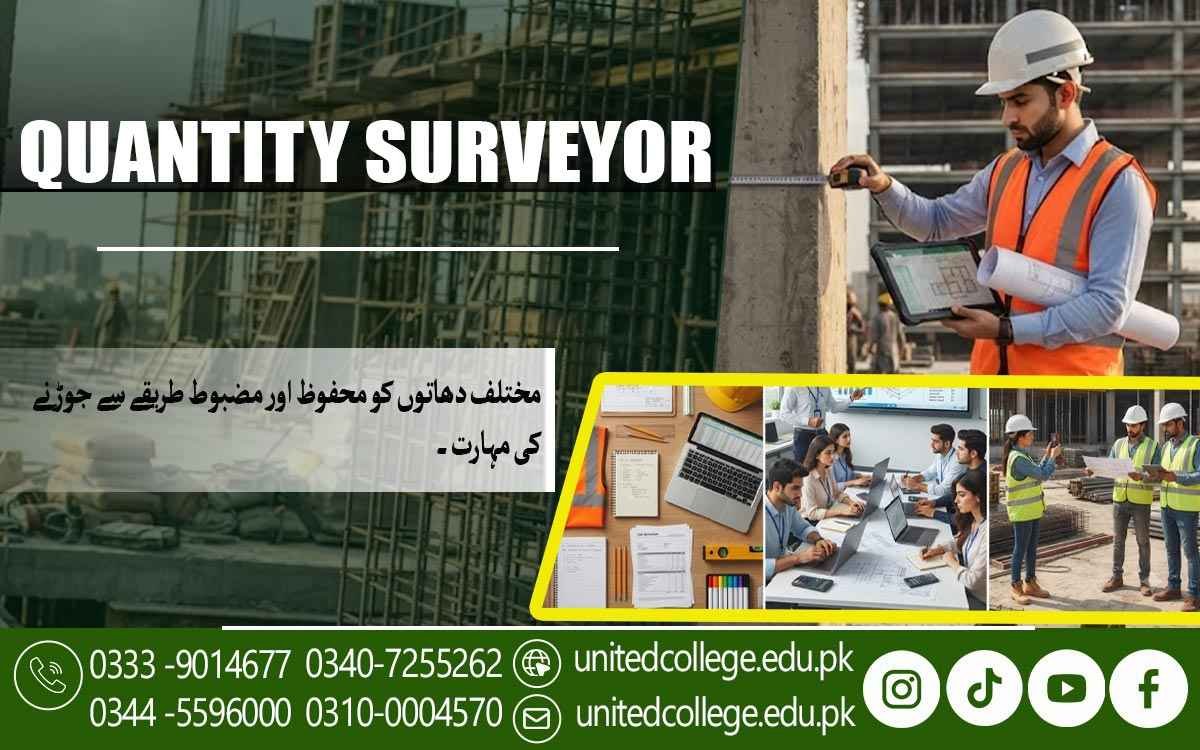

Quantity Surveyor Course in Sheikhupura for Smarter Site Planning
Quantity Surveyor Course in Sheikhupura to Build Practical Construction Expertise
Construction projects depend on careful planning long before the first brick is placed. Someone needs to understand measurements, calculate quantities, study material requirements, estimate costs, and organize important project information. These tasks make quantity surveying an important part of modern construction work.
The Quantity Surveyor Course in Sheikhupura provides an opportunity for students, diploma holders, beginners, and job seekers to explore this technical field. Through structured learning, students can develop an understanding of construction measurement, quantity estimation, costing, drawings, and project documentation. The course is offered by United College of Technology, where learners can build their knowledge through practical, construction-focused training.
Where Building Ideas Become Measurable Construction Work
Quantity surveying is closely connected with the planning and financial side of construction. A quantity surveyor studies project information and determines the amount of work and materials involved in different construction activities. This information can then support estimating, budgeting, purchasing, and project planning. For a beginner, the field becomes easier to understand when construction activities are broken into smaller parts.
Foundations, walls, concrete, plaster, flooring, roofing, and other elements can each be measured and assessed. Learning these fundamentals helps students see how a building project is converted into organized quantities and cost information. The Quantity Surveyor Course in Sheikhupura introduces learners to this process in a structured way. Instead of focusing only on theory, students can learn how different construction details connect with practical estimating work.
Measuring Materials with Greater Accuracy
Construction measurement is one of the key areas learners need to understand. Before estimating the cost of a project, it is necessary to know how much work and material may be required. Measurement provides the basic information needed for these calculations. Students can learn how quantities are identified from construction drawings and project details.
They may work with common construction elements and understand how dimensions are used to calculate areas, volumes, lengths, and other quantities. This knowledge supports quantity estimation and helps learners become more comfortable with construction-related calculations. With regular practice, beginners can improve their ability to organize measurement information and reduce common errors in quantity calculations.
Turning Quantities Into Clear Cost Information
Once quantities have been established, the next stage involves understanding their financial value. Cost estimation helps determine the expected expense of construction work by considering quantities, material rates, labor-related factors, and other relevant costs. Learners can study how different rates are applied to measured quantities. This introduces them to basic rate analysis, where the cost of a particular construction activity is examined in more detail.
For example, the cost of a construction item may depend on the materials used, required quantities, labor, and other resources. Understanding these elements gives students a stronger foundation in construction cost management and helps them recognize how individual expenses contribute to a larger project budget.
BOQ Preparation Brings Project Information Together
A Bill of Quantities (BOQ) is an important document used to present measured construction items in an organized form. It can contain descriptions of work, quantities, units, and other information used during estimating and project planning. Learning BOQ preparation allows students to organize construction data rather than simply calculate individual figures.
They can understand how separate measurements are brought together into a structured document. This skill also introduces learners to the importance of clear construction documentation. When project information is arranged properly, it becomes easier to review quantities, compare costs, and follow the details of planned construction work.
Reading Drawings With An Estimator’s Eye
Construction drawings contain valuable information about dimensions, layouts, rooms, structural elements, and other parts of a building. A learner developing quantity surveying skills needs to understand how to find useful measurement information within these drawings. During the Quantity Surveyor Training, students can become familiar with reading basic plans and identifying details that may be needed for quantity calculations. In the Quantity Surveyor Course in Sheikhupura, students can also learn how to understand drawings and apply measurement techniques to practical construction projects.
This can include dimensions, areas, lengths, and specifications connected with different construction activities. Learning to interpret drawings also strengthens the connection between classroom exercises and construction work. When students understand where measurement information comes from, calculations become more meaningful and easier to relate to real projects.
Developing Practical Estimating Skills Beyond Basic Calculations
A good understanding of quantity surveying requires more than knowing formulas. Learners also need to develop attention to detail, organized working habits, basic mathematical ability, and the patience to check their calculations. The course can introduce students to practical exercises involving quantities, material estimation, drawings, costing, and documentation.
These activities allow beginners to work through construction-related examples instead of treating every concept as an isolated theory topic. Learners may also become familiar with the idea of quantity surveying software and how digital tools can support estimating and documentation. Software can make certain tasks faster, but a strong understanding of measurement and construction principles remains important for using such tools effectively.
Building Construction Knowledge Through Local Technical Training
For students in Sheikhupura, learning a construction-related skill locally can provide a convenient way to explore a specialized technical field. The Quantity Surveying Course in Sheikhupura can be relevant to learners who want to understand the planning, measurement, and costing side of building work. Students do not need to begin as construction experts. A beginner can start by learning common construction terms, basic measurements, drawing interpretation, material quantities, and simple costing methods.
Gradual practice can make more advanced concepts easier to understand later. Technical education can also help learners connect academic knowledge with practical tasks. For someone interested in construction project management or estimating work, this connection can provide a clearer understanding of how different project activities fit together.
Practical Quantity Surveying Training at United College of Technology
United College of Technology offers the Quantity Surveyor Course in Sheikhupura for learners interested in developing construction-related knowledge and practical estimating skills. The learning focus can help students understand the relationship between measurements, materials, costs, drawings, and project records.
Instead of trying to understand construction costing as one large subject, students can build their knowledge through individual areas and gradually see how they connect. This type of training can be relevant to students, diploma holders, job seekers, and individuals looking to add a construction-focused technical skill to their existing knowledge.
Turning Quantity Surveying Knowledge Into Your Next Technical Step
Quantity surveying brings together several important parts of construction, including measurement, estimating, material planning, costing, documentation, and project information. Learning these areas can give beginners a clearer understanding of the work that supports construction projects behind the scenes. The Quantity Surveyor Course in Sheikhupura can serve as a starting point for learners who want to explore this specialized field and develop practical quantity surveying knowledge.
With consistent learning and hands-on practice, students can strengthen their understanding of construction estimating and related technical tasks. For those ready to explore the field further, United College of Technology provides a local learning option for developing foundational quantity surveying skills. Starting with the basics and building step by step can create a stronger foundation for continued technical growth in the construction field.
Frequently Asked Questions (FAQs)
A quantity surveyor may review drawings, specifications, measurements, material requirements, and other project details to understand the work involved.
Learners commonly work with measurements, areas, volumes, percentages, rates, and basic calculations when preparing construction estimates.
Rate analysis helps break down the expected cost of a construction activity by considering its materials, labor, and other relevant components.
Well-organized records make project information easier to track, review, compare, and update when construction requirements change.
Yes. Diploma holders can explore the subject to expand their understanding of construction estimation, measurement, costing, and project-related documentation.
Regular practice with sample drawings, measurement exercises, quantity calculations, BOQs, and simple estimating tasks can help reinforce newly learned concepts.
Admission Open: Start Your Professional Journey Today!
Join United College of Technology and build a career with practical training, recognized certifications, and Gulf job support. Seats are limited.
Apply Now via WhatsAppContact Information
- Address: Rawalpindi: F-272 Main New Katarian Stop, Old IJP Road | Lahore Campus: Lahore, Pakistan
- Phone/WhatsApp: 0333-9014677 / 0344-5596000 / 0310-0004570 / 0301-5044340 / 0340-7255262
- Website: unitedcollege.edu.pk
















Leave a Comment