


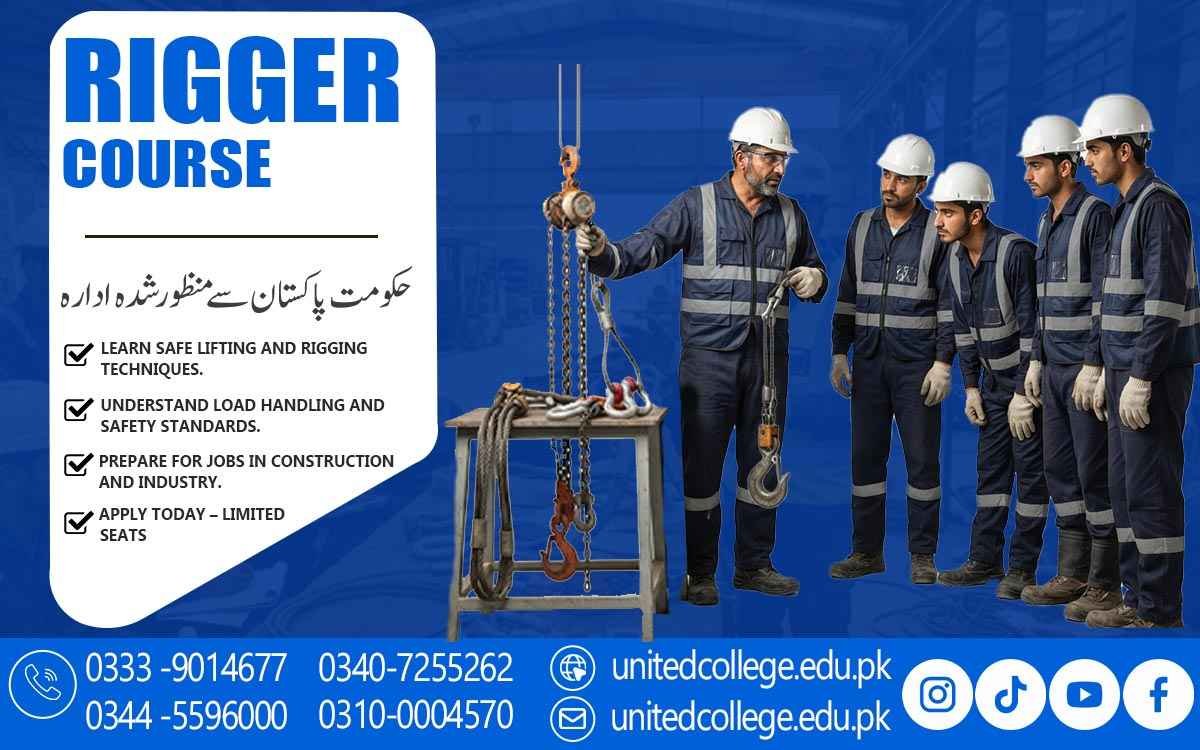

Rigger Course in Bagh AJK – Master Safer Load Handling Skills
Build Practical Skills for Safer Lifting Work
Rigging is an important part of many construction, industrial, and lifting activities where heavy materials or equipment need to be moved safely. A trained rigger must understand how loads are prepared, secured, lifted, and guided while keeping people and equipment protected.
The Rigger Course in Bagh AJK allows learners to understand the practical side of rigging work and develop awareness of safe lifting operations. Offered by United College of Technology, the training can help beginners and workers build useful technical knowledge for environments where lifting and load handling are part of daily tasks.
Strong Rigging Skills Begin with Safe Work Awareness
Rigging is not simply about attaching a load to lifting equipment. A rigger needs to think carefully about the load, equipment, surroundings, lifting method, and people working nearby. Even a small mistake in preparation can create serious workplace risks. Through the Rigger Course in Bagh AJK, learners can develop a better understanding of responsible lifting practices.
The focus can include workplace awareness, careful preparation, communication, and the correct use of rigging equipment. For beginners, this knowledge creates a foundation before they take on practical responsibilities. It also helps workers understand why every lifting operation requires attention rather than rushing through routine tasks.
Practical Lifting Knowledge That Supports Real Work
A useful rigging course should connect technical knowledge with situations that workers may face on a job site. Learners can explore basic lifting and rigging skills, load handling concepts, equipment awareness, and methods used to prepare loads for movement.
Training may also introduce learners to different rigging techniques and the factors that should be considered before a lifting operation begins. Understanding these areas helps students develop a more careful approach to handling materials and equipment. The Rigger Course in Bagh AJK can therefore be useful for people who want technical training that focuses on practical responsibilities rather than only classroom concepts.
Equipment Knowledge Makes Every Lift More Controlled
A rigger works with different types of equipment and accessories used during lifting activities. Developing basic knowledge of rigging equipment helps learners understand what each item is designed to do and why proper selection and handling matter.
Learners may study the purpose and safe handling of equipment such as slings, shackles, hooks, ropes, lifting accessories, and related tools. The exact training content can vary, but the main goal is to build awareness of equipment condition, proper use, and safe working practices. Good equipment knowledge also encourages workers to pay attention to visible damage, unsuitable equipment, and unsafe conditions before a lifting task begins.
Safety Decisions Matter Before the Load Leaves the Ground
Safe lifting starts before the actual lift. A rigger needs to consider the weight and position of the load, the condition of lifting accessories, the working area, and possible obstacles around the lifting path. Rigging safety training helps learners understand why preparation and checking are important parts of lifting operations.
Instead of treating safety as a final step, workers learn to consider it throughout the entire task. These rigger safety practices can include maintaining a clear working area, using suitable equipment, following instructions, and avoiding unnecessary risks. A careful approach is especially important when working around heavy or suspended loads.
Communication and Teamwork Keep Lifting Operations Organized
Rigging work often requires several people to work together during a lifting operation. Crane operators, riggers, supervisors, helpers, and other workers must coordinate their actions to keep the process organized. Clear communication helps everyone understand what is happening, which signals to follow, and when a movement should take place. A professional rigger therefore needs more than physical strength and practical ability.
Attention, discipline, teamwork, and the ability to follow established signals are important parts of responsible rigging work. Through a Rigger Course in Bagh AJK, learners can develop a better understanding of how communication and coordination support safe lifting activities. Knowing one's role within a team can reduce confusion and help workers respond more effectively during demanding workplace situations.
Practical Training Connects Technical Lessons with Workplace Situations
Reading about lifting procedures is useful, but practical learning can make technical concepts easier to understand. Learners benefit from seeing how equipment, loads, work areas, and safety procedures relate to one another. At United College of Technology, the Rigger Course in Bagh AJK is presented as technical training where learners can focus on relevant rigging knowledge and practical skills.
Students can use training activities to understand the type of care and attention expected during lifting-related work. This practical approach can be valuable for beginners who have limited experience with industrial or construction environments. It allows them to develop familiarity with basic procedures before applying their knowledge in an actual workplace.
Rigging Skills Connect with Construction and Industrial Work
Rigging knowledge can be relevant in workplaces where materials, machinery, structural components, or other heavy loads need to be moved or positioned. Construction sites, industrial facilities, warehouses, maintenance areas, and lifting-related operations may involve tasks where rigging awareness is important.
Construction rigging skills and industrial rigging training can help learners understand the responsibilities associated with load handling. The exact duties depend on the workplace, equipment, and level of responsibility assigned to a worker. For people exploring technical training in Bagh AJK, rigging can be one practical area to consider when they are interested in construction, industrial work, equipment handling, or other hands-on technical fields.
A Focused Mindset Builds Stronger Rigger Career Skills
Rigger work requires patience and concentration. A person who ignores instructions, overlooks equipment conditions, or becomes careless around suspended loads can create unnecessary risks. This is why a responsible attitude is an important part of skilled rigger training. The course can be considered by beginners, students, workers, job seekers, and individuals interested in developing practical technical abilities.
Previous experience may be helpful in some workplace situations, but a learner's willingness to follow safety procedures and improve their skills is equally important. People considering vocational courses in Bagh AJK can explore rigging training as a way to develop a specialized set of workplace skills. The training can provide useful knowledge that learners may continue developing through practice and workplace experience.
Turn Technical Learning into a More Responsible Skill Set
Professional rigging is built on preparation, equipment awareness, communication, teamwork, and respect for workplace safety. Learning these areas can help a person understand the responsibilities involved in lifting and load handling more clearly. The Rigger Course in Bagh AJK offered by United College of Technology provides a learning path for individuals interested in developing practical rigger skills.
Rather than depending only on theoretical knowledge, learners can focus on understanding the principles and careful practices connected with lifting work. For anyone interested in hands-on technical learning, developing rigging career skills can be a meaningful step toward becoming more confident and responsible in lifting-related environments. With continuous practice, attention to safety, and a willingness to learn, technical training can become a useful part of long-term professional development.
Frequently Asked Questions (FAQs)
A rigger should be alert, responsible, physically careful, willing to follow instructions, and able to stay focused during lifting-related tasks.
Yes. Workers with related experience can use training to refresh their knowledge and develop a more structured understanding of rigging responsibilities.
Rigging involves planned methods for preparing, securing, and moving loads with lifting equipment, requiring greater attention to load control and safety.
Beginners can start by learning basic equipment knowledge, workplace procedures, safety principles, communication methods, and controlled load-handling practices.
Yes. Rigging-related skills can also be relevant in industrial facilities, maintenance areas, warehouses, workshops, and other places where lifting equipment is used.
Learners should continue improving through supervised practice, workplace experience, safety awareness, and regular attention to proper equipment-handling procedures.
Admission Open: Start Your Professional Journey Today!
Join United College of Technology and build a career with practical training, recognized certifications, and Gulf job support. Seats are limited.
Apply Now via WhatsAppContact Information
- Address: Rawalpindi: F-272 Main New Katarian Stop, Old IJP Road | Lahore Campus: Lahore, Pakistan
- Phone/WhatsApp: 0333-9014677 / 0344-5596000 / 0310-0004570 / 0301-5044340 / 0340-7255262
- Website: unitedcollege.edu.pk
















Leave a Comment