


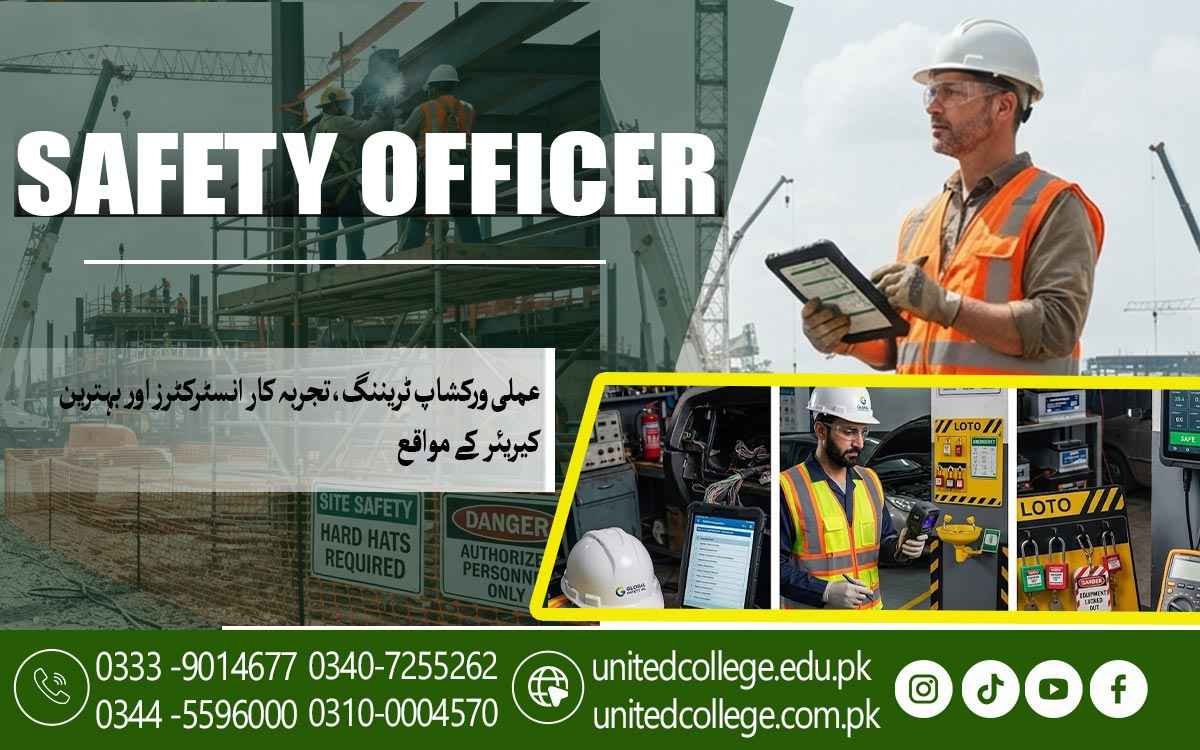

Safety Officer Course in Mandi Bahauddin – Step Beyond Basic Skills
Give Your Career a Safer Direction
Imagine a worker entering a busy site and noticing a slippery floor near a machine. Everyone is in a hurry, so nobody pays attention. A few minutes later, someone could slip, get injured, and stop the entire operation. Situations like this show why workplace safety depends on awareness long before an accident happens. A trained person can notice warning signs, encourage corrective action, and help workers understand safer ways of performing their duties.
For students, fresh learners, and job seekers, the Safety Officer Course in Mandi Bahauddin can provide an opportunity to learn these practical concepts in a structured way. The course introduces learners to workplace hazards, preventive practices, emergency awareness, inspections, and responsible safety behavior. United College of Technology offers professional-oriented learning for individuals who want to develop practical safety knowledge and understand the responsibilities associated with safety-related work.
A Safety Officer's Day Is Built Around Observation and Prevention
The responsibilities of a Safety Officer Course in Mandi Bahauddin can change according to the workplace, but the central purpose remains reducing avoidable risks. During a normal working day, a safety professional may observe employees, inspect work areas, check safety practices, discuss concerns, review procedures, and report unsafe conditions. The role can require patience because not every safety problem is immediately obvious.
In a factory, attention may be focused on machinery, electrical systems, chemicals, or production processes. On a construction site, fall protection, tools, lifting activities, and changing work conditions may require greater attention. An occupational safety course helps learners understand that safety work involves more than simply reminding people to wear protective equipment.
Learn to Read a Workplace Before You Try to Control Its Risks
Before a risk can be controlled, it needs to be recognized. Workplace hazards can take many forms, including unsafe machinery, electrical problems, poor housekeeping, hazardous substances, excessive noise, fire risks, and unsafe work practices. Safety Officer training in Mandi Bahauddin can introduce beginners to methods of identifying these hazards in different environments.
Similarly, damaged equipment may create a danger that is not immediately visible to an inexperienced worker. Workplace hazard management encourages learners to look beyond appearances and consider what could happen if an unsafe condition remains unchanged. This practical way of thinking can strengthen safety awareness and help students understand why early identification is an important part of accident prevention.
Fire Safety and Emergency Readiness Are Skills You Cannot Learn at the Last Minute
An emergency does not give workers time to study instructions. They need to know what to do beforehand. Fire safety training can help learners understand common prevention practices, emergency exits, alarms, evacuation procedures, fire protection equipment, and the importance of keeping escape routes accessible. Emergency response training can also introduce students to the importance of communication and organized action during unexpected situations.
The focus is not simply on reacting to a fire. It is also about recognizing conditions that could increase the chance of an emergency and supporting better preparedness. A Safety Officer may help communicate emergency procedures, identify weaknesses in arrangements, and encourage workers to take preparedness seriously. These lessons can be useful across offices, factories, workshops, construction areas, and other workplaces where emergency planning forms part of occupational health and safety.
PPE Protects Better When Workers Understand More Than Just Its Name
Personal protective equipment is familiar to most people, but using it correctly requires proper understanding. Depending on the task, personal protective equipment can include helmets, gloves, safety footwear, eye protection, hearing protection, protective clothing, or respiratory protection. A Safety Officer Course in Mandi Bahauddin can help learners understand PPE safety, including selecting appropriate equipment, using it correctly, checking its condition, and following workplace procedures.
Students can also learn that PPE is only one part of a wider workplace safety system. If a workplace has an unsafe process, simply providing gloves or a helmet may not solve the underlying problem. Professional workplace safety training helps students understand how protective measures can work alongside hazard control, safer procedures, supervision, and worker awareness.
Construction and Industrial Sites Demand Different Safety Thinking
Safety principles are widely applicable, but every industry has its own challenges. Construction safety may involve working at height, excavation, lifting operations, temporary structures, electrical equipment, and constantly changing site conditions. Industrial safety training, on the other hand, may focus more heavily on machinery, production systems, chemicals, maintenance activities, and fixed workplace processes.
Regular inspections provide opportunities to identify unsafe conditions and check whether agreed safety practices are being followed. Clear records can help organizations understand incidents, observations, and corrective actions. These activities form an important part of effective safety management and give learners a more realistic picture of professional responsibilities.
Good Safety Rules Work Best When People Know How to Communicate Them
Even well-designed safety procedures can fail if workers do not understand them or do not take them seriously. This makes communication an important part of professional safety work. A Safety Officer may need to explain a workplace rule, discuss an unsafe practice with an employee, share inspection findings with management, or guide workers during an emergency.
Safety rules and regulations provide a framework, but communication helps turn those requirements into everyday behavior. Students can develop safety management skills by learning how observation, documentation, teamwork, and clear instructions work together. At United College of Technology, learners can build practical understanding of workplace safety concepts and develop a foundation for handling safety responsibilities professionally.
Make Professional Safety Knowledge the Beginning of Something Bigger
Workplace safety knowledge can be relevant in factories, construction companies, workshops, warehouses, engineering environments, offices, and other organizations. Depending on their qualifications, experience, and employer requirements, learners may explore safety jobs in Pakistan and related roles after developing appropriate knowledge and workplace experience. The Safety Officer Course in Mandi Bahauddin can serve as a starting point for students, job seekers, workers, and fresh learners who want to explore a safety career in Pakistan.
Training alone does not guarantee employment, but it can provide a foundation that learners can strengthen through experience, further education, additional professional training, and industry-specific knowledge. United College of Technology can help learners take that first structured step by developing relevant safety awareness and practical understanding.
Frequently Asked Questions (FAQs)
No. A Safety Officer mainly supports safer working practices by identifying concerns, guiding workers, checking procedures, and communicating safety requirements.
Safety compliance means following applicable workplace requirements, established procedures, and safety practices that help an organization operate responsibly.
Yes. Training encourages learners to pay closer attention to work areas, equipment, employee behavior, and changing conditions that could create potential risks.
Workplaces can change through new equipment, different tasks, or updated processes. Reviewing procedures helps ensure that safety practices remain suitable for current conditions.
They can seek relevant workplace experience, continue professional learning, explore industry-specific training, and build the skills needed for their chosen safety-related direction.
Yes. Offices can also have risks involving ergonomics, electrical equipment, fire evacuation, slips, trips, and emergency procedures, so safety awareness is useful in office environments as well.
Admission Open: Start Your Professional Journey Today!
Join United College of Technology and build a career with practical training, recognized certifications, and Gulf job support. Seats are limited.
Apply Now via WhatsAppContact Information
- Address: Rawalpindi: F-272 Main New Katarian Stop, Old IJP Road | Lahore Campus: Lahore, Pakistan
- Phone/WhatsApp: 0333-9014677 / 0344-5596000 / 0310-0004570 / 0301-5044340 / 0340-7255262
- Website: unitedcollege.edu.pk
















Leave a Comment