


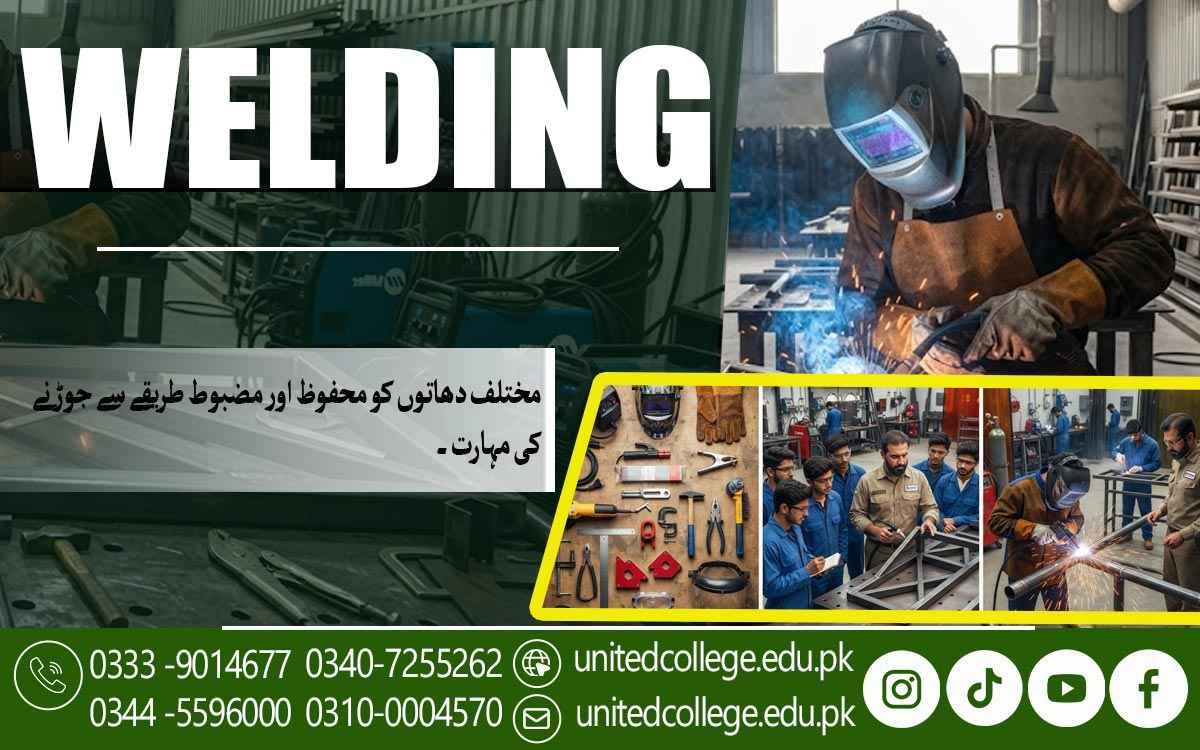

Welding Course in Sheikhupura – Build Skills That Create
Turn Metalwork Into a Hands-On Skill
A welding joint may look simple from the outside, but creating it properly requires control, timing, preparation, and practice. Welding is used to connect metal parts, repair damaged components, build frames, and support fabrication work in many technical settings. For beginners in Sheikhupura, learning this trade can be a practical way to develop a skill that depends on real hands-on ability rather than theory alone.
The Welding Course in Sheikhupura, offered by United College of Technology, introduces learners to the basic principles and practical side of welding. Students can learn how welding machines work, how metal is prepared, how different joining methods are performed, and how safety procedures are followed. The course can be useful for fresh learners, students, job seekers, and anyone interested in developing practical trade skills.
The First Step From Metal Pieces To Useful Work
Welding is a metal-joining process in which heat is used to connect separate pieces. Depending on the process and material, the heat can melt the edges of the metals or use another material to form the joint. During a Welding Course In Sheikhupura, understanding this basic idea gives beginners a starting point for learning more detailed welding techniques.
Welding skills can support many types of technical activities. Metal fabrication, equipment repair, structural work, workshop projects, and maintenance tasks may all involve some form of welding. However, the actual work a person can perform depends on their training, experience, equipment, and workplace requirements.
Real Workshop Practice Makes the Learning Different
Reading about welding is useful, but practical work allows learners to understand how tools and materials respond during an actual task. In welding classes, beginners can become familiar with setting up equipment, preparing workpieces, positioning metal, and carrying out basic joining exercises.
Practical training can also introduce learners to supporting activities such as measuring, marking, cutting, grinding, and cleaning metal. These steps matter because a good weld often begins before the welding machine is switched on. Careful preparation helps learners understand the complete workflow instead of seeing welding as a single action.
Four Welding Methods, Four Ways of Working
Different welding processes use different equipment and techniques. Arc welding uses an electric arc to produce the heat needed for joining metal and is an important process for beginners to understand. MIG welding uses a continuously fed wire, while TIG welding provides controlled heat through a tungsten electrode. Gas welding uses a flame created from fuel gas and oxygen.
Learners do not need to master every method at once. A sensible training process introduces the purpose and basic operation of different techniques before learners move toward more detailed practice. Understanding where each process fits can help students develop a broader view of welding and fabrication work.
Tools, Machines and Equipment on the Welding Floor
A welding workshop includes several tools that support different stages of metalwork. Learners may become familiar with a welding machine, electrodes, cables, holders, clamps, measuring tools, grinders, and cutting equipment. Each item has a specific purpose, so knowing how to handle it correctly is an important part of training.
Protective equipment also belongs in the basic toolkit of a welder. Helmets, gloves, suitable protective clothing, and safety footwear can help reduce exposure to common workshop hazards. Learners should also understand basic equipment checks and keep cables, tools, and work areas arranged safely before starting practical activities.
Precision Begins With A Tape Measure And A Clear Mark
Accurate welding starts with accurate preparation. Before joining two pieces, learners may need to measure their dimensions, mark cutting points, check alignment, and position the material correctly. Even a small error in measurement can affect how two pieces fit together. During a Welding Course In Sheikhupura, learners can develop these basic preparation skills through practical exercises.
Simple technical instructions also become easier to follow when learners understand common measurements and markings. During practical welding training, these skills can be connected directly with metal cutting, fitting, and fabrication exercises. This helps students see how measuring and preparation contribute to the final result and build a stronger foundation for practical welding work.
Safety Habits That Belong in Every Workshop
Welding produces intense light, heat, sparks, fumes, and hot metal, making safety a central part of practical training. Learners should use suitable PPE, inspect equipment before use, and keep their working area free from unnecessary hazards. Proper ventilation is especially important when welding fumes may be produced.
Fire prevention also deserves attention. Flammable materials should be kept away from welding operations, and learners should understand the importance of safe equipment handling. Cables, connections, and machines should be checked for visible problems before work begins. These habits help make welding practice more controlled and responsible.
Mistakes Can Become Useful Training Points
Beginners may struggle with uneven movement, poor alignment, excessive spatter, incorrect positioning, or inconsistent joints. Instead of trying to rush past these problems, learners can use them to identify where their technique needs adjustment.
Regular practice allows students to repeat a task, observe the result, make corrections, and try again. Over time, this process can improve hand control, timing, accuracy, and confidence. Welding is therefore a skill where patient practice can be more valuable than trying to achieve speed too early.
Building Skills That Connect With Metal Fabrication
Welding often works alongside other metalworking skills. A fabrication task may involve reading measurements, cutting material, preparing edges, positioning pieces, joining them, and finishing the completed work. Understanding these connected activities gives learners a wider foundation for workshop work.
Such knowledge can be useful in areas including metal fabrication, construction-related work, maintenance, repair workshops, and equipment-related tasks. Learning welding does not automatically qualify someone for every type of technical job, but it can provide a foundation for further skill development when combined with experience and additional training.
United College of Technology Creates a Starting Point for Learners
United College of Technology offers the Welding Course in Sheikhupura for learners who want to explore welding as a practical technical skill. The learning path can introduce students to welding concepts, equipment, workshop practices, safety, and hands-on exercises in a structured way.
For someone with little or no previous experience, starting with fundamentals can make technical subjects easier to understand. Learners can gradually become familiar with equipment and practical processes while developing the habits needed for careful workshop work.
Let Every Practice Joint Move Your Skills Forward
Welding ability grows through consistent practice and attention to small details. Learners can continue improving by repeating basic joints, studying different welding techniques, reviewing safety procedures, learning from practical feedback, and gradually taking on more challenging exercises.
If you are exploring a Welding Course in Sheikhupura, consider what type of practical skills you want to develop and what kind of workshop knowledge you need. United College of Technology can be a starting point for learning welding fundamentals and building a stronger technical foundation. The real progress comes when training is followed by regular practice, careful observation, and a willingness to keep improving.
Frequently Asked Questions (FAQs)
A beginner can start by learning the purpose of each machine and tool, following demonstrations, and practicing basic handling before attempting more detailed welding tasks.
Yes. Correct positioning helps keep pieces stable during joining. Learners can practice arranging workpieces according to the task before beginning the welding process.
Working with different joint arrangements can help learners understand how metal pieces meet and how welding technique may change according to the shape and position of the joint.
Yes. Measuring devices, grinders, clamps, and cutting tools can support preparation and finishing work. Understanding these tools gives learners a wider view of metalworking.
Checking cables, connections, holders, and other equipment before use can help identify visible issues early and encourage safer, more responsible workshop behavior.
Learners can build on their foundation by practicing regularly, exploring additional welding processes, studying fabrication methods, and gaining supervised experience with different practical tasks.
Admission Open: Start Your Professional Journey Today!
Join United College of Technology and build a career with practical training, recognized certifications, and Gulf job support. Seats are limited.
Apply Now via WhatsAppContact Information
- Address: Rawalpindi: F-272 Main New Katarian Stop, Old IJP Road | Lahore Campus: Lahore, Pakistan
- Phone/WhatsApp: 0333-9014677 / 0344-5596000 / 0310-0004570 / 0301-5044340 / 0340-7255262
- Website: unitedcollege.edu.pk
















Leave a Comment