


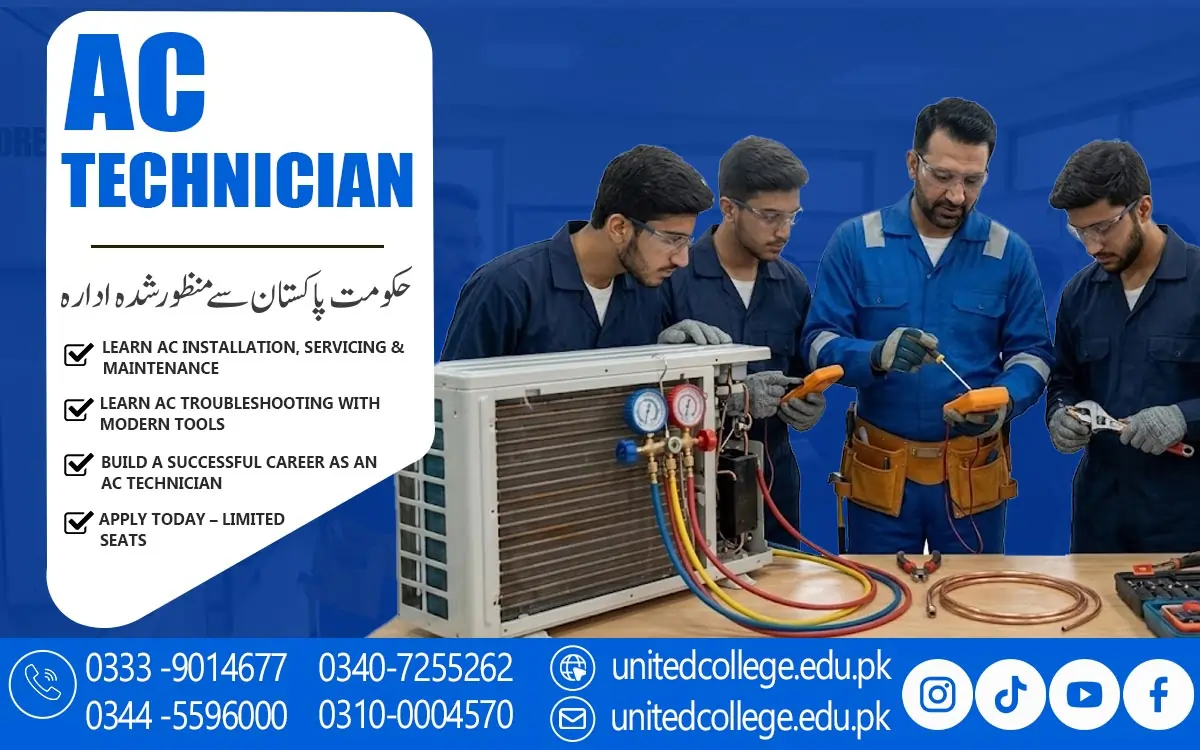

AC Technician Course in Bhakkar for Practical Cooling Training
Introduction to Practical Cooling Technology
Air conditioning has become an important part of comfortable living and working environments, especially during hot weather. An AC Technician Course in Bhakkar introduces students to the basic concepts of cooling technology and helps them understand how different air conditioning systems operate.
Students learn about the cooling cycle and the basic principles that allow an air conditioner to remove heat from an indoor space. They are introduced to important concepts such as airflow, temperature control, refrigerant circulation, and heat transfer.
The training focuses on practical understanding rathfundamentals of cooling technology and helps them understand how variouser than only theoretical knowledge. Learners gradually become familiar with AC tools, equipment, components, and common service procedures. This foundation can help beginners develop useful technical skills for the air conditioning field.
Exploring the Main Parts of an Air Conditioner
Understanding the main components of an air conditioner is essential for anyone who wants to work as an AC technician. Students learn about important parts such as the compressor, condenser, evaporator, expansion device, blower, fan, filter, and thermostat.
Each component performs a specific function within the cooling system. Learners explore how these parts work together to produce cooling and maintain the desired indoor temperature. Understanding their functions also helps students recognize possible causes of system problems.
Students are also introduced to the differences between indoor and outdoor AC units. They learn how components are connected through refrigerant lines, drainage systems, and electrical connections. This knowledge provides a strong base for future installation and maintenance work.
Learning How AC Installation Tasks Are Performed
AC installation requires proper positioning, secure mounting, accurate connections, and careful testing. During training, students learn the basic steps involved in installing residential air conditioning units. They understand how to select appropriate locations for indoor and outdoor units.
Learners are introduced to tasks such as mounting units, preparing refrigerant piping, arranging drainage lines, and connecting electrical wiring. They also learn why proper alignment and secure connections are important for reliable AC operation.
After installation, testing is an important step. Students learn how to check cooling performance, airflow, drainage, and general system operation. Practical installation activities help them develop confidence in handling common AC installation tasks.
Understanding Electrical Safety in AC Maintenance
Electrical safety is an essential part of air conditioner maintenance. Students learn about basic electrical components used in AC systems, including capacitors, relays, motors, switches, thermostats, and wiring connections.
The course teaches learners to approach electrical inspection carefully and follow appropriate safety procedures. They learn the importance of switching off the power before carrying out maintenance and using suitable tools when checking electrical components.
Students also learn how to identify visible signs of electrical problems, such as damaged wires, loose connections, burnt components, or unusual electrical behavior. Developing safe working habits helps prepare learners for responsible AC servicing tasks.
Developing Techniques for Detecting System Faults
Troubleshooting is one of the most important skills for an AC technician. Students learn how to identify common symptoms such as weak cooling, unusual sounds, water leakage, poor airflow, frequent shutdowns, and abnormal system operation.
Learners practice inspecting different parts of an AC system to determine possible causes of faults. They may examine filters, coils, fans, electrical connections, drainage systems, and other components during practical exercises.
A systematic approach to troubleshooting can help technicians avoid unnecessary part replacement. Students learn to observe the problem, inspect relevant components, identify the likely cause, and select an appropriate servicing procedure.
Practicing Repair Procedures for Common AC Issues
AC technicians regularly encounter problems that require basic repair or adjustment. Training introduces students to common AC issues and the procedures used to address them. This may include cleaning components, correcting loose connections, checking drainage, and addressing airflow problems.
Students gain practical experience with tools and equipment used during routine AC repair work. They learn how to handle components carefully and follow suitable procedures when servicing different parts of an air conditioning system.
The focus is on building practical confidence while maintaining safety and accuracy. With repeated practice, learners can improve their ability to respond to common service requirements and understand when a problem requires more advanced technical attention.
Learning Preventive Care for Efficient AC Operation
Preventive maintenance helps keep an air conditioner running efficiently and reduces the likelihood of unexpected problems. Students learn routine maintenance tasks such as cleaning filters, inspecting coils, checking airflow, and examining drainage systems.
Learners also understand the importance of keeping indoor and outdoor units clean and ensuring that important connectirunning efficiently and reduces the likelihoodons remain in suitable condition. Regular inspection can help identify minor issues before they develop into more serious system faults.
Through preventive care training, students learn how professional AC technicians support reliable system performance. These skills can be valuable for residential maintenance work and can provide a strong foundation for individuals planning to build a career in air conditioning services.
Frequently Asked Questions (FAQs)
Is course mein cooling technology, AC components, installation, electrical safety, troubleshooting, repair aur preventive maintenance ki practical training di jati hai.
Ji haan, beginners is course ko join kar sakte hain. Training basic AC concepts se start hoti hai aur gradually practical technical skills develop karti hai.
Students indoor aur outdoor unit placement, mounting, refrigerant piping, drainage arrangements, electrical connections aur basic installation testing ke baare mein seekhte hain.
Fault detection technicians ko cooling problems, water leakage, poor airflow, unusual sounds aur electrical issues ki possible causes identify karne mein madad deti hai.
Course ke baad students AC installation, maintenance aur repair services, workshops, service companies ya independent technical work mein opportunities explore kar sakte hain.
Admission Open: Start Your Professional Journey Today!
Join United College of Technology and build a career with practical training, recognized certifications, and Gulf job support. Seats are limited.
Apply Now via WhatsAppContact Information
- Address: Rawalpindi: F-272 Main New Katarian Stop, Old IJP Road | Lahore Campus: Lahore, Pakistan
- Phone/WhatsApp: 0333-9014677 / 0344-5596000 / 0310-0004570 / 0301-5044340 / 0340-7255262
- Website: unitedcollege.edu.pk















Leave a Comment