

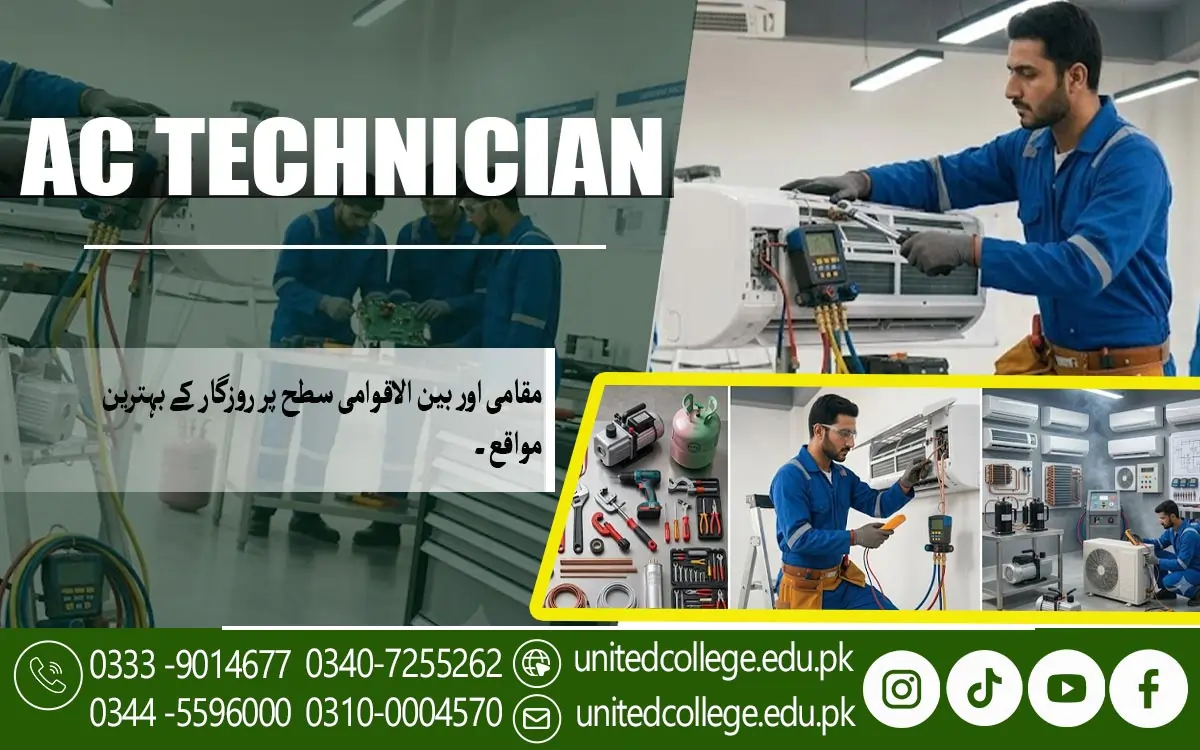
AC Technician Course in Narowal | Build Skills for a Technical Career
Could a Practical AC Skill Become Your Next Career Move?
Think about how many homes, shops, offices, schools, and businesses depend on air conditioning, especially during the hot months. When an AC stops cooling, makes unusual sounds, leaks water, or refuses to start, people need someone who knows how to find the problem and fix it properly. This is where trained AC technicians become valuable. If you are looking for a practical skill that can be learned step by step, an AC Technician Course in Narowal can give you a useful starting point for entering the technical field.
Working as an AC technician is not simply about opening an air conditioner and replacing a part. A professional technician needs to understand different components, use tools correctly, follow safety procedures, identify faults, perform servicing, and communicate with customers. With practical training, beginners can gradually learn how air conditioning systems work and how common problems are handled. This makes AC technician training an interesting option for students, job seekers, and anyone who wants to develop a hands-on technical skill.
Learn What Is Really Happening Inside an Air Conditioner
Have you ever wondered why an AC sometimes blows warm air even though the unit is running? Or why water starts dripping from an indoor unit? Problems like these can have different causes, and a technician needs to inspect the system before deciding what needs to be done. An AC Technician Course can help learners understand the main parts of an AC system and the role each part plays. Students can become familiar with important components such as the compressor, condenser, evaporator, fan, filters, electrical connections, and other working parts. Troubleshooting and basic repair techniques.
These components work together to remove heat and provide cooled air. Understanding their basic functions helps beginners develop better troubleshooting skills instead of simply guessing which part is faulty. The purpose of this learning is not to make technical subjects unnecessarily complicated. A good training approach explains each component in simple terms and connects it with practical work. Once learners understand what they are looking at, it becomes easier to follow repair and maintenance procedures.
Turn Tools and Equipment Into Skills You Can Actually Use
Knowing the names of AC tools is not enough. A technician needs to understand how and when to use them safely. Practical AC technician training can introduce learners to common tools and equipment used during installation, servicing, testing, maintenance, and repair work. Students can practice handling tools while learning how to inspect AC units and perform different service tasks. They can gradually become familiar with procedures such as cleaning filters, checking connections, inspecting components, and preparing an AC for maintenance.
Working with actual equipment allows beginners to understand how technical concepts apply in real situations. This hands-on approach is especially useful for someone with little technical experience. Instead of only reading about an AC system, learners get an opportunity to observe its components and practice relevant procedures. Repeated practice can improve confidence, accuracy, and overall technical ability.
Master Split AC Installation Without Guesswork
Installing a split AC involves more than simply placing the indoor and outdoor units on a wall. Correct positioning, connections, piping, wiring, drainage, and safety checks all matter. Poor installation can affect cooling performance and may create problems later. That is why AC installation training is an important part of learning professional AC repair skills. During practical training, students can learn the general steps involved in preparing an installation, understanding the relationship between indoor and outdoor units, making appropriate connections, and checking the system after installation.
They can also learn why proper drainage and secure connections are important for reliable operation. For beginners, installation practice can provide a valuable introduction to real technical work. It helps learners understand how planning and careful execution can make a difference. With guidance and repeated practice, students can become more comfortable with the procedures involved in split AC installation.
Find the Fault Instead of Replacing Parts Randomly
A common mistake for beginners is assuming that every AC problem requires a new part. In reality, a cooling problem can have several possible causes. The issue might involve airflow, electrical connections, filters, components, refrigerant-related conditions, or another part of the system. Learning AC troubleshooting helps technicians approach these problems more carefully. An AC Technician Course can teach learners how to observe symptoms, inspect relevant components, identify possible causes, and follow a logical troubleshooting process.
For example, if an AC is not cooling properly, a technician should not immediately assume that one specific component has failed. The system needs to be checked step by step. Students can also learn about common issues such as weak cooling, unusual sounds, water leakage, frequent switching off, electrical faults, and other problems. The aim is to develop a problem-solving mindset so that learners understand how to investigate faults rather than rely on guesswork.
Understand Inverter ACs and Modern Cooling Systems
Air conditioning technology continues to change, and inverter ACs are now common in many homes and workplaces. These systems operate differently from some traditional AC units, so technicians need to understand their basic working principles and service requirements. Learning about inverter technology can help students broaden their technical knowledge. An HVAC technician course or practical AC training may introduce learners to the differences between conventional and inverter systems. Students can learn about the components involved, basic electrical concepts, safe inspection procedures, and common service considerations.
Technical terms should be explained clearly so beginners can understand their purpose rather than simply memorizing them. Refrigeration and air conditioning also involve areas that require careful handling. Topics related to refrigerants, pressure, electrical systems, and cooling components should always be approached with proper safety awareness and under suitable practical supervision. Developing safe working habits is just as important as learning repair techniques.
Make Safety, Cleaning, and Maintenance Part of Your Routine
A skilled technician should know how to repair an AC, but a professional technician also needs to know how to work safely. Air conditioners involve electrical connections, moving parts, sharp edges, cleaning chemicals, and other potential hazards. Learning safe procedures can help reduce unnecessary risks during service and maintenance work. An AC maintenance training program can help learners understand the importance of regular cleaning, filter care, inspection, electrical checks, and general preventive maintenance.
Simple maintenance can help identify problems before they become more serious and can support the efficient operation of cooling equipment. Food safety is not relevant here, but workplace safety and equipment cleanliness certainly are. Students can learn to keep tools organized, disconnect power when appropriate, use protective equipment where required, and follow safe procedures when working on AC systems. These habits can become valuable when moving into professional service work.
Learn to Work Like a Technician, Not Just a Student
Technical knowledge becomes much more useful when you can apply it under real working conditions. A professional technician may need to arrive at a customer's location, inspect an AC, understand the complaint, identify the likely problem, explain the required work, and complete the service carefully. This requires technical knowledge along with communication, organization, patience, and time management. This is why practical AC training is so important.
Students can work toward understanding AC components, tools, installation procedures, servicing, troubleshooting, maintenance, and safety practices. For someone starting from zero, learning step by step can make technical subjects much easier to understand. Practical sessions can help learners gain familiarity with equipment and gradually develop the confidence needed to perform tasks more carefully. The objective is to build useful job-ready technical skills rather than depend only on theoretical knowledge.
Where Can AC Technician Skills Take You in Narowal and Beyond?
Once a learner develops suitable technical skills and gains practical experience, there are several possible career directions to explore. AC and cooling systems are used across residential, commercial, and industrial environments, creating different types of service and maintenance work. The exact opportunities available to an individual will depend on their experience, qualifications, skills, and local demand. An AC Technician Course can help learners build practical knowledge for working with air conditioning systems.
Some experienced technicians may also choose to offer independent AC installation, servicing, and repair services. For people in Narowal, learning a technician course in Narowal can provide a convenient way to start developing a practical skill locally. With continued practice and experience, these skills may also be useful when exploring opportunities in other parts of Pakistan. Those who eventually meet the relevant requirements may explore work opportunities beyond Pakistan as well, but employment abroad depends on qualifications, experience, employer requirements, and applicable regulations.
Frequently Asked Questions (FAQs)
Students can learn AC installation, servicing, maintenance, troubleshooting, split AC repair, inverter AC basics, tools, components, electrical connections, and safety practices.
Yes, the course is suitable for beginners who want to learn AC repair and maintenance skills step by step through practical technical training.
Yes, practical training helps students work with AC tools and equipment while practicing installation, servicing, maintenance, and basic troubleshooting procedures.
Yes, students can learn the practical procedures involved in split AC installation, servicing, common fault identification, and repair under proper training and supervision.
Depending on their skills and experience, learners can explore roles such as AC Technician, HVAC Technician, AC Repair Technician, Maintenance Technician, Refrigeration Technician, or Service Technician.
Admission Open: Start Your Professional Journey Today!
Join United College of Technology and build a career with practical training, recognized certifications, and Gulf job support. Seats are limited.
Apply Now via WhatsAppContact Information
- Address: Rawalpindi: F-272 Main New Katarian Stop, Old IJP Road | Lahore Campus: Lahore, Pakistan
- Phone/WhatsApp: 0333-9014677 / 0344-5596000 / 0310-0004570 / 0301-5044340 / 0340-7255262
- Website: unitedcollege.edu.pk















Leave a Comment