


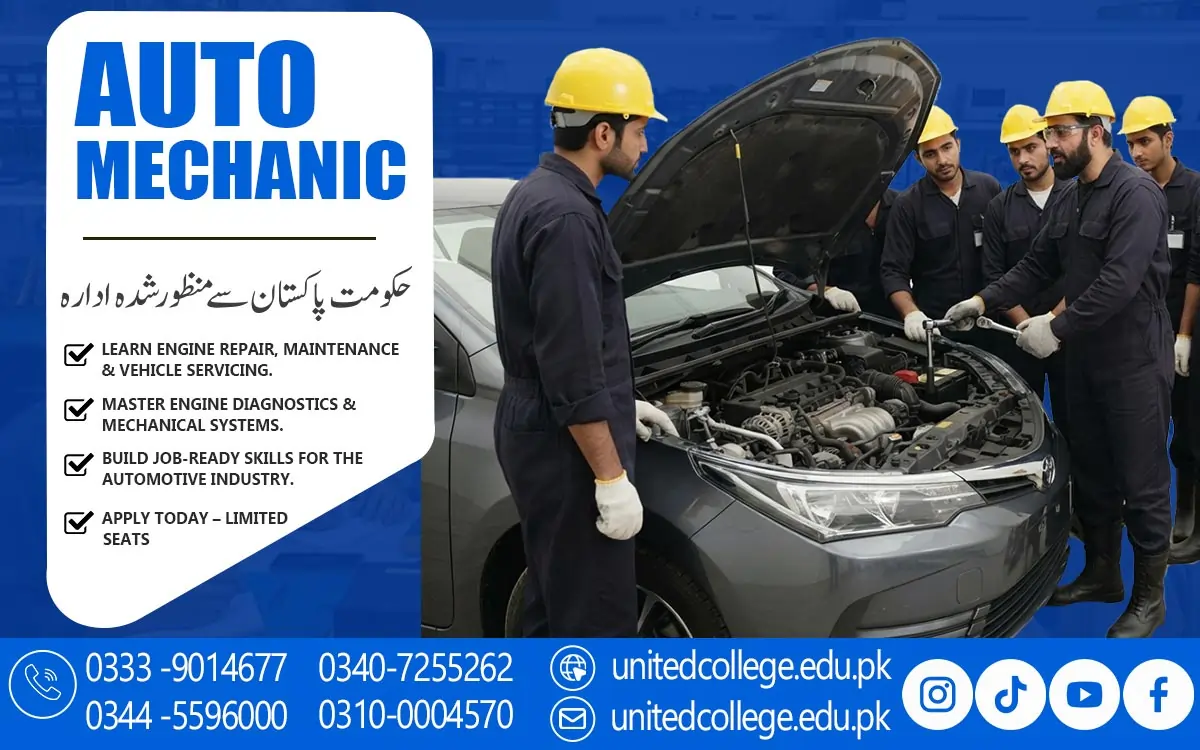

Auto Mechanic Course in Bagh AJK – Build Skills for Your Future
Build Real Workshop Skills for the Cars of Tomorrow
The automobile industry is changing quickly, and modern vehicles require more than basic mechanical knowledge. From traditional engines and braking systems to electronic controls and computer-based diagnostics, today’s vehicles need skilled people who understand how different systems work together. For students and beginners in Bagh AJK, learning these skills can be a practical step toward entering the automotive field.
The Auto Mechanic Course in Bagh AJK offered by United College of Technology is designed to help learners understand automobile repair, maintenance, troubleshooting, and workshop practices through practical learning. Instead of depending only on textbook information, students can develop useful vehicle repair skills and become more familiar with the tools and tasks used in an automotive workshop.
Start by Understanding What Happens Under the Hood
A strong mechanic career begins with the basics. Students in the Auto Mechanic Course in Bagh AJK can learn about major automobile systems and understand the purpose of important engine components. Topics can include engine parts, fuel systems, lubrication, cooling, air intake, and the basic process through which an engine produces power. Practical engine repair training can help learners recognize common issues and understand how inspection is performed.
Rather than simply memorizing the names of components, students can learn why each part matters and how different parts affect engine performance. This foundation is important because a mechanic who understands how a vehicle operates can approach repairs more logically and avoid unnecessary part replacement.
Learn to Find Problems Instead of Guessing
One of the most valuable skills for a modern mechanic is the ability to identify the cause of a vehicle problem. A car may fail to start, lose power, make unusual sounds, overheat, or show warning lights on the dashboard. These symptoms can have different causes, so proper vehicle troubleshooting is essential. Students can develop basic skills in inspection, testing, and car diagnostics to understand how problems are located.
Engine diagnostics, for example, can involve checking visible signs, listening for unusual sounds, inspecting components, and understanding diagnostic information. This approach teaches learners to investigate before repairing. Such skills can make a major difference in a workshop because effective mechanics do not simply replace parts randomly; they try to understand what has actually gone wrong.
Master the Systems That Keep Every Journey Safe
Mechanical training is not only about making an engine run. A vehicle must also stop, turn, and remain stable on the road. Students can therefore study important areas such as brake system repair, steering, and the suspension system. They can learn about components such as brake pads, discs, steering parts, shock absorbers, and related systems.
These areas require careful inspection because incorrect work can create serious safety risks. Learning the correct principles and procedures gives beginners a better understanding of why vehicle maintenance should be performed carefully and professionally.
Discover the Electrical Side of Today’s Automobile
Automobiles are becoming increasingly dependent on electrical and electronic systems. Even a person interested mainly in mechanical repair can benefit from understanding basic automotive electrical systems. The Auto Mechanic Course in Bagh AJK can introduce students to important electrical areas such as batteries, starting systems, charging systems, wiring, and basic electrical components. Learners can understand how a battery provides power and how the starting and charging systems work together.
This knowledge is useful when dealing with problems such as starting failure, weak battery performance, or electrical faults. As vehicle technology continues to develop, mechanics who combine traditional mechanical knowledge with basic electrical and diagnostic skills can be better prepared to understand the changing requirements of automotive repair.
Get Comfortable With Tools Through Practical Training
Knowing what a tool is called is very different from knowing how to use it correctly. Practical training allows learners to become familiar with common workshop tools and equipment while understanding their correct purpose. Students can learn how tools are selected for different tasks, how components are handled, and why careful working methods matter. Hands-on activities can also help beginners build confidence because they get the opportunity to connect classroom knowledge with real mechanical tasks.
Vehicle maintenance training can cover routine activities such as inspections, basic servicing, checking components, and identifying signs of wear. With repeated practice, learners can become more comfortable approaching workshop jobs in an organized way rather than feeling overwhelmed by unfamiliar vehicle components.
Make Safety Part of Every Mechanical Skill
A good mechanic must know not only how to repair a vehicle but also how to work safely. An automotive workshop contains heavy components, moving parts, electrical systems, oils, tools, and equipment that require responsible handling. Workshop safety should therefore be an important part of professional training. Students can learn why protective equipment, proper tool handling, clean working areas, and careful inspection are important.
They can also understand the need to follow correct procedures before working on vehicle systems. These habits may seem simple, but they can help reduce avoidable accidents and damage. Developing safe working behavior during training prepares beginners for the disciplined environment of a professional automotive workshop.
Turn Practical Knowledge Into a Direction for Your Future
Learning automobile repair can open different paths for people with different goals. Some learners may want to work in an automotive workshop, while others may eventually want to gain experience and establish their own repair service. Others may use their skills as a foundation for further technical education. The Auto Mechanic Course in Bagh AJK can help beginners build a practical foundation in engine repair, diagnostics, vehicle maintenance, electrical basics, braking, transmission, steering, and other important areas.
The key is to continue practicing, learning about newer vehicle technologies, and improving problem-solving ability. A professional auto mechanic is not simply someone who can replace a damaged part; it is someone who can understand a vehicle, investigate problems carefully, work safely, and perform tasks with responsibility. For students, job seekers, and beginners in Bagh AJK, professional auto mechanic training can therefore be a meaningful starting point for building practical skills and preparing for the evolving automobile industry.
Frequently Asked Questions (FAQs)
Anyone interested in learning about vehicles can consider this type of training. It can be suitable for beginners, school leavers, job seekers, and people who want to develop a technical skill without having previous workshop experience.
Yes. Beginners can start with fundamental concepts and gradually move toward more practical automotive tasks. A structured learning process helps new students become familiar with vehicle parts, workshop terminology, and basic repair procedures.
Training may introduce learners to common automobiles such as cars and other light vehicles. The exact vehicle types used for practice depend on the available workshop facilities and training setup at the institute.
Automotive work often requires observation and logical thinking. Students learn to look at symptoms, consider possible causes, inspect relevant areas, and decide what should be checked next instead of immediately assuming that a particular part is faulty.
It can provide a technical foundation for someone who later wants to gain more field experience and explore independent work. However, running a workshop also requires business knowledge, customer handling, equipment investment, and practical experience beyond classroom training.
Vehicle technology does not remain the same. New models can include advanced electronics, sensors, and computer-controlled features. Continued learning helps mechanics stay familiar with changing repair methods and emerging automotive technologies.
Admission Open: Start Your Professional Journey Today!
Join United College of Technology and build a career with practical training, recognized certifications, and Gulf job support. Seats are limited.
Apply Now via WhatsAppContact Information
- Address: Rawalpindi: F-272 Main New Katarian Stop, Old IJP Road | Lahore Campus: Lahore, Pakistan
- Phone/WhatsApp: 0333-9014677 / 0344-5596000 / 0310-0004570 / 0301-5044340 / 0340-7255262
- Website: unitedcollege.edu.pk
















Leave a Comment