


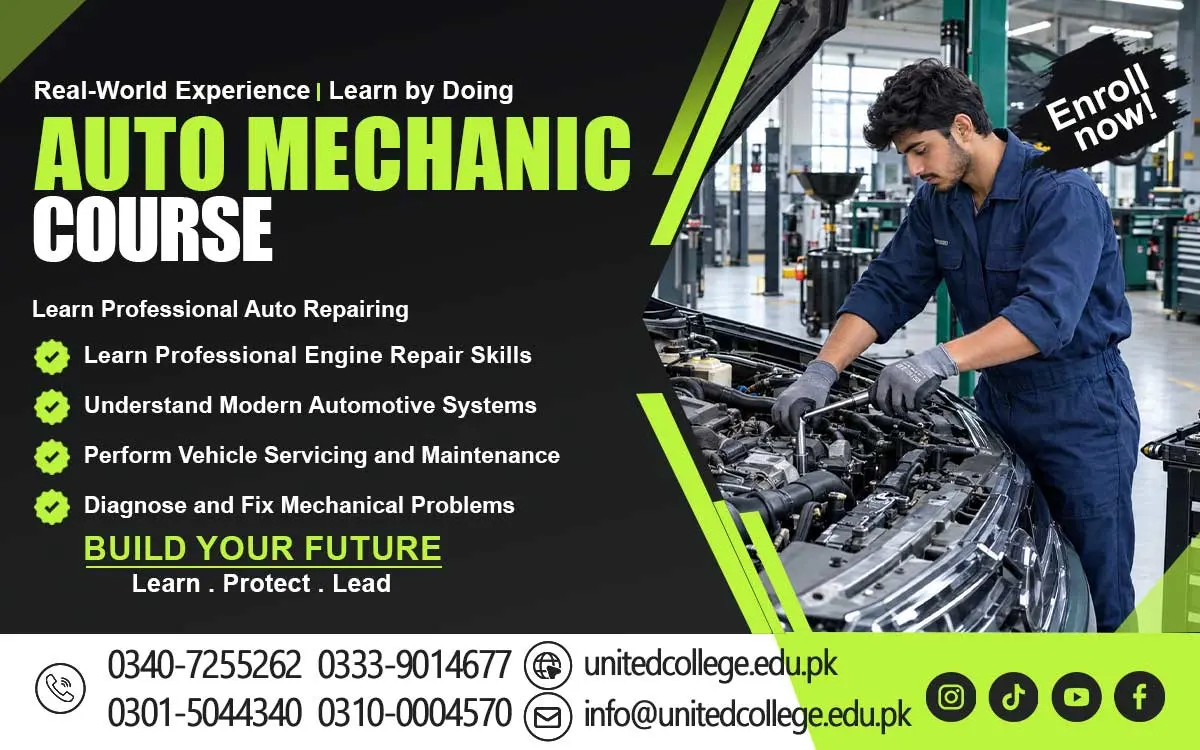

Auto Mechanic Course in Bajaur with Hands On Automotive Learning
Auto Mechanic Course in Bajaur Builds Practical Skills for Real Vehicle Repair Challenges
Vehicles need regular care to remain safe, reliable, and ready for everyday travel. From engine problems to worn brake parts, even a small mechanical fault can affect how a vehicle performs. Learning how to inspect and maintain vehicles can help beginners understand these problems and develop useful technical abilities. The Auto Mechanic Course in Bajaur is a relevant topic for students, fresh learners, job seekers, and anyone interested in understanding vehicle repair.
Through auto mechanic training, learners can explore how different vehicle systems work, how mechanics identify faults, and why correct repair procedures matter. This knowledge can also help people make informed decisions about their future learning and career direction. Instead of relying only on theory, practical mechanic training connects basic concepts with the tasks performed in an automotive workshop.
Discover the Mechanical Systems That Keep Vehicles Moving
A vehicle contains several connected systems that work together to support movement, control, and performance. An engine produces power, the transmission helps transfer that power to the wheels, and the braking system helps the driver slow down or stop. Cooling and lubrication systems also play important roles in protecting engine components. During an Auto Mechanic Course in Bajaur, beginners can learn the purpose of these systems and understand how their parts interact.
In automotive maintenance, an engine that becomes unusually hot may indicate a cooling system issue, while a vehicle that struggles to start may require an inspection of its battery, starter motor, or electrical connections. These symptoms can have different causes, so a mechanic must examine the vehicle carefully before deciding on the appropriate repair.
Build Useful Car Repair Skills Through Everyday Maintenance Tasks
Basic maintenance is an important part of learning automotive repair because it introduces learners to common workshop responsibilities. Students can explore oil changes, fluid checks, air filter inspection, tyre condition, and routine vehicle servicing. They can also learn why mechanics follow recommended maintenance schedules instead of waiting for a problem to become serious.
Checking fluid levels and inspecting visible leaks can help identify issues that need further attention. Learning the correct procedure is essential because careless servicing can damage components or create safety risks. With proper guidance and repeated practice, beginners can gradually become more familiar with maintenance routines and the reasons behind each step.
Turn Workshop Tools Into Practical Automotive Knowledge
Workshop tools are more than equipment used to loosen bolts or remove vehicle parts. Each tool has a specific purpose, and using it correctly can make repair work safer and more effective. During an Auto Mechanic Course in Bajaur, beginners can learn about spanners, socket sets, screwdrivers, pliers, jacks, torque wrenches, and basic inspection equipment. They can also develop an understanding of how to select the right tool for a particular task and keep equipment organised after use.
Practical mechanic training introduces learners to these procedures through demonstrations and supervised activities. Students should also learn how to secure a vehicle before working beneath it and understand the importance of protective equipment. Becoming comfortable with workshop tools takes time, but careful handling and consistent practice can help beginners approach automotive maintenance and repair tasks with greater confidence.
Learn to Recognise Mechanical Faults Before Attempting Repairs
Troubleshooting begins with observation, not guesswork. A mechanic may listen for unusual sounds, check warning lights, inspect visible components, or ask when a problem first appeared. Learning to collect these clues helps beginners understand how technicians narrow down possible causes. For example, squealing brakes may indicate worn brake components, although other faults can produce similar sounds. Difficulty changing gears may require an inspection of the transmission or related systems, depending on the vehicle.
A weak battery can also cause starting problems, but the starter motor and electrical connections may need checking before the cause becomes clear. Through Auto Mechanic Training in Bajaur, learners can explore the importance of inspecting symptoms, following a logical process, and confirming a fault before replacing parts. Engine troubleshooting and basic diagnostic knowledge are useful skills, but beginners should recognise their limits and seek experienced supervision when dealing with complex or safety-critical repairs.
Overcome Early Learning Challenges With Patience and Safe Practice
Vehicle repair can feel difficult at first because many parts look unfamiliar and several systems may produce similar symptoms. Beginners might struggle to remember tool names, understand technical terms, or follow a repair procedure in the correct order. These challenges are a normal part of developing practical skills. Breaking each task into smaller steps can make learning easier. A student might first identify the main engine components, then study their functions, and later observe how a mechanic checks them.
Repeating tasks under proper supervision helps learners understand procedures instead of simply memorising instructions. Safety awareness must remain part of every lesson. Vehicles should be supported correctly, moving parts should be approached with care, and work involving fuel, electrical systems, or hot engine components requires suitable precautions. Learners should ask questions when a procedure is unclear rather than rushing to complete it.
Explore Practical Learning Through United College of Technology
For learners interested in developing automotive knowledge, the Auto Mechanic Training offered by United College of Technology is worth exploring as a training option. It relates to the practical skills people need to understand vehicle servicing, mechanical components, workshop procedures, and common repair tasks. Before choosing any course, prospective students should review the available course information and confirm which topics and practical activities are included.
Beginners should look for training that explains technical ideas in clear language and provides appropriate guidance when learners work with tools or vehicle components. They should also consider how much time they can devote to practice outside lessons, since technical ability develops through repeated application. A course can provide a starting point for learning, while continued study and supervised experience help learners deepen their understanding.
Connect Automotive Skills With Possible Future Work Pathways
Learning vehicle repair can introduce several directions for further development, although the right path depends on a person's abilities, experience, and opportunities. Some learners may want to assist an experienced mechanic in an established workshop, where they can observe real repair procedures and gradually take on suitable tasks. Others may wish to build their knowledge of vehicle servicing, brake inspection, engine maintenance, or fault diagnosis before deciding which area interests them most.
People considering a future vehicle maintenance service will also need to understand customer communication, tool care, work planning, and responsible handling of repairs. In Bajaur, learners can consider how practical automotive knowledge fits their personal goals without assuming that completing training guarantees employment or income. Experience, reliability, continued learning, and safe working habits all matter when developing technical ability.
Start a Practical Journey Toward Greater Mechanical Understanding
A genuine interest in how vehicles work can be the beginning of a useful technical learning journey. The Auto Mechanic Course in Bajaur offers a relevant starting point for people who want to explore engine systems, routine servicing, mechanical troubleshooting, and workshop practices. Beginners do not need to understand every component immediately. They can start by learning basic terms, observing maintenance procedures, and practising simple tasks under suitable supervision.
Before enrolling, learners should check the current course details, ask about the learning content, and consider whether the training suits their goals. Building car repair skills requires patience, responsibility, and a willingness to keep learning. For students and fresh learners who enjoy practical problem-solving, developing automotive knowledge can be a meaningful way to explore technical interests and prepare for future learning opportunities.
Frequently Asked Questions (FAQs)
The suspension system helps support the vehicle and absorb road impacts. Understanding its components can help learners recognise signs of worn shocks, damaged springs, or uneven vehicle handling.
The fuel system delivers fuel to the engine in the required way. Learning its basic operation helps beginners understand possible issues involving fuel filters, injectors, and fuel delivery.
Mechanics can follow service instructions, use suitable tools, inspect their work, and avoid replacing parts without checking the actual fault. Careful procedures help reduce unnecessary damage.
Service records can show when parts were replaced, which maintenance tasks were completed, and whether a problem has appeared before. This information can guide further inspection.
Vehicle diagrams help learners understand component locations and connections. They can also make it easier to follow repair instructions and understand how mechanical or electrical systems are arranged.
Uneven tyre wear may indicate incorrect tyre pressure, alignment problems, suspension faults, or other issues. Recognising wear patterns helps mechanics identify what may need further inspection.
Admission Open: Start Your Professional Journey Today!
Join United College of Technology and build a career with practical training, recognized certifications, and Gulf job support. Seats are limited.
Apply Now via WhatsAppContact Information
- Address: Rawalpindi: F-272 Main New Katarian Stop, Old IJP Road | Lahore Campus: Lahore, Pakistan
- Phone/WhatsApp: 0340-7255262 / 0333-9014677 / 0301-5044340 / 0310-0004570 / 051-8770756
- Website: unitedcollege.edu.pk
















Leave a Comment