


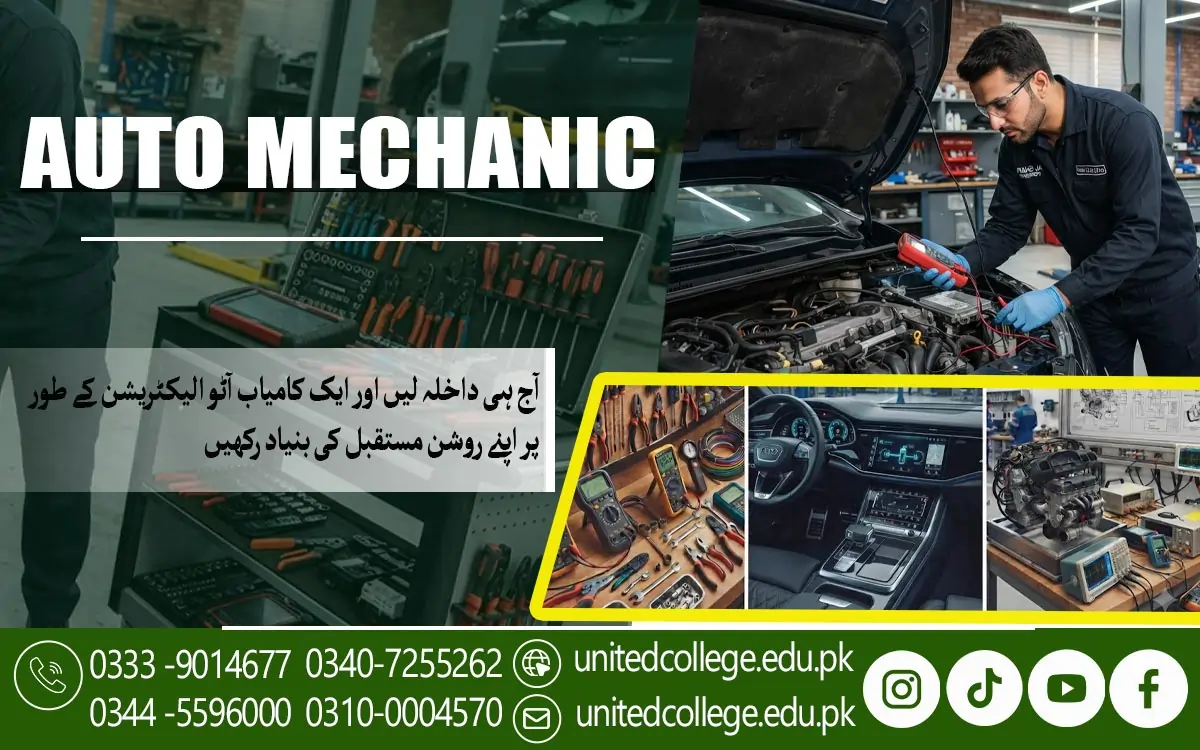

Auto Mechanic Course in Jhang – Learn Modern Vehicle Repair Skills
Discover the Skills Behind Every Reliable Vehicle
A vehicle can tell a story through the way it starts, moves, stops, and responds on the road. A strange sound, difficult starting, weak brakes, or unusual vibration can all give clues about its condition. For someone who enjoys understanding how vehicles work, learning automobile repair can turn natural curiosity into a useful technical ability.
The Auto Mechanic Course in Jhang offered by United College of Technology gives beginners a structured opportunity to explore the practical side of automotive work. Students can learn how different vehicle systems function, how basic faults are identified, and how routine servicing is carried out. This kind of training can be especially useful for learners who want practical education instead of relying only on theoretical classroom knowledge.
Move From Watching Repairs to Understanding Them
Many beginners have seen mechanics repair cars but have never understood what happens during the process. A professional approach starts with knowing the purpose of each major vehicle system. Students in an Auto Mechanic Course in Jhang can learn automobile engineering basics in an easy way, including the roles of the engine, transmission, braking system, steering, suspension, cooling, and fuel systems.
This foundation helps learners understand why a vehicle behaves differently when one component develops a problem. During car mechanic training, students can gradually connect basic theory with workshop activities. Instead of learning isolated facts, they can begin to see how different parts support one another.
Let the Engine Become Easier to Understand
The engine may appear complicated when viewed for the first time, but its basic purpose is simple: it produces the power needed to move the vehicle. Training can introduce students to important engine components and explain their functions without unnecessary technical language. Engine repair training may cover areas such as filters, belts, lubrication, cooling, combustion-related components, and routine inspection.
Students can also learn why regular oil and filter changes are important parts of vehicle care. Through practical exercises, beginners can become familiar with checking engine conditions and recognizing signs that may require further attention. This learning can help develop useful vehicle maintenance skills because students start to understand the difference between routine servicing and a repair that requires deeper inspection.
Learn to Follow the Clues Behind a Vehicle Fault
A good mechanic does not treat every vehicle problem in the same way. A car that loses power may have several possible causes, while a starting problem can involve different systems. Vehicle diagnostics teaches learners to investigate these situations step by step. Students can learn to observe symptoms, inspect relevant components, and use basic diagnostic methods to narrow down possible faults. This approach is known as vehicle troubleshooting, and it encourages careful thinking instead of guesswork.
Beginners can practice identifying common issues and understanding what information a vehicle provides through sounds, warning signs, performance changes, or visible conditions. Developing this habit can make learners more confident because they begin to understand the reasoning behind a repair rather than simply copying a procedure.
Explore the Parts That Affect Every Journey
A vehicle needs dependable systems for stopping, changing direction, transferring power, and handling uneven roads. Students in an Auto Mechanic Course in Jhang can therefore study brakes, clutch, transmission, steering, and suspension as separate but connected areas of automotive work.
Brake system repair can introduce the purpose of important braking components and the need for proper inspection. Clutch repair training can help learners understand how engine power is connected and controlled through the transmission. Suspension and steering lessons can explain how different components influence vehicle stability and movement.
Add Electrical Knowledge to Your Mechanical Foundation
Modern vehicles increasingly depend on electrical and electronic systems, making basic electrical knowledge valuable for anyone entering the automotive field. Students can explore automotive electrical systems through simple concepts involving batteries, starters, alternators, fuses, wiring, and electrical connections. They can learn how the battery supports the starting process and why charging problems can affect vehicle operation.
Understanding these basics can also help learners separate electrical faults from mechanical problems. As automotive technology develops, mechanics may encounter more sensors, electronic controls, and diagnostic equipment. Building awareness of these systems during training can prepare students to continue learning as vehicle technology changes. This combination of mechanical and electrical knowledge can strengthen a learner's overall car repair skills.
Make the Workshop Your Place to Learn by Doing
Practical experience is where technical knowledge begins to feel real. Students can become familiar with workshop tools and learn why the correct tool should be selected for a particular job. Mechanical workshop training may involve guided inspection, servicing activities, component handling, and basic repair exercises. These activities can teach learners how to work carefully rather than rushing through a task.
United College of Technology focuses on practical learning as part of its technical training environment, allowing students to connect lessons with workshop-based activities. Repeated practice can help beginners become more comfortable with automotive equipment and develop better working habits. Along with technical ability, students can improve patience, attention to detail, and the confidence needed to approach unfamiliar mechanical tasks.
Give Your Mechanical Skills Room to Grow
Completing training is only one stage of becoming a capable automotive worker. Continued practice and real workshop experience are important for improving speed, accuracy, and judgment. The Auto Mechanic Course in Jhang can give learners a foundation that may support different directions, such as working as an auto mechanic, automobile technician, vehicle service assistant, or workshop technician.
Whatever direction a learner chooses, automotive career skills become more valuable when they are regularly updated. New vehicle designs and electronic systems mean that mechanics need to keep learning rather than depending only on older methods. For students and job seekers in Jhang, practical mechanic training can therefore be a useful first step toward developing a technical profession based on knowledge, practice, responsibility, and continuous improvement.
Frequently Asked Questions (FAQs)
Automobile mechanics combines practical work with problem-solving. Learners can spend time understanding machines, examining vehicle components, and discovering how different parts contribute to the overall performance of a vehicle.
Training schedules can vary by institute. Students should check the available class timings and course structure to see whether they can manage the program alongside their existing educational or personal commitments.
Advanced mathematics is generally not the main focus of beginner-level mechanic training. Students mainly need basic practical understanding, careful observation, and the ability to follow measurements and instructions correctly.
Regular workshop practice is one of the best ways to improve. Working with experienced technicians, observing different vehicle problems, studying newer systems, and taking additional technical training can support continued development.
Beginners should avoid rushing, using tools incorrectly, skipping inspections, or attempting unfamiliar repairs without proper guidance. Careful work and following recommended procedures are important for developing reliable professional habits.
Yes. Knowledge of vehicle systems can be useful in maintenance-related workplaces, service centers, transport operations, and other settings where vehicles need regular inspection and care. Further experience can expand the range of possible work environments.
Admission Open: Start Your Professional Journey Today!
Join United College of Technology and build a career with practical training, recognized certifications, and Gulf job support. Seats are limited.
Apply Now via WhatsAppContact Information
- Address: Rawalpindi: F-272 Main New Katarian Stop, Old IJP Road | Lahore Campus: Lahore, Pakistan
- Phone/WhatsApp: 0333-9014677 / 0344-5596000 / 0310-0004570 / 0301-5044340 / 0340-7255262
- Website: unitedcollege.edu.pk
















Leave a Comment