


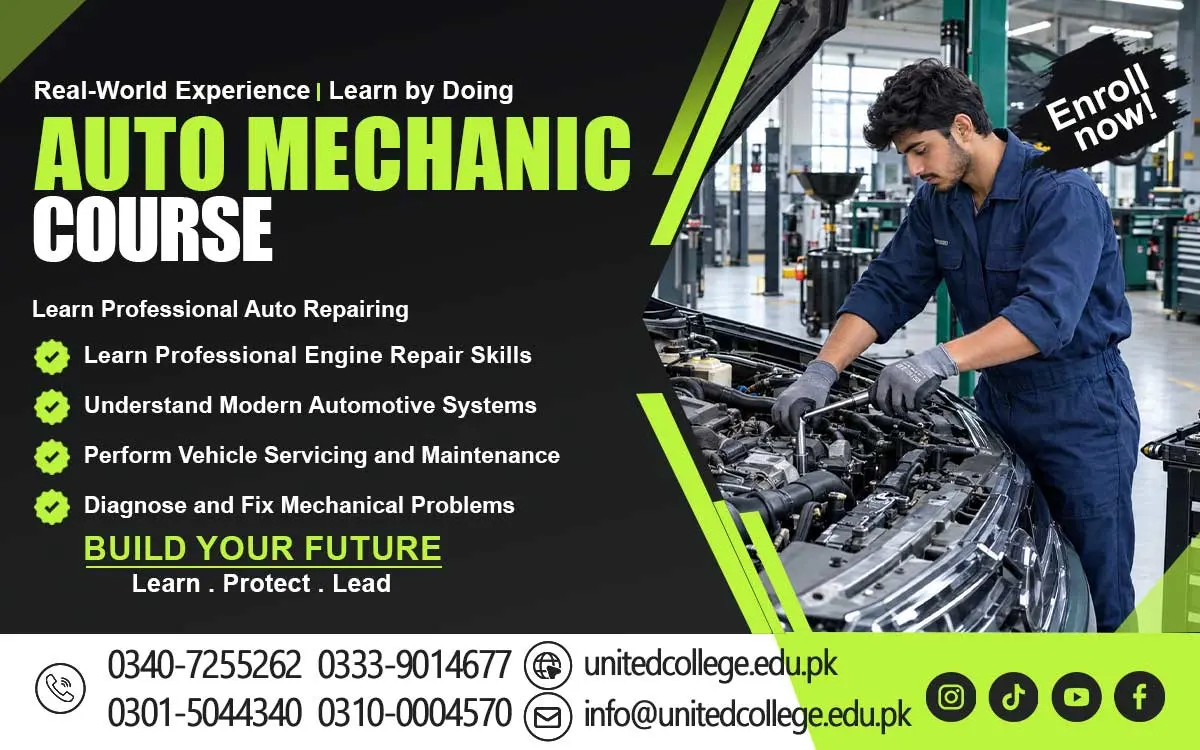

Auto Mechanic Course in Kohat: Learn Practical Repair Skills
Everyday Vehicle Problems That Require Skilled Auto Mechanics
Imagine you are travelling to work when your car suddenly stops in the middle of the road. You try to start the engine again, but it does not respond. In another situation, a vehicle may produce unusual noises, lose power while climbing a hill, or begin overheating during a long journey. These problems can cause stress for drivers and may become dangerous if they are not handled properly. Skilled auto mechanics help identify the reasons behind such issues and carry out suitable repairs. They inspect different vehicle components, check for faults, and determine whether a part needs adjustment, cleaning, repair, or replacement. In Kohat, where people use cars, motorcycles, and other vehicles for daily travel and business, automotive maintenance skills can be useful in many practical situations.
However, repairing a vehicle requires more than simply knowing how to use tools. A mechanic must understand how different systems work together and how to identify the actual cause of a problem. The Auto Mechanic Course in Kohat, offered by United College of Technology (UCT), provides a learning pathway for people interested in developing automotive repair knowledge and technical abilities. Through automotive training, beginners can start understanding common mechanical problems, routine vehicle maintenance, and workshop practices. Learning these skills can help students build a foundation for further technical development while understanding the responsibility involved in keeping vehicles safe and reliable.
How is the Auto Mechanic Course in Kohat?
Starting a technical career can feel challenging when you have little or no experience with engines, tools, or mechanical systems. You might know how to drive a car or ride a motorcycle but have limited knowledge of what happens when the engine fails or the brakes begin making unusual sounds. An automotive mechanic course helps learners better understand these systems and the work involved in maintaining them. The Auto Mechanic Course in Kohat at United College of Technology is relevant to students, fresh learners, and individuals interested in learning vehicle repair skills. Automotive training introduces learners to engine components, vehicle servicing, mechanical troubleshooting, and the proper use of basic workshop tools.
Students can also learn why mechanics inspect a vehicle before deciding which repair is necessary. For example, a car that struggles to start may have a weak battery, a faulty starter motor, a fuel delivery problem, or another issue. Replacing parts without checking the cause can waste time and money. A trained mechanic learns to examine the symptoms and follow a logical process before recommending repairs. This approach helps beginners understand that vehicle maintenance involves observation, technical knowledge, and careful decision-making. By studying automotive repair principles and developing practical abilities under suitable supervision, learners can begin building the foundation needed for more advanced mechanical work.
Engine Components and Common Mechanical Faults Learners Should Understand
A vehicle engine contains several components that work together to produce the power needed for movement. Understanding these parts is an important step in automotive mechanic training. For example, the pistons move inside the engine cylinders, while the crankshaft helps convert their movement into rotational force. The lubrication system circulates oil to reduce friction between moving parts, and the cooling system helps control engine temperature. If the engine overheats, the cause might involve low coolant, a leaking hose, a faulty thermostat, or a problem with the radiator. Similarly, low engine oil can increase friction and contribute to serious mechanical damage.
Beginners also need to understand the purpose of air filters, oil filters, spark plugs, and fuel system components. In petrol engines, spark plugs help ignite the air-and-fuel mixture, while diesel engines use a different ignition process based on compressed air and fuel injection. Recognising these differences helps learners understand why repair methods are not identical for every vehicle. Engine repair training also introduces the importance of listening for unusual sounds, checking warning signs, and examining visible leaks without making assumptions about the cause. For instance, a vehicle that loses power may have an air intake problem, a fuel delivery fault, or another mechanical or electronic issue. The Auto Mechanic Course in Kohat can provide a starting point for understanding these subjects through automotive learning.
Learning to Inspect Brakes, Steering, Suspension, and Transmission Systems
An engine may provide the power that moves a vehicle, but several other systems help control its movement and keep it stable. The braking system allows drivers to slow down or stop, while the steering system helps them control direction. Suspension components absorb road impacts and help maintain contact between the tyres and the road. The transmission transfers engine power to the wheels at suitable speeds and loads. When any of these systems develops a fault, vehicle handling, comfort, or safety may be affected. For example, a driver might notice vibration while braking, unusual movement over bumps, difficulty turning the steering wheel, or a transmission that does not change gears smoothly. These symptoms need proper inspection because different problems can produce similar warning signs.
Brake system inspection may involve checking brake pads, discs, fluid levels, and visible signs of leakage, following the correct procedures for the particular vehicle. Steering and suspension checks may include examining relevant joints, bushes, and other components for wear or damage. Transmission maintenance varies according to the vehicle design and manufacturer recommendations. Students learning automotive repair skills should also understand their limits. Problems affecting braking, steering, or other safety-critical systems must be handled carefully and checked by a qualified person when necessary. Through the Auto Mechanic Course in Kohat offered by United College of Technology, interested learners can begin exploring the mechanical systems that contribute to vehicle performance.
Practical Workshop Activities That Develop Automotive Repair Skills
Reading about vehicle parts is useful, but practical experience helps learners understand how those parts look, fit together, and function. Imagine examining a car that will not start. A beginner might immediately assume that the battery needs replacing, while a more careful approach begins with observing the symptoms and checking the battery condition, electrical connections, and other possible causes. This is the kind of problem-solving approach that automotive workshop training aims to develop. Practical mechanic training may involve identifying engine components, learning the names and purposes of tools, inspecting accessible parts, and understanding routine servicing procedures. Learners can also study how to use spanners, sockets, screwdrivers, pliers, and suitable measuring equipment correctly.
Students also need to learn how to keep tools organised, maintain a clean workspace, and record observations accurately. These habits are important because workshop tasks often involve several steps, and missing a small detail can lead to an incorrect diagnosis or an incomplete repair. The Auto Mechanic Course in Kohat can serve as a starting point for people who want to develop automotive technical skills. Learners should gradually move from simple tasks to more complex work as their knowledge and confidence improve. Repairs involving unfamiliar systems or safety-critical components should remain under appropriate supervision until the learner has the necessary competence.
Modern Vehicle Technology and the Role of Diagnostic Tools
Vehicle repair has changed as manufacturers have introduced electronic controls, sensors, and computerised systems. Many modern cars use electronic control units to monitor and manage functions such as engine performance, fuel delivery, and emissions. When a problem occurs, a warning light may appear on the dashboard. However, a warning light does not always identify the exact faulty part. For example, an engine warning light may relate to a sensor, an electrical connection, an emissions issue, or another problem that needs further investigation. Mechanics may use an automotive diagnostic scanner to retrieve fault codes from compatible vehicle systems. These codes provide useful information, but they must be interpreted correctly and checked against other evidence.
Battery testers and multimeters can also help technicians examine electrical conditions, provided they know how to use the equipment safely. The Auto Mechanic Course in Kohat can introduce learners to the importance of understanding both traditional mechanical components and modern automotive technology. As vehicles become more electronically controlled, mechanics increasingly need knowledge of wiring diagrams, electrical measurements, sensors, and manufacturer-specific diagnostic procedures. Not every beginner course covers advanced electronic diagnosis in depth, so learners should check the actual syllabus before assuming that a particular subject is included.
Safety Procedures Every Beginner Mechanic Should Follow in a Workshop
A repair workshop can contain sharp tools, heavy components, hot engine parts, moving machinery, fuel, oils, and electrical equipment. Without suitable precautions, even a routine maintenance task can lead to injury. This is why workshop safety should be treated as an essential part of automotive training rather than an optional subject. Learners need to understand when protective equipment, such as safety glasses, suitable gloves, and protective footwear, is required. They should also learn to keep loose clothing away from rotating machinery and avoid working near moving engine components. Before inspecting a vehicle, the mechanic must understand how to secure it properly and prevent unintended movement.
A vehicle should never be supported only by a hydraulic jack when someone needs to work underneath it; appropriately rated stands and the correct lifting points are essential. Hot radiators and cooling systems can release pressurised coolant, so they must be allowed to cool before opening. Batteries also require careful handling because they can produce dangerous electrical currents and may release explosive gas under certain conditions. Spilled oil and other workshop fluids should be cleaned up promptly to reduce slipping hazards. During the Auto Mechanic Course in Kohat, learners should pay attention to the safety procedures relevant to every practical activity.
Career Paths and Practical Opportunities After Automotive Training
Learning automotive repair skills can open different paths for people interested in technical work, but the opportunities available to each person depend on their abilities, experience, and local market conditions. After developing foundational knowledge, a learner may seek an entry-level assistant role in a car repair workshop, service centre, or vehicle maintenance business. Working alongside an experienced mechanic can provide opportunities to observe real faults, understand customer concerns, and practise appropriate inspection procedures. Some learners may prefer to focus on routine vehicle servicing, while others may eventually develop specialised knowledge in engine repair, automotive electrical systems, brakes, or vehicle diagnostics.
These areas require different levels of training and practical experience. For example, someone interested in automotive electrical work may need further study of circuits, wiring diagrams, batteries, and electronic testing equipment. Similarly, advanced engine repairs require a deeper understanding of measurements, tolerances, and manufacturer specifications. The Auto Mechanic Course in Kohat offered by United College of Technology can be considered by individuals who want to begin developing relevant technical knowledge. However, completing a course alone does not guarantee employment, a particular salary, or work in another country.
Building Long-Term Mechanical Skills Through Practice and Continued Learning
Becoming a capable auto mechanic is a gradual process that involves learning, practising, making corrections, and gaining experience with different vehicles. A student may initially struggle to identify the source of an engine noise or understand why a vehicle's battery keeps losing charge. With guidance and repeated practice, these problems can become easier to investigate systematically. One useful habit is to record the symptoms, inspection results, and steps taken during a repair. Such notes help learners recognise patterns and understand which diagnostic methods are effective. They should also become familiar with service manuals, maintenance schedules, technical diagrams, and manufacturer recommendations because repair procedures can differ between vehicle models.
The Auto Mechanic Course in Kohat can provide a starting point for developing these habits, while additional practice helps learners strengthen their knowledge. Feedback from experienced technicians is valuable because it can reveal mistakes that beginners may overlook. Learners should also understand when a task is beyond their current ability and seek help rather than risk damaging a vehicle or creating a safety hazard. As automotive technology changes, continued learning becomes increasingly important, particularly for those interested in electronic diagnostics, hybrid systems, or electric vehicles. United College of Technology can be explored as a training option for people who want to begin learning automotive repair principles and develop a foundation for further technical growth.
Frequently Asked Questions (FAQs)
The Auto Mechanic Course in Kohat is a technical training option offered by United College of Technology (UCT) for people interested in learning vehicle maintenance, engine repair, and automotive troubleshooting.
Students can learn about engine components, brake systems, vehicle servicing, mechanical faults, workshop tools, and basic automotive diagnostic methods.
Students, beginners, fresh learners, and individuals interested in automotive repair can explore this course. Specific admission requirements should be confirmed with United College of Technology.
Yes, automotive training can help beginners understand vehicle components and basic repair procedures. Practical experience and supervised training are important for developing these skills.
Depending on their skills and experience, learners may explore opportunities in automotive workshops, vehicle service centres, and maintenance businesses.
Admission Open: Start Your Professional Journey Today!
Join United College of Technology and build a career with practical training, recognized certifications, and Gulf job support. Seats are limited.
Apply Now via WhatsAppContact Information
- Address: Rawalpindi: F-272 Main New Katarian Stop, Old IJP Road | Lahore Campus: Lahore, Pakistan
- Phone/WhatsApp: 0340-7255262 / 0333-9014677 / 0301-5044340 / 0310-0004570 / 051-8770756
- Website: unitedcollege.edu.pk
















Leave a Comment