


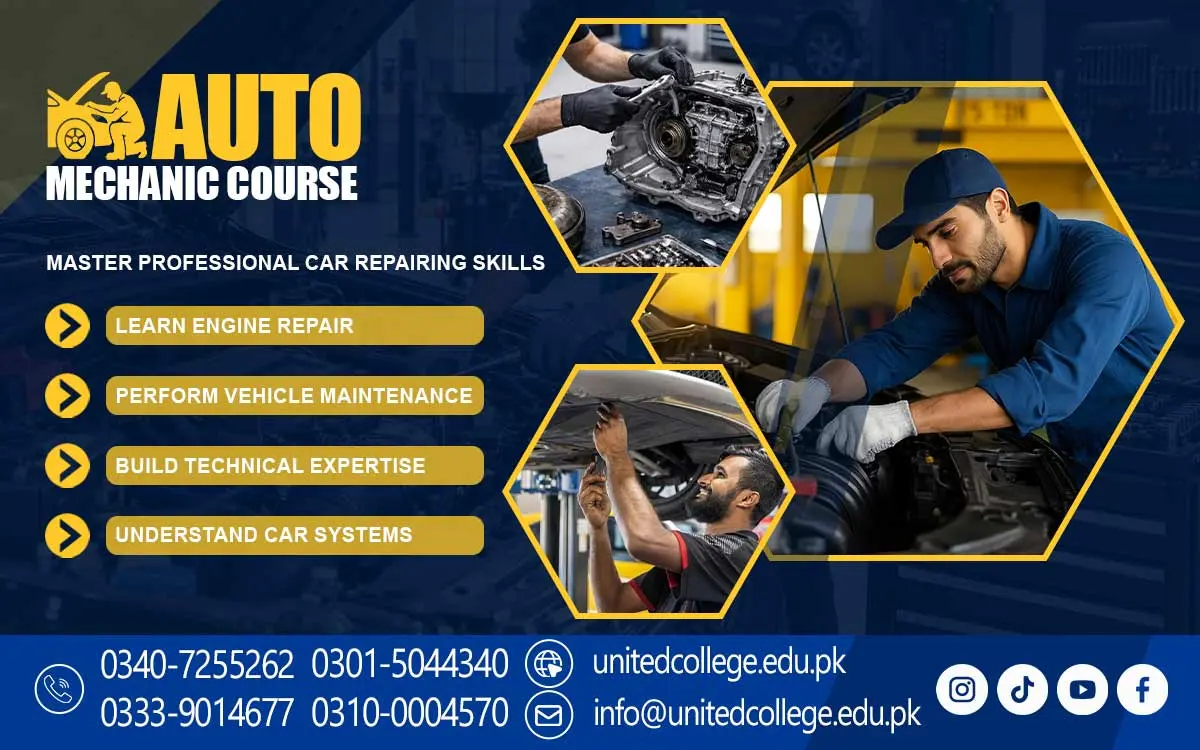

Auto Mechanic Course in Noshehra: Learn Practical Repair Skills
How Do Auto Mechanics Identify Problems? Before They Become Serious
A small vehicle problem can become more expensive when it is ignored for too long. For example, a driver may notice a strange sound from the engine but continue using the car without checking its cause. In another situation, a vehicle may take longer than usual to stop, indicating a possible problem with the braking system. An auto mechanic learns to pay attention to these warning signs and investigate them carefully. During auto mechanic training in Noshehra, learners can develop an understanding of how mechanics inspect vehicles, ask drivers about their experiences, and examine possible causes before starting a repair.
These initial checks can help identify areas that need further investigation. However, a warning sign does not always point to one specific fault, so mechanics must avoid guessing and use suitable testing methods. Students also need to understand the difference between a symptom and its actual cause. A weak battery, for example, may cause starting difficulties, but damaged wiring or a faulty starter motor can create similar symptoms. Learning this process helps beginners develop patience, observation skills, and a systematic approach to automotive troubleshooting rather than replacing parts without proper inspection.
Understanding Engine Components and Common Engine Faults
The engine is one of the most important parts of a vehicle because it produces the power needed to move it. When an engine develops a fault, the vehicle may become difficult to start, lose power, consume more fuel, or produce unusual smoke and sounds. The Auto Mechanic Course in Noshehra can introduce learners to major engine components, including pistons, cylinders, valves, the crankshaft, and the camshaft. Students can explore how these parts work together to convert fuel energy into movement. They can also learn about the lubrication system, which circulates oil to reduce friction between moving parts, and the cooling system, which helps control engine temperature.
Consider a car that overheats during a long journey. The cause might involve low coolant, a leak, a malfunctioning thermostat, a damaged radiator, or another issue. A mechanic needs to inspect the vehicle before deciding which repair is appropriate. Similarly, engine oil that has not been changed according to the manufacturer's recommendations may lose its ability to protect internal components effectively. Through automotive repair training, beginners can learn about oil changing, basic engine inspection, and routine servicing procedures. They should also understand that major engine repairs require proper tools, technical knowledge, and supervised practice.
Learning Brake, Steering, and Suspension System Maintenance
A vehicle needs more than a working engine to operate safely. The braking system helps the driver slow down or stop, the steering system controls direction, and the suspension system supports the vehicle while reducing the effect of bumps and uneven roads. Problems in any of these systems can affect handling, comfort, and road safety. During an Auto Mechanic Course in Noshehra, learners can study the purpose of brake pads, brake discs, brake fluid, steering components, suspension springs, and shock absorbers. They can learn why worn brake pads may create noise and why a vehicle pulling to one side needs proper inspection.
Uneven tyre wear can also indicate incorrect tyre pressure, wheel alignment problems, worn suspension parts, or other issues. Understanding these signs helps students recognise when a vehicle requires professional attention. They may also learn how routine inspections contribute to preventive maintenance, which means identifying potential problems before they develop into more serious faults. However, brakes and steering are safety-critical systems, so repairs must follow manufacturer specifications and appropriate workshop procedures. Beginners should not attempt road testing or complex repairs without qualified supervision.
Exploring Vehicle Electrical Systems and Starting Problems
Sometimes the dashboard lights remain off, while in other cases the engine clicks without starting. These situations can involve the battery, starter motor, alternator, electrical connections, or other components. Modern vehicles also depend on sensors, electronic control units, fuses, and wiring to manage many functions. For this reason, understanding vehicle electrical systems is an important part of automotive learning. Students undertaking auto mechanic training can become familiar with battery terminals, fuses, relays, wiring connections, and basic electrical testing. They can learn that a battery supplies electrical energy for starting, while the alternator generally recharges it when the engine is running.
During the Auto Mechanic Course in Noshehra, learners can understand how to use a multimeter correctly to measure voltage and investigate electrical faults. They should also understand the importance of following safe procedures when working around batteries and electrical components. Some modern vehicles contain high-voltage systems, particularly hybrid and electric models, which require specialised training and protective equipment. A sound understanding of basic automotive electricity gives beginners a useful foundation for diagnosing common problems and learning more advanced automobile technology as their experience develops.
Using Diagnostic Tools and Workshop Equipment Correctly
An experienced mechanic does not depend only on sight and sound when investigating a complicated vehicle fault. Suitable tools can help measure, test, inspect, and confirm what may be happening inside a vehicle. During automotive workshop training, students can become familiar with common hand tools, spanners, sockets, screwdrivers, pliers, torque wrenches, tyre pressure gauges, and other equipment used for maintenance tasks. They can also learn the purpose of a multimeter and an automotive diagnostic scanner. A diagnostic scanner may read fault codes stored in a vehicle's electronic systems, helping a mechanic identify an area that needs further investigation.
The mechanic must interpret the information, carry out suitable tests, and compare the results with the vehicle manufacturer's instructions. For example, an engine warning light may be linked to a sensor reading, an electrical connection, or a problem elsewhere in the system. Replacing a component without confirming the cause can waste time and money. Learners should also understand how to select the correct tool, inspect it before use, and keep equipment organised after completing a task. Developing these habits helps prevent damage to vehicle components and reduces avoidable workshop risks. As students gain experience, they can gradually learn more advanced diagnostic methods under qualified supervision and understand when a fault requires specialised equipment.
Building Practical Skills Through Routine Vehicle Servicing
Regular maintenance helps vehicles remain in suitable working condition and can reveal developing problems before they cause unexpected breakdowns. A vehicle owner may visit a workshop for an oil change, a filter replacement, a tyre inspection, or a check of the cooling system. These tasks may appear simple, but they still require the correct procedures and attention to detail. A vehicle maintenance course can introduce learners to the purpose of scheduled servicing and the importance of following manufacturer recommendations. Students may learn how mechanics inspect fluid levels, check tyre pressure, examine visible belts and hoses, and look for signs of leaks or wear.
Practical learning is especially important because reading about a repair is different from carrying it out correctly. Under appropriate supervision, beginners can practise identifying tools, following service instructions, recording observations, and checking their work. They should learn to use suitable lifting equipment and never work beneath a vehicle supported only by a jack. Used oil, coolant, and other workshop waste must also be handled and disposed of responsibly. At United College of Technology, learners interested in the Auto Mechanic Course in Noshehra can explore automotive training as a pathway towards developing practical knowledge.
Following Workshop Safety Rules During Automotive Repairs
A busy automotive workshop contains several hazards that beginners need to recognise before attempting repair work. Hot engine components can cause burns, moving machinery can injure hands, and incorrectly lifted vehicles can fall. Fuel, oil, coolant, and cleaning products may also create fire, slipping, or skin-contact risks if handled carelessly. Learning workshop safety is therefore an essential part of developing practical auto mechanic skills. Students should understand when protective gloves, safety glasses, suitable footwear, or other personal protective equipment are required. They should keep the working area clean, return tools to their proper places, and remove spilled fluids promptly using appropriate procedures.
Before inspecting or repairing a vehicle, a mechanic must ensure it is parked securely and that the relevant system is safe to work on. Some tasks require the battery to be disconnected, while others require specific precautions to preserve electronic settings or avoid damaging sensitive components. Learners should follow the manufacturer's instructions rather than applying the same procedure to every vehicle. They must also know when a repair exceeds their experience and requires assistance from a qualified technician. Safe working practices protect the mechanic, other workshop staff, customers, and the vehicle itself. By developing these habits early, beginners can build a responsible approach to automotive repair and understand that completing a task correctly is more important than finishing it quickly.
Developing Problem-Solving Skills Through Hands-On Training
Imagine two cars arriving at a workshop with similar complaints: both engines are difficult to start. One vehicle has a weak battery, while the other faults its starting circuit. Although the symptoms appear similar, the correct repairs may be completely different. This is why problem-solving is an important skill for anyone learning automotive repair. A mechanic must collect information, inspect the vehicle, test possible causes, and confirm the results before carrying out a repair. Through practical auto mechanic training, beginners can learn to follow this process instead of immediately assuming that a familiar symptom always has the same cause.
Communication is another useful skill because customers may describe a problem without knowing the technical reason behind it. A mechanic needs to ask clear questions and explain findings in understandable language. Regular practice can help students become more comfortable with workshop procedures, although progress depends on the quality of instruction, the complexity of tasks, and individual effort. At first, learners may focus on simple inspections and routine servicing. With further training and experience, they may move towards more advanced engine diagnostics, electrical troubleshooting, or specialised vehicle systems. A careful learning process helps develop sound judgement and prepares students to recognise when they need additional guidance.
Exploring Automotive Career Paths After Learning Repair Skills
People who enjoy working with tools, solving mechanical problems, and understanding how vehicles operate may find automotive training worth exploring. Completing training does not automatically guarantee a job, but it can help learners build knowledge that may be useful when applying for entry-level opportunities or seeking further instruction. Depending on their practical ability and the requirements of an employer, beginners may explore roles such as automotive workshop assistant, junior mechanic, vehicle maintenance assistant, or service-centre trainee. Some may eventually focus on areas such as engine repair, automotive electrical systems, vehicle diagnostics, or routine maintenance.
Anyone considering self-employment should first understand the costs of tools, workshop space, replacement parts, safety equipment, and customer service. Accurate diagnosis, honest communication, and reliable workmanship are important for building trust with customers. The Auto Mechanic Course in Noshehra, offered by United College of Technology (UCT), is relevant to learners who want to begin exploring the automotive repair field and develop a foundation in vehicle maintenance. Before enrolling, prospective students should confirm the current course outline, practical training arrangements, duration, fees, and any certificate details directly with the college.
Frequently Asked Questions (FAQs)
An Auto Mechanic Course in Noshehra teaches students about vehicle maintenance, engine repair, brake systems, automotive electrical systems, and common vehicle faults.
Students, fresh learners, job seekers, and anyone interested in learning car repair and vehicle maintenance can explore this course.
Students can learn engine troubleshooting, oil changing, brake inspection, battery testing, vehicle servicing, and the use of basic automotive tools.
Practical training helps learners understand how vehicle components work and how to inspect faults, use tools correctly, and follow workshop safety procedures.
United College of Technology (UCT) is the training provider featured in this article. Contact the college directly to confirm current course availability and admission details.
Admission Open: Start Your Professional Journey Today!
Join United College of Technology and build a career with practical training, recognized certifications, and Gulf job support. Seats are limited.
Apply Now via WhatsAppContact Information
- Address: Rawalpindi: F-272 Main New Katarian Stop, Old IJP Road | Lahore Campus: Lahore, Pakistan
- Phone/WhatsApp: 0340-7255262 / 0333-9014677 / 0301-5044340 / 0310-0004570 / 051-8770756
- Website: unitedcollege.edu.pk
















Leave a Comment