


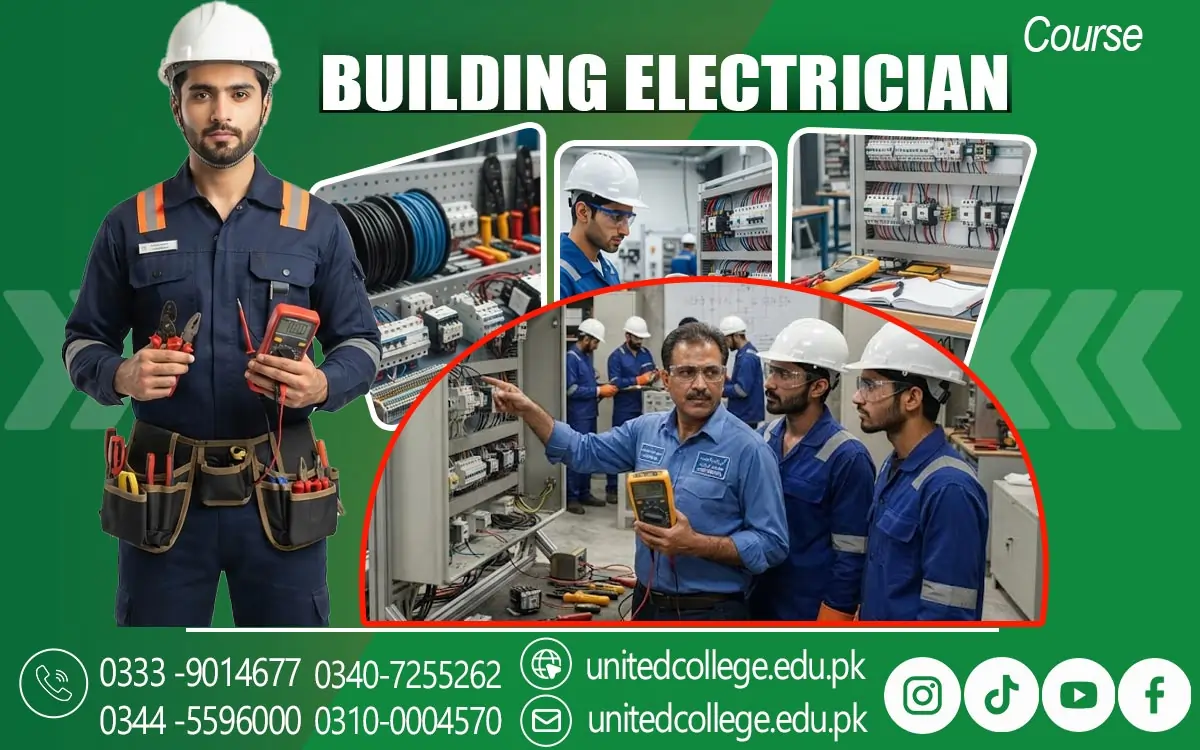

Building Electrician Course in Khanewal for Practical Wiring Skills
When a Building Circuit Fails, Practical Electrical Skills Matter
Imagine entering a room where the lights suddenly go off, a socket feels unusually warm, or a newly installed switch does not work even though the main supply is available. These situations may look simple from the outside, but finding the actual cause requires more than knowing how to connect two wires. A building electrician needs to understand how electricity moves through a building, how circuits are arranged, how protection devices work, and how faults can be identified safely.
This is where practical electrician training becomes useful for beginners who want to understand real building electrical work. The Building Electrician Course in Khanewal offered by United College of Technology focuses on developing practical knowledge related to electrical installation, wiring techniques, safety procedures, testing, and troubleshooting. Learners can gradually become familiar with the work involved in homes, shops, offices, and other buildings while learning how to approach electrical tasks carefully instead of relying on guesswork.
Learning How Electrical Wiring Comes Together in a Building
Electrical wiring is one of the most important areas for anyone preparing for building electrical work. A Building Electrician Course can help learners understand how a building may have separate circuits for lighting, sockets, fans, appliances, and other equipment, with each circuit planned and connected correctly. During electrician training, learners can study domestic electrical wiring and understand how electrical cables travel from the supply point toward different parts of a building. They can also learn the purpose of live, neutral, and earth conductors and why correct connections matter.
Switches, sockets, plugs, lighting points, and other accessories are connected according to the requirements of the circuit rather than randomly. For example, if a light does not operate after installation, the problem could involve a loose connection, incorrect switch wiring, a damaged cable, or an issue somewhere else in the circuit. Understanding these relationships helps learners develop practical electrical skills that can be applied when working on building wiring in Khanewal and surrounding areas.
Working with Switches, Sockets, Lights, and Electrical Accessories
A large part of everyday electrical installation involves the accessories people interact with regularly. Switches control lighting and other loads, sockets provide connection points for electrical appliances, and lighting fixtures need suitable wiring and secure connections. A Building Electrician Course in Khanewal can introduce learners to the correct methods of installing and connecting these common electrical points while emphasizing safe working practices. Learners can practice identifying different switches, sockets, plugs, cables, connectors, and lighting components and understand where each is normally used.
They can also learn why a loose terminal can create heat and why an overloaded socket should not simply be treated as a minor inconvenience. Lighting installation may involve single or multiple control points, while socket installation requires attention to circuit arrangement and protection. These practical exercises help beginners understand that neat installation is not only about appearance; proper connections, secure fittings, and suitable cable management can also contribute to safer and more reliable electrical work.
Understanding Distribution Boards, MCBs, Fuses, and Circuit Protection
Behind the switches and sockets of a building is a system that distributes electrical power and provides protection when something goes wrong. The distribution board is an important part of this arrangement because it separates and protects different electrical circuits. Learners studying electrical installation can explore components such as circuit breakers, MCBs, and fuses and understand their basic purposes. An MCB, or miniature circuit breaker, can disconnect a circuit when excessive current is detected, helping protect wiring from conditions such as overloads or short circuits.
A fuse performs a related protective function by using a designed element that breaks the circuit when current becomes too high. Understanding these devices is important because a tripped breaker should not simply be reset repeatedly without considering why it operated. For example, an overloaded circuit, damaged appliance, or wiring fault may cause repeated tripping. Through practical electrician training, beginners can learn how distribution boards are organized and why electrical protection must be considered during building wiring rather than added as an afterthought.
Using Wiring Diagrams, Electrical Symbols, and the Right Cables
Following a wiring diagram can make a complicated electrical installation much easier to understand. Instead of looking at a collection of wires and trying to guess where they belong, an electrician can use diagrams and electrical symbols to understand how switches, lights, sockets, protective devices, and other components are connected. Learners can develop the ability to recognize common symbols and follow simple circuit drawings before applying the information to practical work. Cable selection is another important part of this process.
Electrical cables come in different sizes and types, and the appropriate choice depends on factors such as the circuit, expected load, installation conditions, and applicable electrical requirements. A cable should not be selected simply because it is available or looks suitable. Conduit wiring and cable management also require attention because cables need to be routed and protected appropriately. In hands-on electrical training, learners can connect these ideas by moving from a diagram to an actual installation, helping them understand how planning, cable selection, connections, and neat routing work together.
Building Safe Circuits Through Earthing and Electrical Protection
Electrical safety becomes especially important when working with building wiring because an incorrect connection can create risks that may not be immediately visible. A Building Electrician Course helps learners understand earthing, also called grounding in many contexts, as an important protective concept. Its purpose is connected with providing a suitable path for fault current and helping protective devices operate under certain fault conditions. Students can also study common hazards such as exposed conductors, damaged insulation, wet electrical areas, overloaded circuits, loose connections, and accidental contact with live parts.
Safe working practices include isolating electrical supplies when appropriate, using suitable tools, checking circuits before working on them, and avoiding unsafe shortcuts. The Building Electrician Course in Khanewal can help beginners develop an awareness that electrical work is not simply about making a circuit operate; it is also about making sensible decisions before, during, and after an installation. Learning to identify hazards early can become an important part of developing responsible electrician skills for practical work.
Developing Skills with Electrical Tools and Measurements
An electrician depends on appropriate tools to install, inspect, test, and troubleshoot electrical systems. Basic electrical tools may include insulated screwdrivers, pliers, wire strippers, cutters, measuring tools, and other equipment designed for specific tasks. Learners can become familiar with how these tools are used and why using the right tool is safer and more effective than improvising. Electrical measurements are equally important because visual inspection alone cannot always reveal a problem. Depending on the task and training level, learners can study concepts such as voltage testing, continuity, resistance, current, and basic load calculation.
They can learn that measurements should be performed using suitable equipment and safe procedures rather than touching wires to determine whether electricity is present. Load calculation also helps explain why circuits need appropriate protection and cable selection. Through practical exercises, students can connect electrical theory with real observations, gradually learning how a building electrician uses tools and measurements to make informed decisions rather than depending entirely on trial and error.
Exploring Single-Phase, Three-Phase, and Different Building Requirements
Not every electrical installation is arranged in exactly the same way. Smaller residential properties commonly use single-phase electrical systems, while some larger buildings, commercial facilities, workshops, and other applications may involve three-phase systems. Beginners can study the basic differences between these arrangements and understand why electrical installations need to be planned according to the type of supply and expected loads. Domestic electrical wiring may include lighting and socket circuits designed for household use, whereas commercial electrical wiring can involve larger loads, more circuits, and different operational requirements.
This does not mean every learner needs to begin with advanced electrical engineering concepts. Instead, the aim is to develop a clear foundation that helps students recognize different types of electrical systems and understand where basic building electrician skills fit within them. For learners in Khanewal and surrounding areas, this broader understanding can be useful when they encounter different buildings and electrical layouts during practical learning or future hands-on work.
Learning to Find Short Circuits, Overloads, and Wiring Faults
A strong electrician does not only install electrical systems; they also need to know how to investigate problems when something stops working. Electrical fault finding involves observing symptoms, considering possible causes, testing safely, and checking the circuit step by step. A short circuit may cause protective equipment to trip, while an overload can occur when a circuit is asked to supply more electrical load than it is designed to handle. Other problems may involve loose terminals, damaged cables, incorrect connections, faulty switches, or defective accessories.
For example, if several sockets stop working while the rest of the building remains powered, the electrician needs to determine whether a protective device has operated or whether another fault is affecting that particular circuit. Practical electrical training can introduce learners to systematic troubleshooting rather than random replacement of components. This approach can help students develop patience and observation skills while learning how testing and inspection support electrical troubleshooting.
Turning Practical Training into Useful Building Electrician Skills
Learning electrical theory becomes much more meaningful when students have opportunities to connect it with practical work. At United College of Technology, the Building Electrician Course in Khanewal can help learners explore building electrical work through practical concepts such as wiring, electrical installation, circuit connections, tools, protection devices, testing, troubleshooting, maintenance, and safe work procedures. Preventive electrical maintenance can also be discussed as an important part of keeping installations in better working condition, including checking for visible damage, loose connections, unusual heating, worn accessories, and other warning signs before they become larger problems.
Hands-on practice can help beginners understand how wiring diagrams translate into actual circuits and how careful testing can help identify faults. For students, fresh learners, job seekers, and others interested in developing practical electrical skills, this type of training can provide a structured way to learn building wiring and electrical installation. The knowledge can be relevant to homes, shops, offices, and other buildings in Khanewal and surrounding areas, while also giving learners a clearer understanding of the responsibility involved in working with electrical systems safely.
Frequently Asked Questions (FAQs)
A Building Electrician Course in Khanewal teaches practical skills related to building wiring, electrical installation, switches, sockets, lighting, distribution boards, circuit protection, testing, troubleshooting, and electrical safety.
You can learn domestic and commercial wiring, electrical circuits, cable selection, conduit wiring, earthing, MCBs, fuses, wiring diagrams, electrical tools, load calculation, fault finding, and basic electrical maintenance.
Yes. The course is suitable for beginners and fresh learners who want to develop practical electrical skills. Basic electrical concepts can be learned step by step through theory and practical training.
Training can cover domestic electrical wiring, commercial electrical wiring, lighting circuits, socket connections, switch installation, conduit wiring, and other common building wiring techniques.
Yes. Learners can study how to identify common problems such as short circuits, overloads, loose connections, faulty switches, and other wiring faults through systematic testing and inspection.
Admission Open: Start Your Professional Journey Today!
Join United College of Technology and build a career with practical training, recognized certifications, and Gulf job support. Seats are limited.
Apply Now via WhatsAppContact Information
- Address: Rawalpindi: F-272 Main New Katarian Stop, Old IJP Road | Lahore Campus: Lahore, Pakistan
- Phone/WhatsApp: 0340-7255262 / 0333-9014677 / 0301-5044340 / 0310-0004570 / 051-8770756
- Website: unitedcollege.edu.pk
















Leave a Comment